

Cash in China: ATMs, Exchange and a Payment Backup
Cash in China for foreigners works best as a backup to mobile payments, not as a replacement for them. My recommendation is simple: keep a modest amount of renminbi in small notes, bring two physical cards from different banks, and know how to get more cash before your phone payment fails.
You do not need to carry your whole holiday budget in a wallet. You need enough to buy water, pay for a meal, take a licensed taxi and reach your hotel while you sort out the problem. This guide covers mainland China; Hong Kong and Macau use different local currencies.
Quick takeaways
- Start with a working cash buffer of about RMB 300–500, then adjust it to your transport and arrival plans. Keep some RMB 5, 10 and 20 notes, not only hundreds.
- Bring two physical debit cards from different issuers. Check overseas ATM access, your actual PIN, fees and limits before departure.
- Use a bank ATM displaying your card network. Choose English, Withdrawal and an account your issuer supports; check the RMB amount and any displayed charge.
- If offered a currency choice, usually choose CNY/RMB. Let your card issuer handle conversion rather than accepting the ATM or merchant’s DCC quote.
- A failed withdrawal is a reason to check, not keep pressing. Record the machine and error; contact the ATM bank for a retained card and your issuer for authorization or missing-cash disputes.
In this guide
- 1. Prepare a cash backup before you fly
- 2. Find the right ATM and follow the screens
- 3. DCC: choose the currency, not the reassuring button
- 4. If the ATM fails, identify which problem you have
- 5. Exchange foreign banknotes through a proper counter
- 6. Make your cash usable: small notes and separate storage
- 7. Know what cash cannot replace
- Useful Chinese phrases for the bank or counter
- Frequently asked questions
1. Prepare a cash backup before you fly
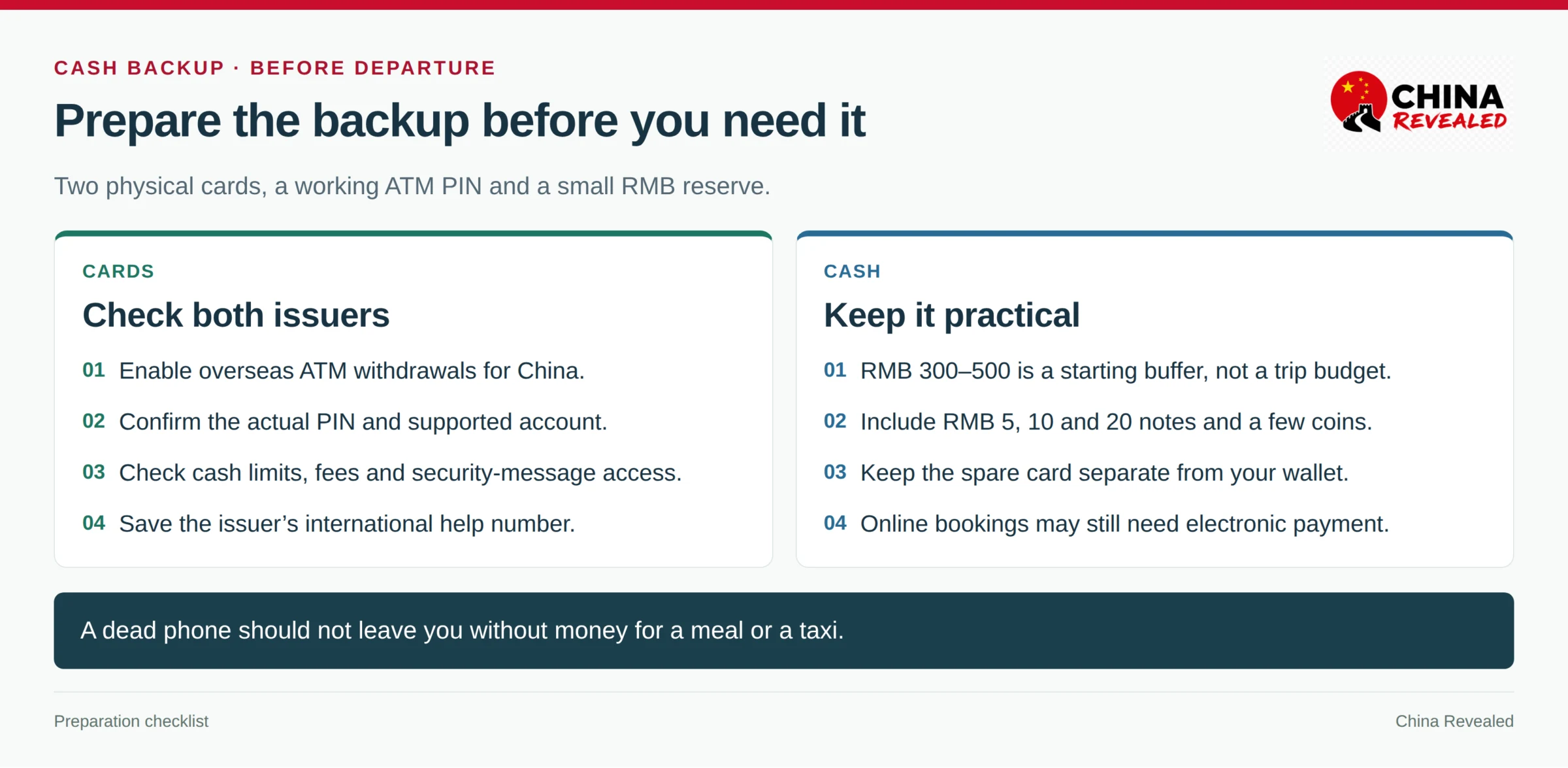
I would rather have two usable debit cards and a small cash reserve than one card and a large promise that “everything is cashless.” A payment app, a phone battery and an ATM card are three different points of failure.
Check the following with each card issuer:
| Check | What you need to know |
|---|---|
| Overseas ATM withdrawals | Is China permitted? Is international cash access switched on? Does the bank require a travel notice? |
| PIN | What is the card’s ATM PIN, and will it work internationally? A banking-app password is not the same thing. |
| Available account | If a machine asks for Checking, Savings or Credit, which account should this card use? |
| Limits | What are the cash withdrawal and overseas limits? Is the available balance sufficient after fees? |
| Charges | Issuer ATM fee, foreign-transaction or conversion charge, and any credit-card cash-advance cost. |
| Help abroad | Save the issuer’s international contact number and make sure you can access its app or security messages. |
Use a debit card for routine cash withdrawals. Taking cash from a credit card normally counts as a cash advance, with separate charges and potentially immediate interest. A credit limit is not the same as an available cash-advance limit.
Bring the physical cards, not just their images in Apple Wallet or Google Wallet. Contactless or cardless withdrawal is not a dependable tourist fallback at every Chinese ATM. Keep the second card separately from your daily wallet.
2. Find the right ATM and follow the screens
Choose a bank machine with the right network
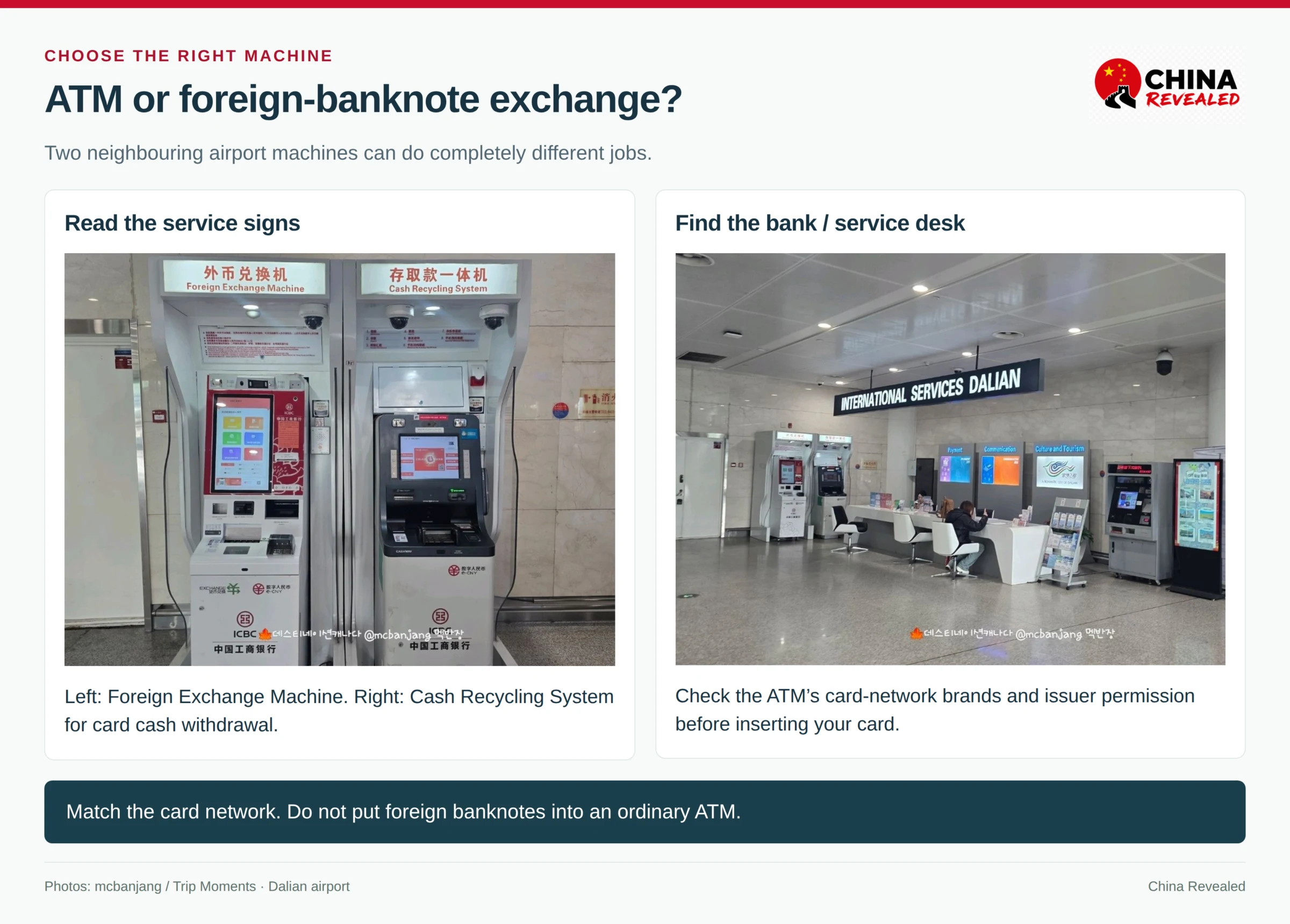
Look for a real bank ATM or Cash Recycling System / 存取款一体机 displaying the network on your card: Visa/PLUS, Mastercard/Cirrus, UnionPay, JCB or American Express, as applicable. The relevant network may appear on the cabinet or the screen.
Bank of China / 中国银行 is a useful starting point because its published ATM service includes several major foreign-issued card networks. ICBC / 中国工商银行 and other banks also have foreign-card-capable machines. The particular machine and your issuer’s authorization matter more than a bank ranking.
When convenient, use a machine attached to an open bank branch. You have a counter to approach if the card is retained. Before inserting your card, check that the machine is operating and offers the network and language you need.
One airport may have an ATM and a foreign-currency exchange machine side by side. They do different jobs: the ATM withdraws RMB from your card account; the exchange machine changes supported foreign banknotes into RMB. Do not insert foreign cash into an ordinary ATM expecting it to be converted.
The withdrawal sequence
Menus differ, but this is the sequence to work through:
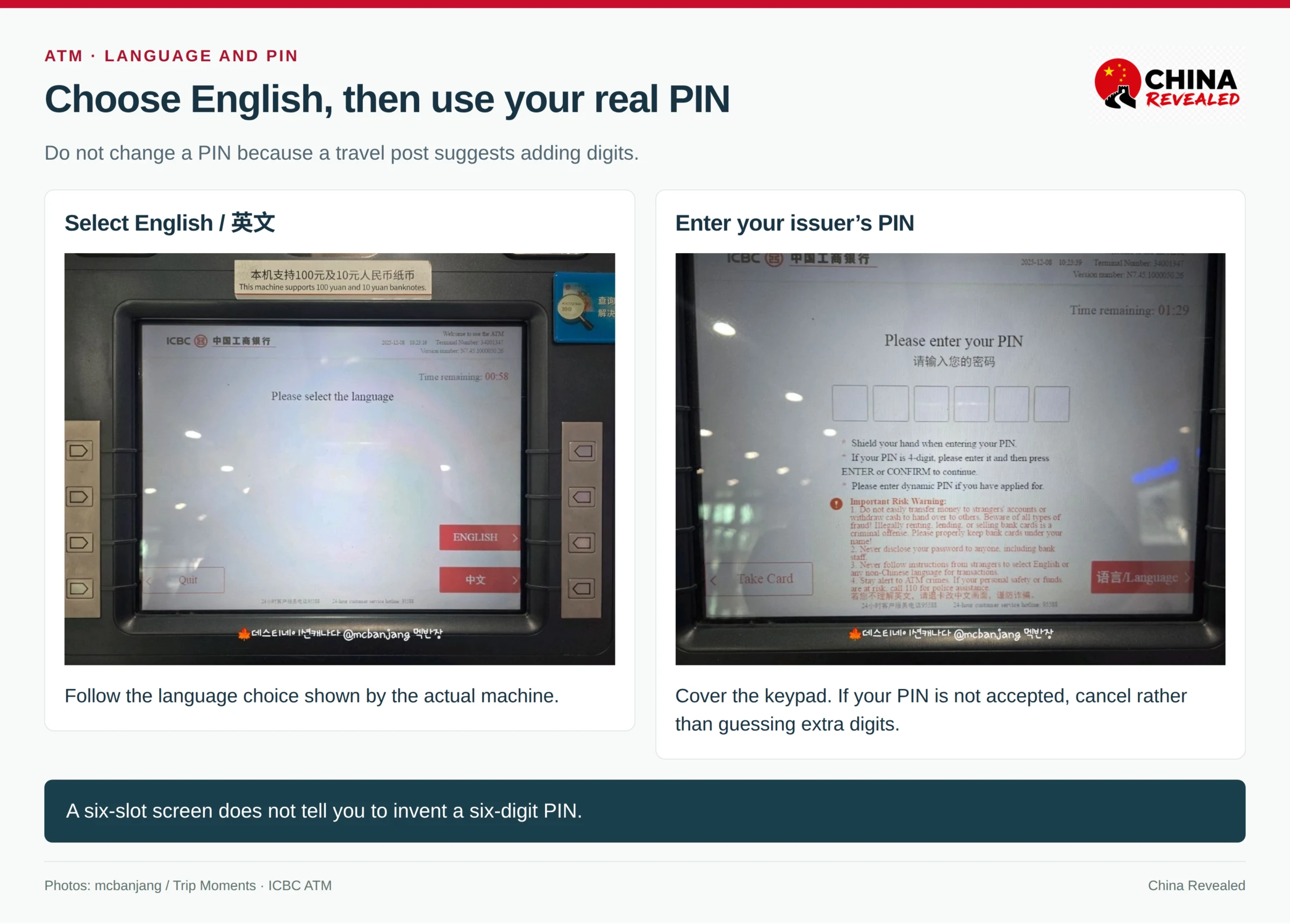
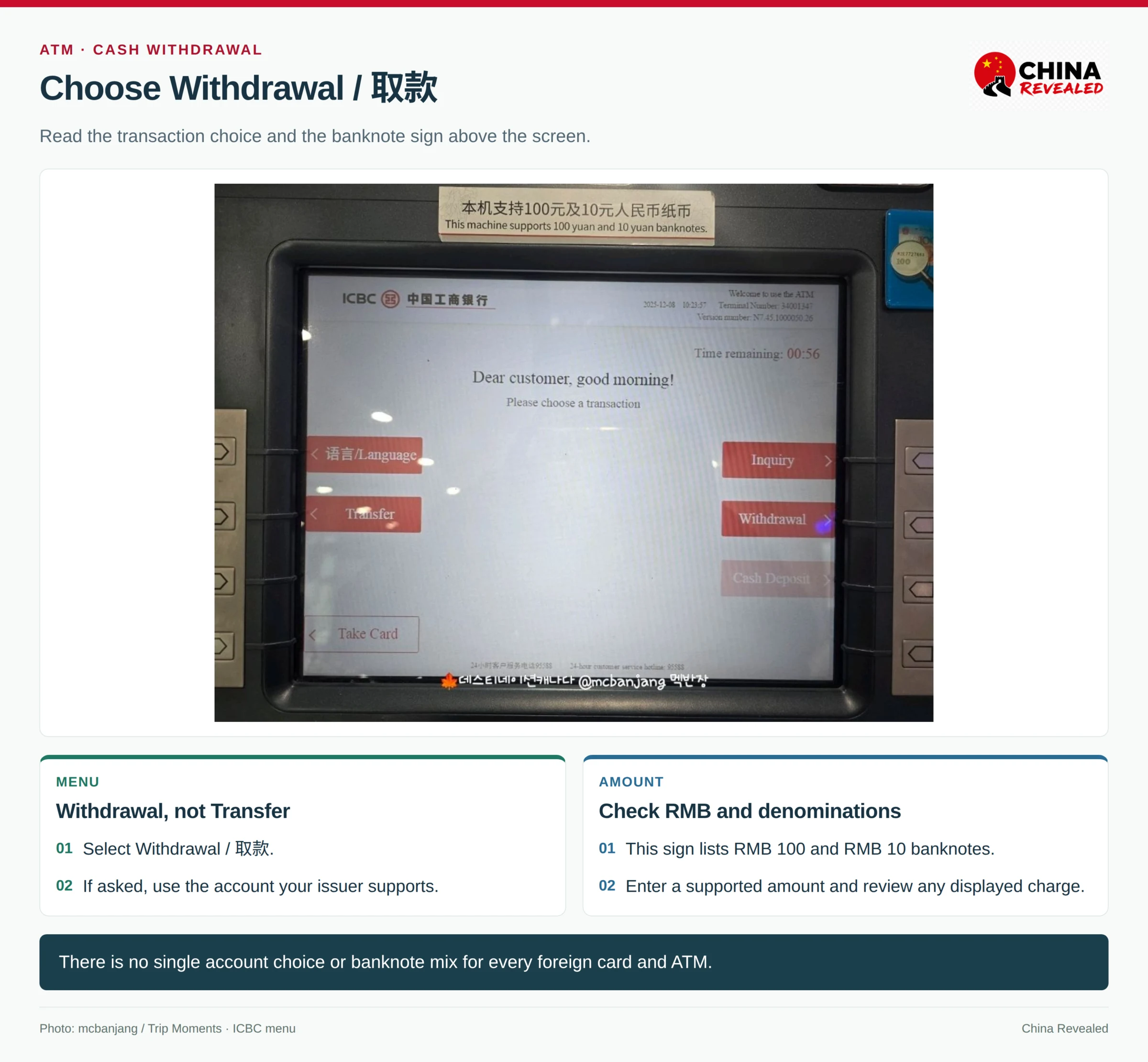
- Choose English / 英文, either before or after inserting your card, as prompted.
- Insert the card as shown and enter your actual PIN. Cover the keypad. Do not give the PIN to a helper.
- Choose Withdrawal / 取款. Deposit / 存款 and Transfer / 转账 are not cash withdrawal.
- Select the account your issuer supports, if asked. Debit cards may use Checking or Savings; there is no single account choice for every foreign card.
- Choose an amount in RMB. Use a supported denomination and stay within both the machine and issuer limits.
- Read any ATM charge and currency-conversion offer before confirming. The next section explains the currency choice.
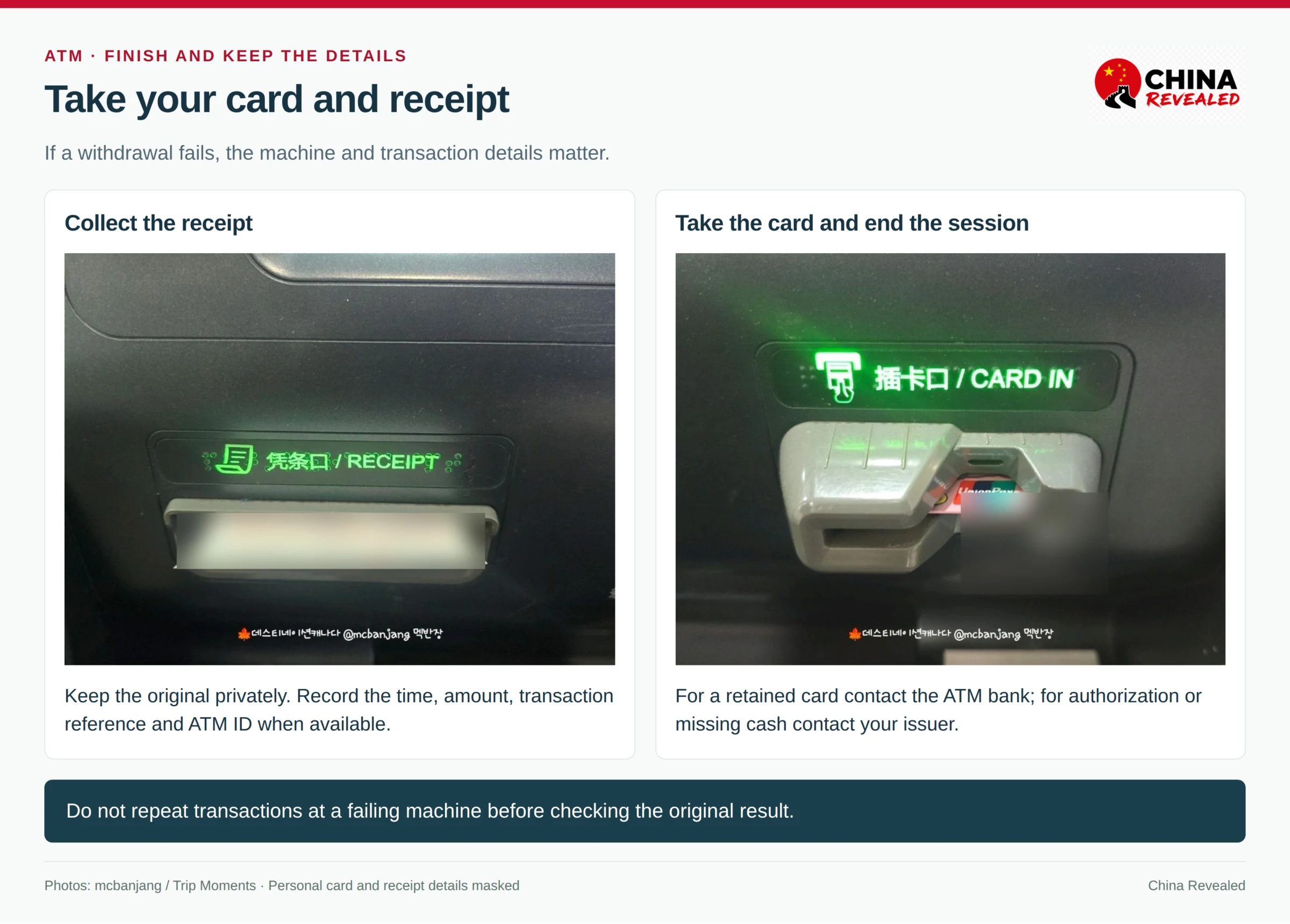
- Collect the cash, card and receipt before leaving. Their order varies by machine. End the session rather than leaving the account menu open.
A four-digit PIN does not become a six-digit PIN because an online guide tells you to add zeros. Use your issuer’s PIN and instructions. If the machine will not accept it, cancel and seek help or use another suitable ATM; do not improvise digits or keep guessing.
Understand limits and the fee stack
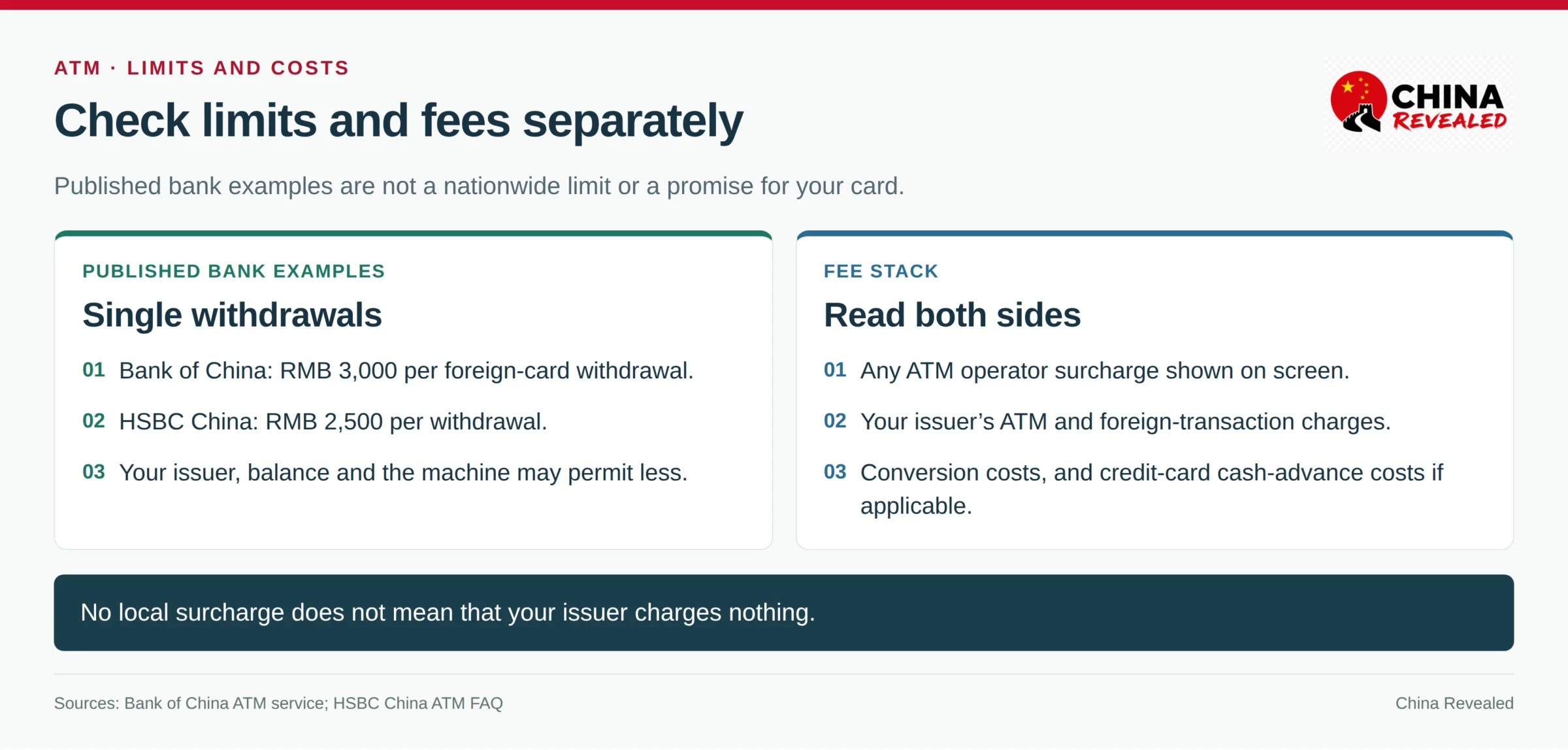
Two published bank examples show why I would not rely on a universal “China ATM limit”:
| Bank’s published foreign-card ATM guidance | Single withdrawal limit | Other limits and charges |
|---|---|---|
| Bank of China | RMB 3,000 | Its page says daily and annual cumulative limits, and relevant card charges, depend on the overseas issuer. |
| HSBC China | RMB 2,500 | Its ATM FAQ says transaction fees and daily withdrawal limits are determined by the card issuer. |
Those figures are bank-specific examples, not an entitlement to withdraw that much on your card. Available funds, cash remaining in the machine and issuer controls may produce a lower usable amount.
Your cost can include an ATM operator’s disclosed surcharge, an issuer withdrawal fee, currency conversion and an issuer foreign-transaction charge. A credit-card cash advance adds a different set of costs. A machine that shows no local surcharge does not establish that your own bank will charge nothing.
If your issuer charges a fixed amount per withdrawal, fewer planned withdrawals can cost less than many small ones. Still, do not withdraw more than you need simply to save a fee.
3. DCC: choose the currency, not the reassuring button
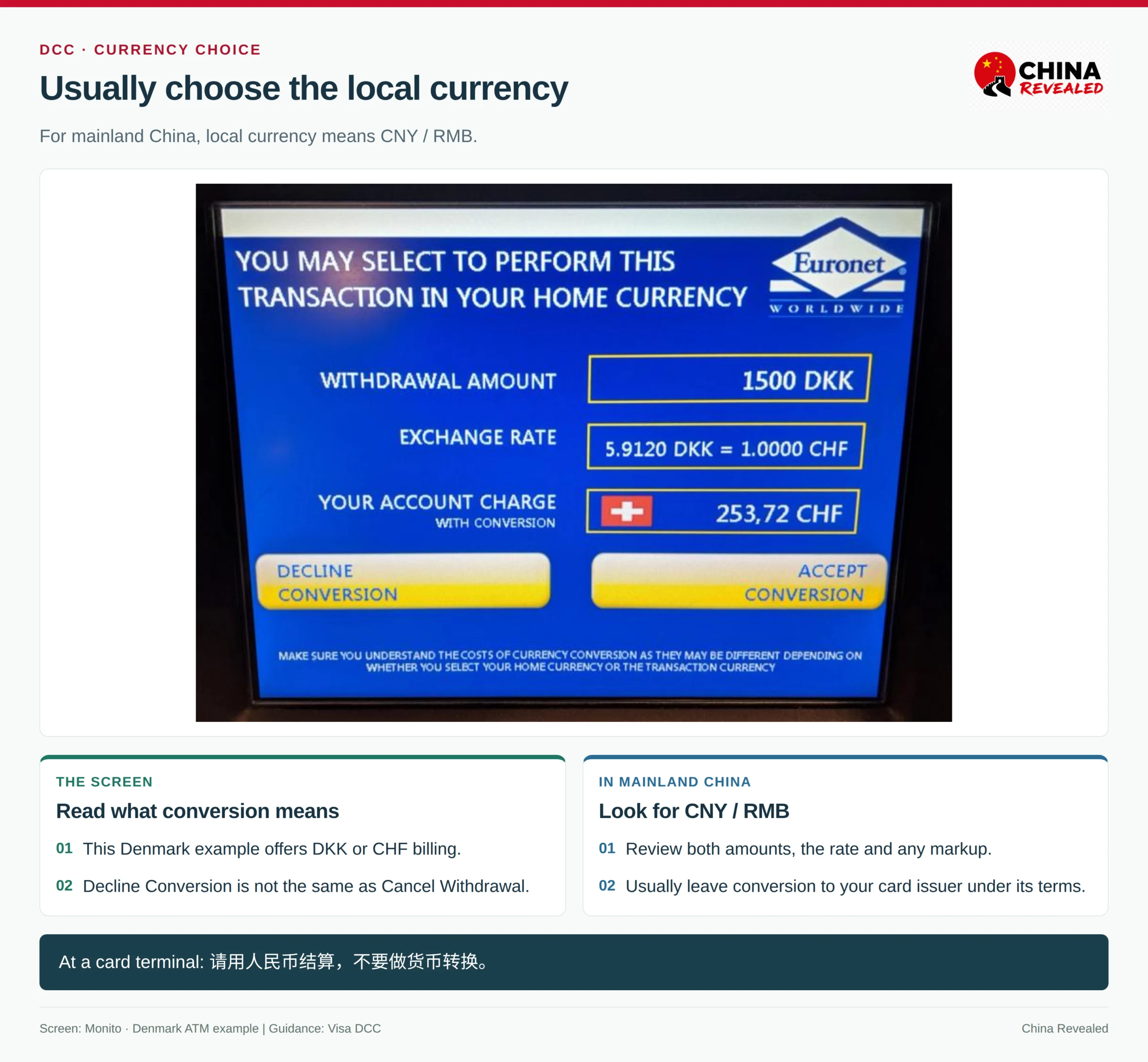
Dynamic Currency Conversion (DCC) is an offer from the ATM operator or merchant to bill your card in its home currency. It can appear at an ATM or a card terminal in a shop or hotel.
For a mainland China transaction, local currency means CNY/RMB. Your card’s home or billing currency might be USD, EUR, GBP, AUD or something else. At an ATM, you still receive RMB cash whichever billing currency you select.
My usual choice is CNY/RMB, without the machine’s conversion. This leaves conversion to the card issuer/card network under the card’s terms. Compare those terms with the offered quote rather than assuming a familiar home-currency total must be a better deal.
Before accepting DCC, the screen should make these details clear:
- The purchase or withdrawal amount in local currency.
- The amount in your card’s billing currency.
- The conversion rate.
- Any additional fee or markup.
- Your option to proceed in local currency instead.
Visa says the merchant or ATM must not choose for you, and declining DCC does not itself prevent an international purchase or withdrawal. If the required details are missing or someone pressures you to accept conversion, decline the conversion and raise the issue with your issuer.
Read the meaning of the button. “Decline conversion” is different from “Cancel withdrawal.” Labels vary. On a screen offering currencies, look for CNY/RMB or local currency. Do not blindly press Yes, Continue or a coloured button.
At a shop or hotel card terminal, say:
Please charge me in RMB, without currency conversion.
请用人民币结算,不要做货币转换。
Check the receipt’s billing currency afterwards. Choosing RMB does not remove a separate issuer foreign-transaction fee. If conversion was applied without your agreement, keep the receipt and contact your issuer; the card network does not manage your individual bank account.
4. If the ATM fails, identify which problem you have
Card or withdrawal declined
Cancel the transaction and retrieve the card. Read the exact error, then check your banking app for a debit, pending authorization or fraud alert before trying again.
If it was a straightforward decline, the PIN is correct and no unresolved debit appears, check that overseas cash access is enabled and the amount is within your available balance and limits. One attempt at a different bank ATM with the matching network, or with your spare card, is a sensible next step. Repeated attempts at the same failing machine are not.
For an incorrect-PIN message, uncertain PIN or blocked card, stop using that card until the issuer tells you what to do. Repeated wrong entries can create a bigger problem than the original decline.
Insufficient funds or amount not available
Check the available balance, including holds and fees—not just the headline account balance. Also check the amount and denomination the machine supports. A machine may be low on cash even when your account has enough money.
Resolve a clear amount or balance issue first. If the error remains, use another suitable machine or another payment method rather than cycling through account types.
The machine retains your card
Contact the bank that operates the ATM. If its branch is open, go straight to the counter with your passport and the incident details. Keep any printed slip and ask when and how the card can be collected. Retrieval depends on the bank’s procedure; plan to use the spare card meanwhile.
Bank of China’s published retained-card instruction is to contact branch staff or 95566. For a different bank’s machine, use that bank’s official contact channel, not Bank of China’s number. Short service numbers may require a usable local calling route; a data-only eSIM is not ordinary voice service.
Also contact your issuer to secure the card and ask about replacement or emergency options. If your issuer offers a temporary freeze, use it while clarifying the retrieval procedure; tell the issuer if the card cannot be recovered.
Your account was debited but no cash—or only some cash—came out
Treat this as a cash-not-received or partial-cash dispute. Record the amount actually dispensed and contact your issuer promptly. Report the machine incident to the ATM bank as well, and keep its reference number.
Do not assume that every debit will reverse immediately. Follow the issuer’s dispute process and deadlines, and avoid creating more transactions at the same malfunctioning machine.
The details to save
- ATM bank, branch or location, and machine/terminal ID.
- Date and local time, attempted amount and amount actually received.
- Exact screen error, receipt or transaction reference, if provided.
- Card network and last four digits—not the full card number or PIN.
- Issuer debit/pending notice and bank incident reference.
The machine ID may be on the cabinet, a service label or the receipt. Keep these records privately; do not post an unredacted bank slip online.
5. Exchange foreign banknotes through a proper counter
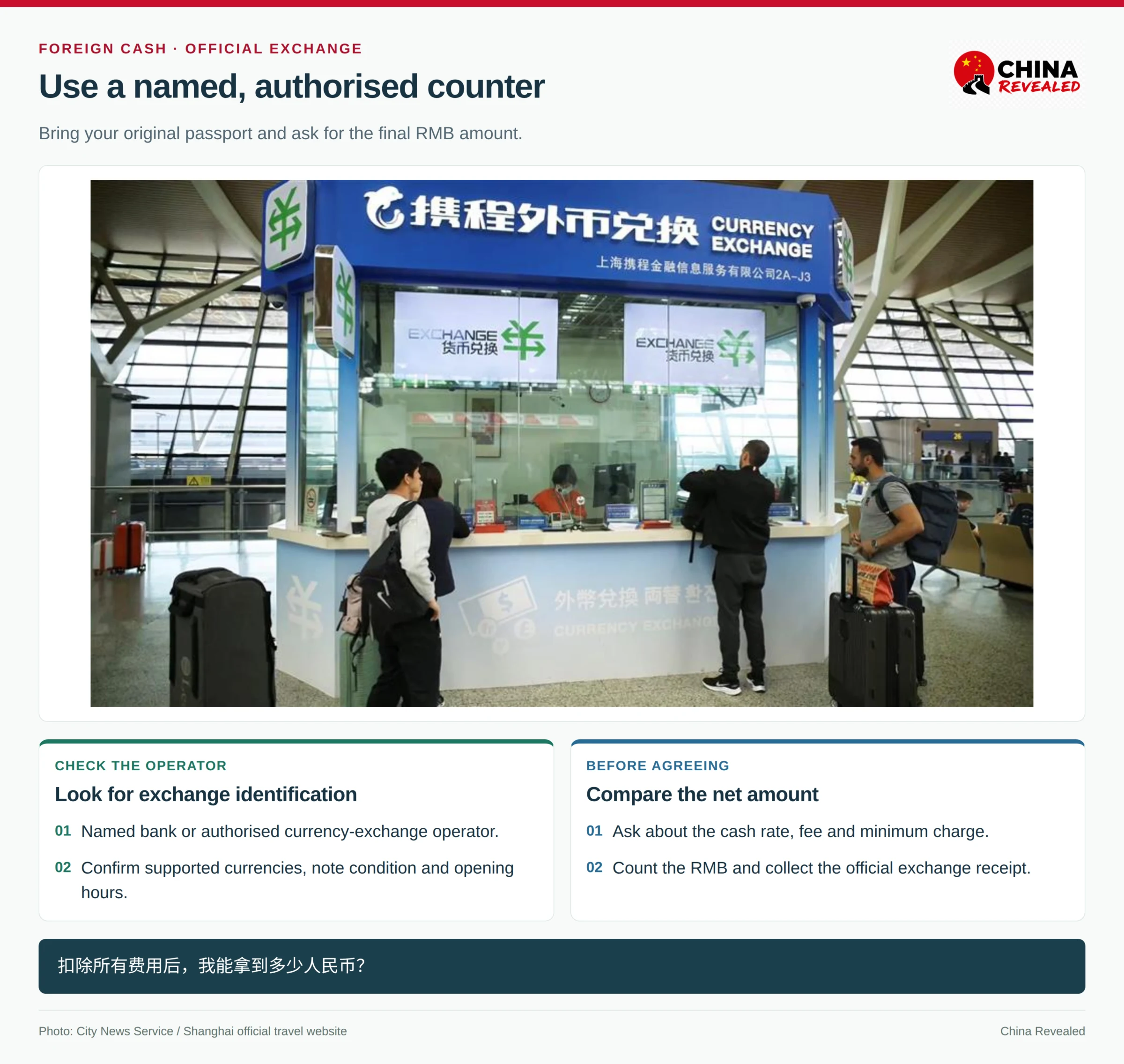
If you arrive with foreign cash, use a bank branch offering foreign exchange, an authorised exchange counter or a supported official exchange machine. Look for Currency Exchange / 外币兑换 or 货币兑换, the operator’s name and its bank or authorised-service identification.
An airport counter is useful when you need cash immediately. A city bank branch is another option once you have time. Compare the net RMB you receive rather than assuming either venue always has the best rate.
Bring your original passport and the foreign notes. Confirm that the venue accepts your currency, note series and condition. A counter may not handle every currency; a torn or heavily marked note may be refused.
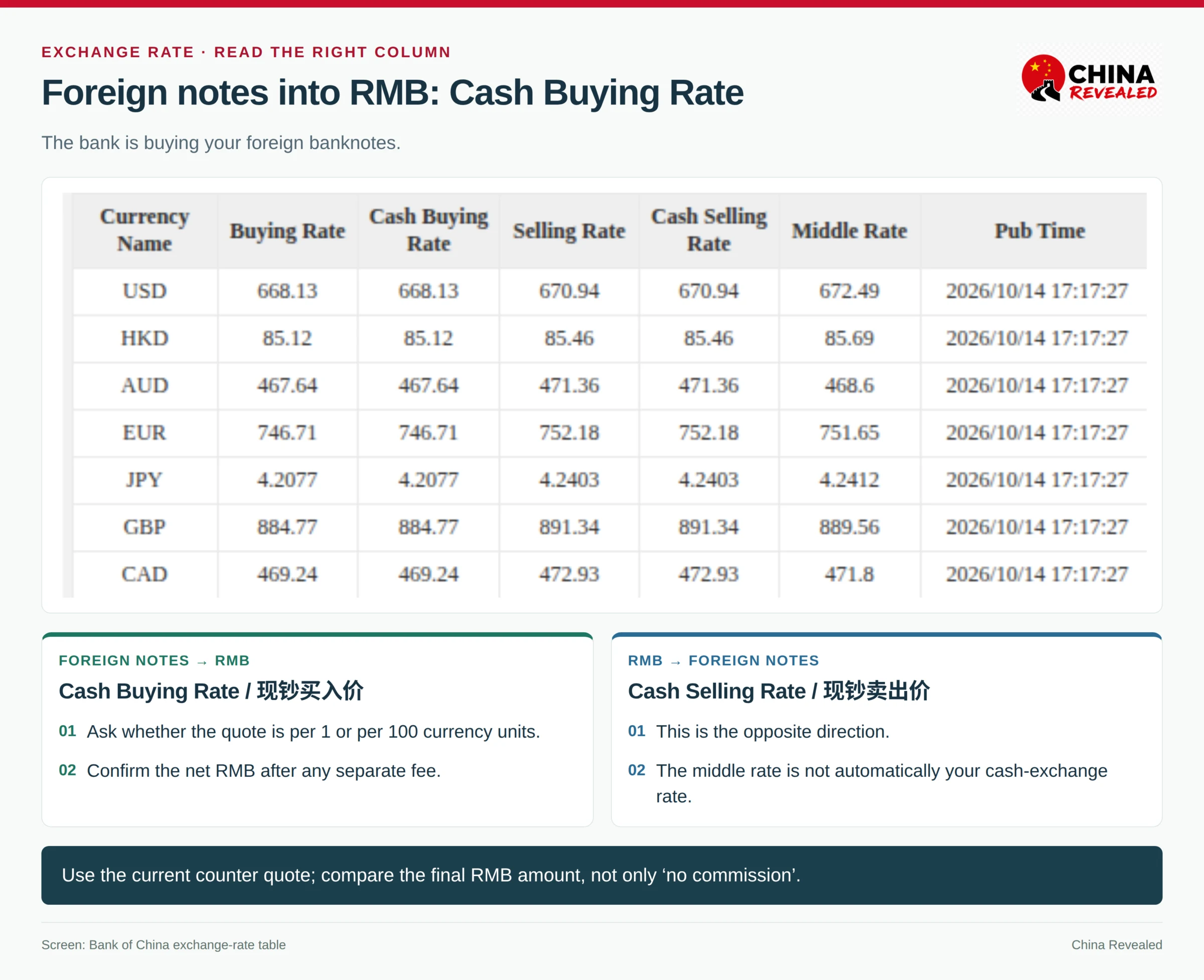
Read the correct exchange-rate column
At a bank, “buying” and “selling” are written from the bank’s perspective.
- You hand over foreign banknotes and receive RMB: the bank is buying your foreign cash. Look for Cash Buying Rate / 现钞买入价.
- You use RMB to buy foreign notes: look for Cash Selling Rate / 现钞卖出价.
- A non-cash buying rate or middle/reference rate is not automatically the rate for your banknotes.
Ask what unit the quotation uses. A board may quote RMB per 100 units of foreign currency, not per one dollar or euro. Confirm any commission, service fee or minimum charge and the final amount before agreeing.
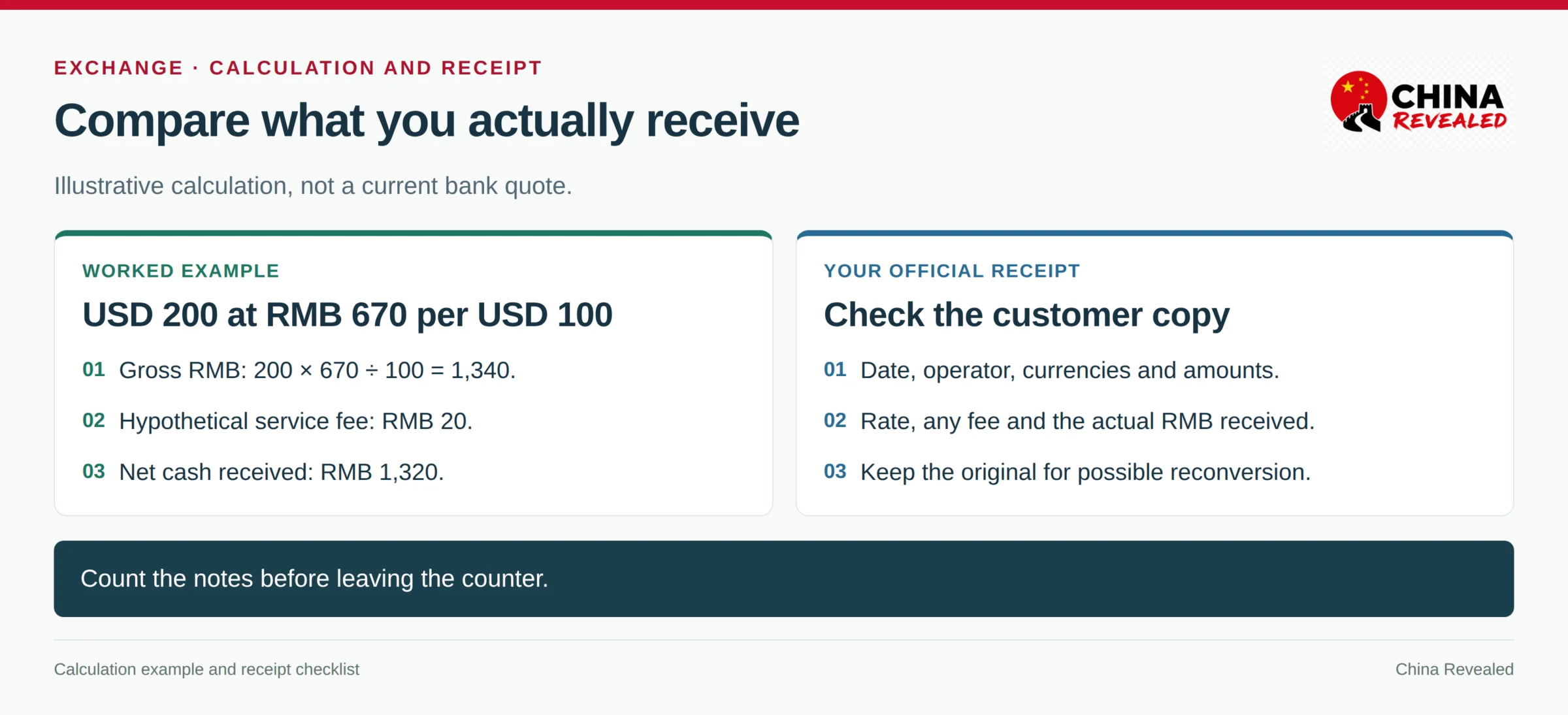
A worked example, not a live quote: suppose a counter quotes RMB 670 per USD 100. Exchanging USD 200 produces RMB 1,340 before fees. If that counter separately charges a hypothetical RMB 20 service fee, you receive RMB 1,320. “No commission” alone is not enough to compare offers: the exchange rate matters too.
Ask this before handing over the notes:
After all fees, how many RMB will I receive?
扣除所有费用后,我能拿到多少人民币?
Count the money and keep the exchange receipt
Check the foreign amount accepted, the rate and fees, and the actual RMB received. Count the notes at the counter and ask for smaller denominations where available.
Take the exchange receipt / 外币兑换水单, not just an informal handwritten total. Check the date, currencies, amounts and operator details, as well as any personal information printed on it. Save a private photo while the receipt is readable.
Keep the original if you might convert unused RMB back into foreign currency. Banks may require the original exchange record and your passport; the availability of foreign banknotes and the applicable reconversion process should be checked before your departure day.
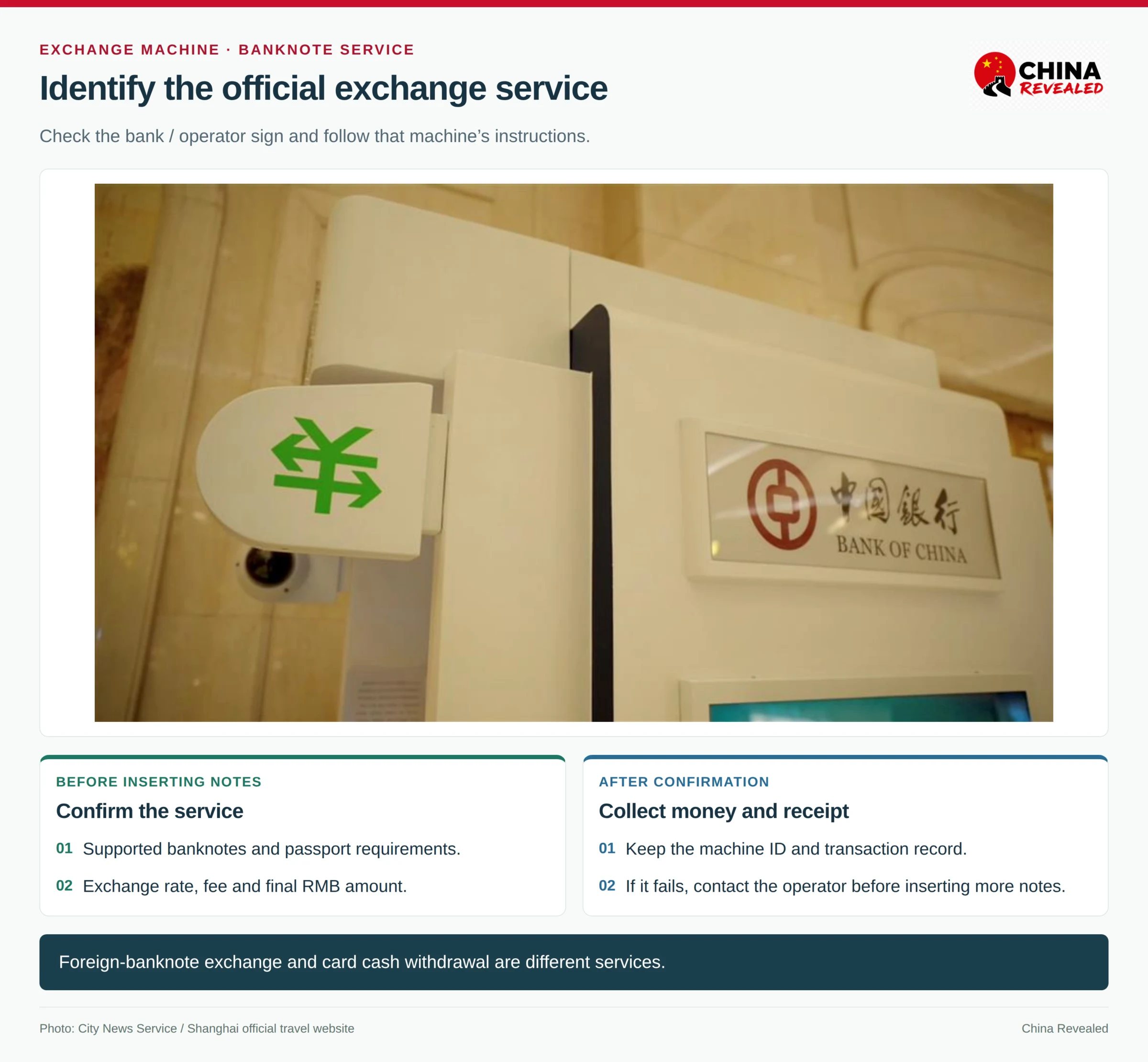
Using an official exchange machine
An exchange machine may scan your passport and accept supported foreign banknotes. Follow that machine’s language, document and note instructions; review the rate, fee and final RMB amount before the final confirmation. Collect the money and receipt.
Use the operator’s help channel if accepted notes are retained or no RMB is dispensed. Record the machine ID and transaction details just as you would for an ATM. Do not keep feeding notes into a machine that has failed.
6. Make your cash usable: small notes and separate storage
The first practical problem is often not getting cash—it is arriving with only RMB 100 notes for a small purchase. Many ATMs dispense hundreds; some also offer smaller notes. Choose smaller denominations when the machine allows them, but do not assume that every ATM does.
For everyday backup, I recommend a mix of RMB 5, 10 and 20 notes, plus a few coins. Keep larger notes for bigger purchases. Ask a bank counter for 零钱包 / língqiánbāo, a small-denomination cash pack, or simply ask to change a large note. The available mix varies by bank.
Could you change this into smaller notes?
可以帮我换成零钱吗?
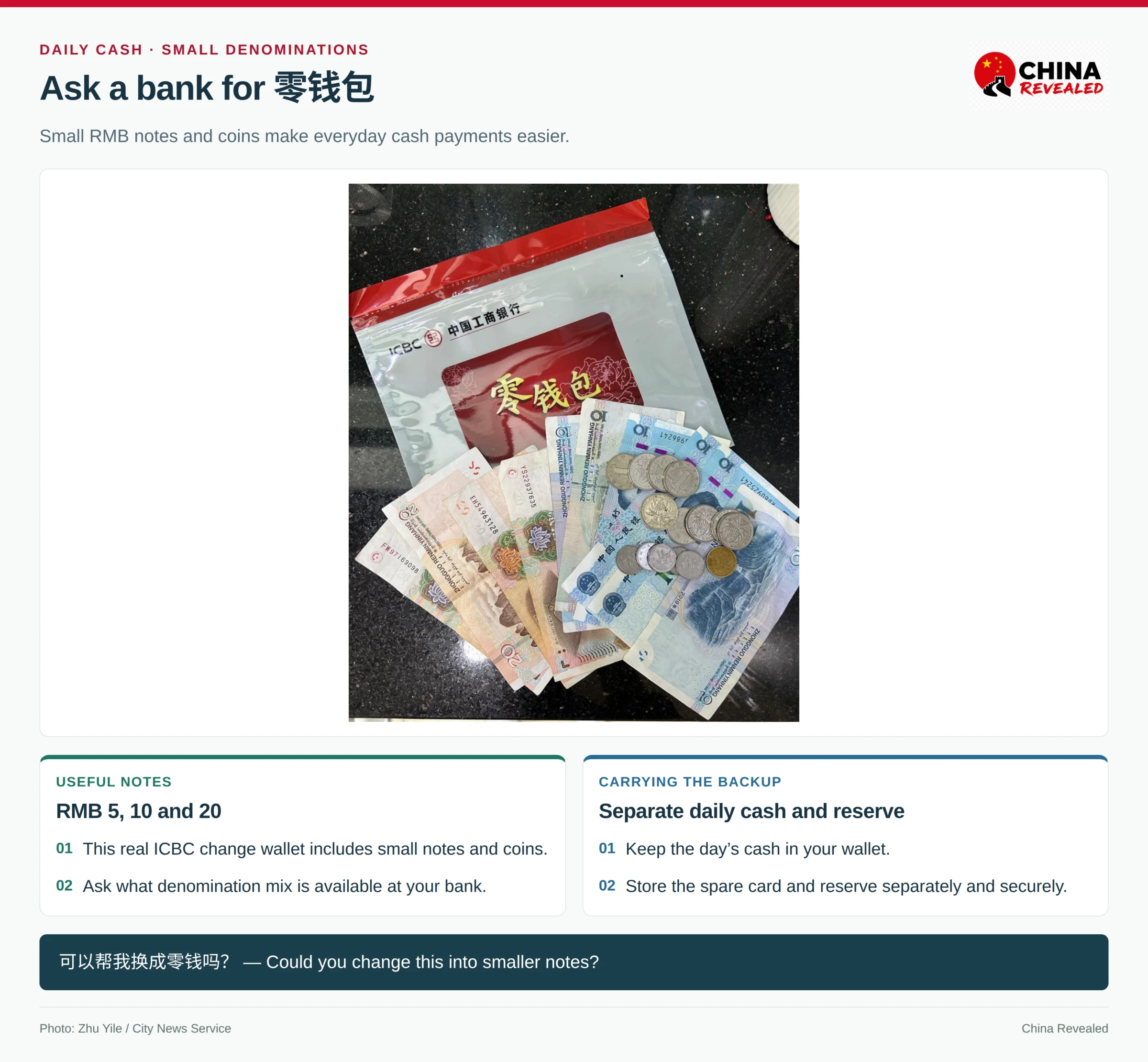
Carry only the day’s cash in your normal wallet. Keep the reserve and spare card separately in a secure place, without a PIN written beside them. There is no need to display or count your whole travel budget at the till.
Renminbi is China’s legal currency and ordinary in-person businesses are expected to accept cash. Small notes make the transaction easier when a cashier or driver has limited change. You can say 我想付现金—“I’d like to pay cash.”
For transport, confirm cash payment with a licensed taxi driver before the journey, or use the staffed ticket counter where available. Do not assume a cash option in every ride-hailing app, unattended machine or online ticket flow.
Book hotels, flights, train tickets, attractions and other travel services on Trip.com.
7. Know what cash cannot replace
Cash can get you through a phone or network failure. It does not repair an online order or remove a booking’s payment conditions.
A prepaid hotel booking may still need online payment. A pay-at-hotel booking may have a guarantee, deposit or accepted-payment requirement. An attraction’s online reservation cannot automatically be replaced by turning up with banknotes.
If your phone fails during a purchase, check the original payment or order status before paying again in cash. If a taxi ride was booked through an app, agree the payment route with the driver and check the app’s status rather than settling twice.
For the next step, use the guide that matches the failure:
- Alipay for foreigners — card linking and merchant payment.
- TenPayGo for foreigners — the simpler visitor payment route.
- WeChat Pay for foreigners — wallet and merchant-payment checks.
- China SIM vs eSIM — data, SMS, roaming and connectivity troubleshooting.
- Money & payments — the payment overview and preparation route.
Useful Chinese phrases for the bank or counter
| What you need to say | Chinese to show staff |
|---|---|
| Does this ATM accept overseas Visa/Mastercard cards? | 这台取款机支持境外的Visa/Mastercard卡吗? |
| My card was retained by this ATM. | 我的银行卡被这台取款机吞了。 |
| My account was debited, but I did not receive any cash. | 我的账户扣款了,但是取款机没有出钞。 |
| Which is the machine number? | 请问这台机器的编号是什么? |
| I want to exchange these foreign banknotes for RMB. | 我想把这些外币现金换成人民币。 |
| How many RMB will I receive after all fees? | 扣除所有费用后,我能拿到多少人民币? |
| I would like to pay cash. | 我想付现金。 |
| Please charge the card in RMB, without conversion. | 请用人民币结算,不要做货币转换。 |
Frequently asked questions
How much cash should I keep as a backup?
RMB 300–500 is a useful starting buffer for basic expenses, not a universal arrival budget. Increase it if your airport transfer, meals or other expected cash expenses cost more. Do not carry your entire trip budget just because mobile payment might fail.
Do I need a Chinese bank account to use an ATM?
You can withdraw with a supported foreign-issued physical card and its ATM PIN, subject to issuer authorization and limits. Ordinary card withdrawal does not require opening a Chinese bank account. Bring your passport if you need counter assistance or foreign-cash exchange.
Should I choose RMB or my home currency?
Usually choose CNY/RMB for a mainland China purchase or withdrawal. Read the displayed DCC quote and your issuer’s terms; do not assume that home-currency billing avoids fees.
Can I use any Chinese ATM with a foreign card?
Use a machine displaying the relevant card network and offering foreign-card service. A network logo does not override a blocked card, unsupported account, incorrect PIN or issuer limit.
Can I withdraw cash if my phone is dead?
A standard card-and-PIN ATM withdrawal does not rely on showing your mobile payment code. However, you may still need a working contact route to resolve an issuer security block or a retained card. That is why the physical card and a saved bank contact are both part of the backup.
Is cash enough for the whole trip?
Not reliably for every online booking, guarantee or app-based transaction. My preferred setup is a working mobile payment method, a modest RMB cash reserve and a spare physical card.
The practical bottom line: prepare the backup while your phone still works. Match the ATM to your card, read the currency and fees, keep small RMB notes, and deal with a failed transaction before trying to create another one.
About China Revealed
China Revealed is an independent English-language travel guide dedicated to China.
We bring together China travel guides, destination information, local insights and practical travel resources in one place.
Our travel database covers China's provinces, cities, famous attractions, hidden gems, local cuisine, transportation, accommodation, visa requirements, digital payments, mobile connectivity and the other practical details travelers need to explore China.
We focus on depth, careful research and accuracy. Our guides combine official sources, detailed destination data, local knowledge and regularly updated information to give reliable, practical travel advice.
Whether you're visiting China for the first time or exploring beyond the popular destinations, China Revealed is an all-in-one resource for discovering the real China.
China Revealed — Your practical guide to China.
Some links on China Revealed, such as Trip.com booking links, are affiliate links. If you book through them, we may earn a commission at no extra cost to you. This does not change what we recommend.