

Explore the region
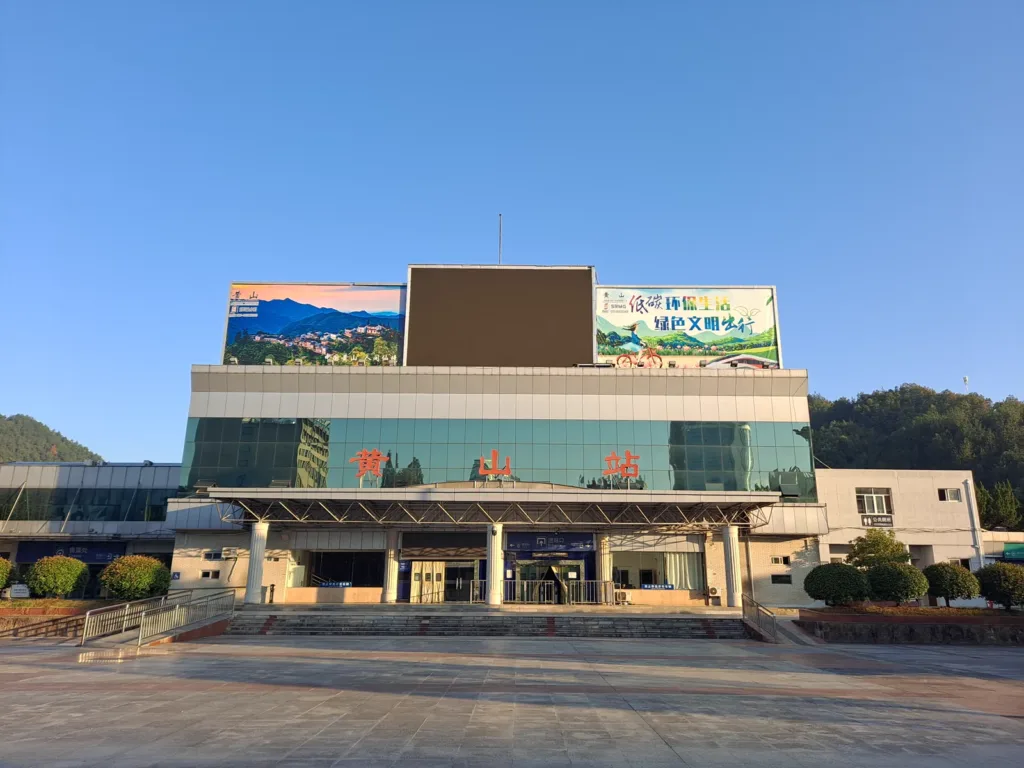
Huangshan Railway Station is the city’s original railway station: a compact 1980s building in the downtown Tunxi district, about 15 km from the high-speed Huangshan North station, served by a handful of conventional K-class trains from Beijing and Hefei. Coaches to Yellow Mountain and city buses leave from its square, and it is the closest station to Tunxi Old Street.
What it is
The station stands on the Anhui–Jiangxi Railway (皖赣铁路), the conventional line through southern Anhui, in Tunxi District (屯溪区). It opened on 31 May 1984 as Tunxi Station (屯溪站) and took its present name in 1987, when the prefecture-level city of Huangshan was set up. It is a class-II station under the Wuhu train-operations section of China Railway Shanghai Group, and the passenger building dates from a rebuild finished before the 2007 Spring Festival, which roughly doubled the waiting area. Passenger numbers fell once high-speed trains began using Huangshan North in 2015. Freight is still handled here, in a goods yard on Beihai Road (北海路) separate from the passenger building.
Keep the three names straight. Huangshan Railway Station (黄山站) is this downtown station. Huangshan North (黄山北站) is the high-speed station about 15 km northwest, and Huangshan West (黄山西站) is a high-speed station opened in 2024 in Huangshan District, close to the mountain’s north and west gates but far from the city. They are separate stations, and your ticket names the one you need.
Which trains stop here
Two pairs of conventional trains use the station. The Beijing train: K1109 arrives from Beijing Fengtai at 09:08, and K1110 leaves for Beijing Fengtai at 16:18, arriving 11:58 the next day after about 19 hours 40 minutes. The Hefei pair: K8381 leaves Hefei at 07:25 and arrives here at 14:31, while K8382 leaves at 12:17 and reaches Hefei at 19:14. Both Hefei trains call at Shexian station (歙县站) on the old line — K8381 before it reaches Huangshan, K8382 after it leaves — and then run through Jixi (绩溪县), Ningguo South (宁国南), Xuancheng (宣城) and Wuhu (芜湖). The two pairs share one set of carriages, which is why their times are spaced through the day.
One seasonal warning matters more than any timetable detail. In recent years the conventional services here have been cut for roughly three months of the flood season: in 2024 passenger service stopped in April and resumed on 1 October, and in 2025 the trains were suspended for three months and restarted on 1 September. If your plan depends on this station, check 12306 for your own date instead of assuming the train runs.
Inside the station
The building is small and read in one glance: ticket hall in the west wing, entrance, security check and waiting rooms through the middle, exit in the east wing. The waiting area is on two levels and was rebuilt to hold about 600 people. Two platforms, one side platform and one island, serve eight tracks, and an underpass links them with the building. Tickets have been electronic since 20 June 2020, so there is no paper ticket to collect: you book online and travel on the passport or ID used for the booking.
Getting in and out
Huangshan has no metro, and no urban rail line serves this station. The tourism rail line now under construction, T1, starts at Huangshan North and runs east towards the mountain’s south and east gates, so it will not change how you reach Huangshan Station.
City bus, 2 yuan flat fare. The 火车站 (Railway Station) stop is at the station itself, and bus 21 calls there. Riding towards 高铁北站 (Huangshan North), it passes 步行街, 荷花新村, 昱中花园, 老街二马路 — the stop for Tunxi Old Street — then 黄山国际大酒店, 汽车站 (the long-distance bus station on Qiyun Avenue), and ends at the high-speed station. At the Huangshan North end the first departure is about 06:50 and the last around 23:00, with headways from roughly 8 to 40 minutes depending on the hour; those published times are for departures from the North station, so read the board at your own stop. A second stop, 站前广场 (Station Front Square), is served by buses 1 and 9, and the same listing puts intercity services 6001 and 6002 on the railway-station stop for trips towards Shexian.
Coaches to Yellow Mountain. The scenic area’s own visitor guidance tells people arriving at Huangshan station to take the tourist coach to the mountain from the station exit, and a station guide updated in September 2025 lists a bus from the station square to the south gate at Tangkou (汤口) roughly every 40 to 60 minutes from about 06:10 to 16:05, about an hour’s drive, around CNY 30. This is the least stable part of the journey; confirm departures at the station before you count on them. At Tangkou nobody stays on the coach: private cars cannot enter the scenic area, and everyone transfers at the south-gate transfer centre to the park shuttle for Ciguang Pavilion (慈光阁, front mountain) or Yungu Temple (云谷寺, back mountain), where the cable cars start.
The city’s main coach station, 黄山市汽车客运总站 (also called 屯溪汽车站), is on Qiyun Avenue (齐云大道 32), about 3.6 km away, and has the densest departures to Tangkou, Hongcun, Xidi and the county towns; bus 21’s 汽车站 stop or a taxi gets you there.
Onward by rail. If your next leg is a high-speed train, it leaves from Huangshan North (黄山北站), about 15 km away, reached by bus 21 or taxi. Huangshan North handles the G- and D-class trains towards Beijing, Shanghai, Hangzhou, Hefei, Nanchang and Fuzhou, and its high-speed offer keeps growing: the national timetable change that took effect on 11 October 2026 added cross-line high-speed services including Huangshan North to Beijing West.
By taxi or ride-hailing. Give the driver 黄山火车站 rather than a street number. Allow about 10 minutes to Tunxi Old Street and around 30 minutes to Huangshan North; Huangshan Tunxi International Airport (黄山屯溪国际机场) is a separate facility about 8 km from the station.
Practical notes
Addresses for the station appear in different listings as 站前路4号 (Zhanqian Road) and 前园北路 (Qianyuan North Road), both in Tunxi District; in practice the station name is what drivers, bus signs and ticket searches use.
If you are heading straight for the mountain, the two stations give you different first steps: from Huangshan Station you board the coach for Tangkou at the station itself, while from Huangshan North the coaches leave the passenger transport centre beside the station. Both routes meet at the south-gate transfer centre.
Find Huangshan Railway Station
黄山站 · 站前路4号(No. 4 Zhanqian Road);部分来源写作前园北路(Qianyuan North Road)/北海路(Beihai Road)
The pin marks the area, not the entrance.
Sources & visit information
Sources checked on 22 October 2026. Hours, tickets, reservations and transport can change; confirm with the operator before you go.
- 黄山站 (安徽) - 维基百科 ↗
- 黄山站 - 百度百科 ↗
- 皖赣铁路芜湖段恢复客运业务 黄山站绿皮火车恢复运行(中新社安徽新闻,搜狐转载) ↗
- K1109/1110次列车 - 维基百科 ↗
- K1110次列车时刻表 - crecc.com ↗
- K8382次列车途经站点时刻表 - 高铁网 ↗
- 黄山公交21路 - 百度百科 ↗
- 从黄山北站出发,畅达黄山市各景点的公交/班车全攻略(澎湃新闻) ↗
- 黄山风景区常见旅游咨询(黄山风景区官方微信,wap.huangshan.com.cn) ↗
- 黄山旅游 常见问题(hstd.com) ↗
- Huangshan Railway Station - TravelChinaGuide ↗
- Huangshan Train Stations - Layout, Transfer, Trains & Tips - China Discovery ↗
- 10月11日起,黄山北—北京西等跨线高铁列车开行(上铁集团,凤凰网转载) ↗
- 城市交通 - 中国南方航空黄山页面 ↗
- 黄山旅游T1线建设跑出“加速度”(新华网安徽,来源安徽日报) ↗
- K8381次列车途经站点时刻表 - 高铁网 ↗
Image credits & notes (1)
- The 2007-vintage station building of Huangshan Railway Station (黄山站) seen from its front square. Photo: EditQ(Wikimedia Commons 用户)Photo: CC BY-SA 4.0