

Explore the region
Tap any red Chinese text to hear it in Mandarin.
Huangshan Tunxi International Airport — 黄山屯溪国际机场, IATA TXN, ICAO ZSTX — is the commercial airport for Huangshan City in southern Anhui and the usual air gateway for Mount Huangshan and the Huizhou villages.
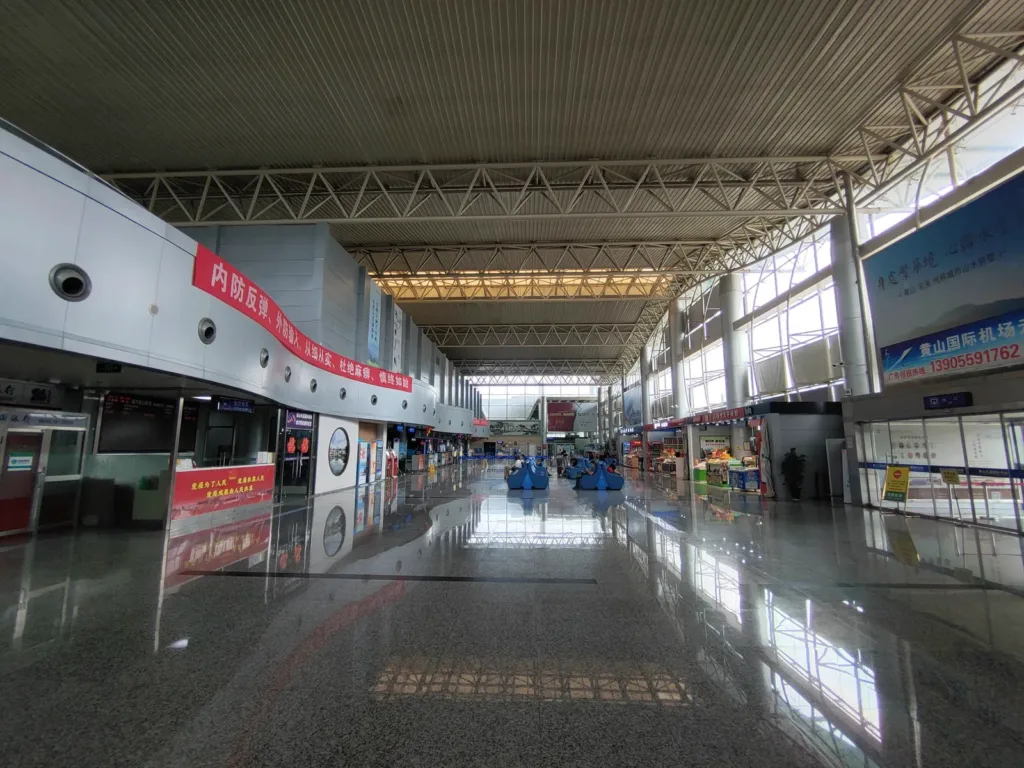
It is a compact regional field: one 2,600 m runway, eight aircraft stands, a single passenger terminal of about 14,000 m², and a design capacity of 1.12 million passengers a year. It opened in October 1959 as Tunxi Airport (屯溪机场), was later renamed Huangshan Tunxi Airport, and took its present international name in June 2014; it is operated by the Huangshan branch of Anhui Civil Aviation Airport Group.
The most useful thing to understand before booking is where the airport is not. It sits inside Tunxi District on the northwest edge of the built-up city, listed at 5.5 km from the central area, and the terminal is reached off 迎宾大道 (Yingbin Avenue). The mountain itself is about 60 km north, with the south gate at Tangkou reached by road. Landing at TXN puts you in Huangshan’s urban core, close to the old street and the city coach station — not at the foot of the peaks.
| | |
|—|—|
| IATA / ICAO | TXN / ZSTX |
| Type | 4D-class public airport; international and regional port of entry |
| Location | Tunxi District, Huangshan City, Anhui — northwest edge of the city, off 迎宾大道 |
| Terminal | One building for domestic and international/regional flights |
| Runway and stands | One 2,600 m runway; eight aircraft stands |
| Operator | Anhui Civil Aviation Airport Group, Huangshan branch (安徽民航机场集团有限公司黄山机场分公司) |
A single terminal, and what that saves you
There is one terminal, not a T1/T2 choice to get wrong. The 2017 expansion left a single 14,000 m² terminal serving both domestic and international/regional flights, with four jet bridges and eight stands outside. Airlines list the airport simply as 航站楼(单体)— a single terminal building. Inside, signs point to a separate 国际/港澳台出发 (international, Hong Kong/Macau/Taiwan departures) channel, so follow those if that is your flight.
Hainan Airlines’ published airport table gives Huangshan a check-in cut-off of 30 minutes before scheduled departure for its international and regional flights, and the same page advises passengers to reach the airport 120 minutes before departure; other carriers set their own cut-offs, so confirm with the airline on your ticket. The airport suspended on-site ticket sales and refunds on 20 August 2025, with no resumption date given in the notice, so buy, change or refund through the airline or its app rather than planning to do it at a counter.
The network: a thin domestic base, seasonal international charters
For the 2026 summer season (29 March to 24 October), the airport scheduled 14 passenger routes to 18 cities and 78 weekly flights, 18% more than the 2025 summer season. Nine of those routes were international or regional, covering Hong Kong, Korea, Vietnam, Thailand and Malaysia. New domestic routings included Guangzhou–Huangshan–Shenyang four times a week and Chongqing–Huangshan–Dalian three times a week, with Shenyang, Dalian and Harbin added as destinations; the Beijing departure was moved from 19:25 to 16:00, and 9 Air (九元航空) began serving the airport. Ho Chi Minh City was flown as a charter about three times every two weeks, and a Jeju charter started on 10 April with four weekly flights.
The pattern repeats each season. For the 2026/27 winter season the airport’s marketing office described Kuala Lumpur back on Saturdays, Seoul and Busan charters twice weekly, and a Thai VietJet Bangkok service three times a week planned from 27 November; international and regional routes were to make up 30% of the total, 15% more than the previous winter. In 2025 the airport opened Hong Kong, Incheon, Busan, Kuala Lumpur and Ulaanbaatar, and carried 25,062 international and regional passengers in the first half of the year, up 492.6% year on year.
Two practical consequences follow. First, most of the international capacity is charter or seasonal, sold through tour operators, and the map is re-cut at the end of March and the end of October — a route listed here may not operate on your dates, so check the airline or a booking site before building a trip around it. Second, the domestic network is thin: outside the trunk routes above, many cities see one flight a day or less, and some appear for a season and then disappear.
Into Tunxi and the old street
Huangshan has no metro system and the airport has no rail station, so the last leg is bus, taxi or coach.
City bus 219路 was extended to a stop at the terminal, 黄山机场候机厅 (Huangshan Airport Terminal), in 2023. It runs between 汽车站站前广场 (the square in front of the city coach station) and 瑶干, following 齐云大道, 西海路 and 迎宾大道 past the airport. From the 汽车站 stop you can change to 5路 or 8路 for 屯溪老街 (Tunxi Old Street) and 黎阳in巷, or to 21路 or 快2线 for 黄山北站 (Huangshan North Railway Station). The same 2023 plan introduced a dedicated airport shuttle from 大润发西门 with three evening departures (19:30, 20:25 and 21:40) and returns at 20:00, 21:15 and 22:25, priced at ¥5. Its current status is not confirmed, so ask at the information desk rather than relying on it.
For a taxi or ride-hailing car, the destination to type is 黄山屯溪国际机场 Huángshān Túnxī Guójì Jīchǎng (or 黄山屯溪国际机场航站楼); for the old street, 屯溪老街 Túnxī Lǎojiē. Published distances from the city centre range from 5.5 km in Chinese reference works to about 9 km in English guidebooks, a gap that reflects different measuring points rather than a disagreement about which city the airport serves. A 2015 CCTV report cited by Wikipedia described taxis at the airport refusing to use the meter; the sensible habit anywhere in Huangshan is to use the marked taxi rank or a ride-hailing app and to check that the meter is running.
To the mountain, and to the villages
There is no direct airport bus to Huangshan Scenic Area. The scenic area’s own guidance for air arrivals is to take a taxi to 黄山长运汽车客运总站 Huángshān Chángyùn Qìchē Kèyùn Zǒngzhàn (the city coach station, also called 黄山市汽车客运总站, at 屯溪区齐云大道32号) and change there for a coach to 黄山风景区汽车站 Huángshān Fēngjǐngqū Qìchēzhàn at Tangkou, or to take a taxi the whole way. At the south gate, private cars and ordinary coaches stop at the transfer centre, and 新国线 shuttle buses carry visitors on to the cableway stations, because vehicles cannot drive into the scenic area itself.
The same coach station is the departure point for the villages. 旅1路 runs from 黄山市汽车客运总站 via 齐云山 and 西递 to 宏村 (Hongcun); 旅2路 runs via 潜口民宅, 呈坎 (Chengkan), 唐模 (Tangmo) and 棠樾牌坊群 to 徽州古城 (Huizhou Ancient City). There is no direct airport coach to Hongcun or Xidi, so the city station is the transfer you need.
To Huangshan North and the high-speed network
Huangshan North Railway Station (黄山北站) is the high-speed station, in 徽州区西溪南镇 on 宏村大道; the older Huangshan Railway Station (黄山站) is on 前园北路 in Tunxi. Both are separate facilities from the airport, in different parts of the city — the airport, the two railway stations and the coach station are four different places, and a ticket or a driver’s instruction should name the one you actually want.
From the airport, take bus 219 to 汽车站 and change to 21路 or 快2线 for 黄山北站, or take a taxi. At Huangshan North, the 黄山旅游客运枢纽 sits next to the station — turn right as you leave the exit — and runs 新国线 coaches directly to the scenic area.
Practical notes
Huangshan Tunxi was added as a port for China’s 240-hour visa-free transit on 17 December 2024. Eligible nationals transiting to a third country or region can stay up to 240 hours, and the permitted area for Anhui is the whole province, so a Huangshan arrival can be combined with Hefei or other Anhui stops.
The airport sits in hilly country, and its approach minima are comparatively high: the airport has worked on required navigation performance (RNP AR) approach procedures in part because of the surrounding terrain. In low cloud, that is a reason to leave slack before a tight train connection or a same-day ascent rather than to assume the flight will be on time.
A replacement airport is planned
Huangshan plans to replace the airport rather than expand it. The relocation was written into the 14th Five-Year Civil Aviation Development Plan in December 2021, and in early 2024 the city’s development commission said the preferred site is about 15 km (straight-line distance) from the downtown area and about 4 km from Huangshan North Railway Station, with temporary weather observations under way at the site. Until a new airport opens, TXN remains the city’s working airport, and everything above applies to the Tunxi site.
Find Huangshan Tunxi International Airport
黄山屯溪国际机场 · Tunxi District, Huangshan City, Anhui — northwest edge of the built-up city, approached off 迎宾大道 (no street number verified)
The pin marks the area, not the entrance.
Sources & visit information
Sources checked on 22 October 2026. Hours, tickets, reservations and transport can change; confirm with the operator before you go.
- 通航城市18个 航班量增加18% 黄山机场优化航线网络布局 (中安在线, 2026-03-18) ↗
- 黄山屯溪国际机场国际航线持续扩容 (凤凰网, 2026-10-15) ↗
- 黄山机场新增黄山=乌兰巴托国际航线 (民航资源网, 2025-07-08) ↗
- 黄山屯溪国际机场 (百度百科) ↗
- 出发机场及截载时间 (海南航空, updated 2025-07-09) ↗
- 黄山机场巴士本月底试运行 (黄山公交, via 搜狐, 2023-06-27) ↗
- 黄山风景区常见旅游咨询 (黄山风景区官方平台, 2021-02-13) ↗
- 黄山机场首选场址净空、飞行和地面条件均较为理想 (2024-03-04) ↗
- 中国过境免签政策全面放宽优化 (国家移民管理局, 2024-12-17) ↗
- 黄山机场暂停现场售票业务 (环球旅讯, 2025-08-28) ↗
- Huangshan Tunxi International Airport (Wikipedia, English) ↗
- 黄山屯溪国际机场 (维基百科, 中文) ↗
- Huangshan Tunxi International Airport (China Discovery travel guide) ↗
- 城市交通 - 黄山 (中国南方航空) ↗
Image credits & notes (1)
- The single passenger terminal at Huangshan Tunxi International Airport, August 2021 Photo: 30000lightyearsPhoto: CC BY-SA 4.0