

Explore the region
A mountain park shaped into an imperial garden
At the western edge of Haidian, Fragrant Hills Park’s official visitor address is No. 40, Maimaijie. It combines forested slopes with the remains and restored elements of Jingyi Garden (静宜园), one of the western Beijing landscape known as the “Three Hills and Five Gardens.” The park dates its human landscape to 1186, and records the Qing Qianlong-era garden as a composition of 28 scenic sites. The municipal forestry authority lists the park at 188 hectares and Incense Burner Peak at 575 metres.
The setting matters as much as the buildings. The park reports forest cover of 96 percent and more than 5,800 first- and second-grade ancient trees. In autumn, colored foliage is a major draw, but changing leaf color depends on the season and weather; a calendar date is not a guarantee of peak color.
What to see
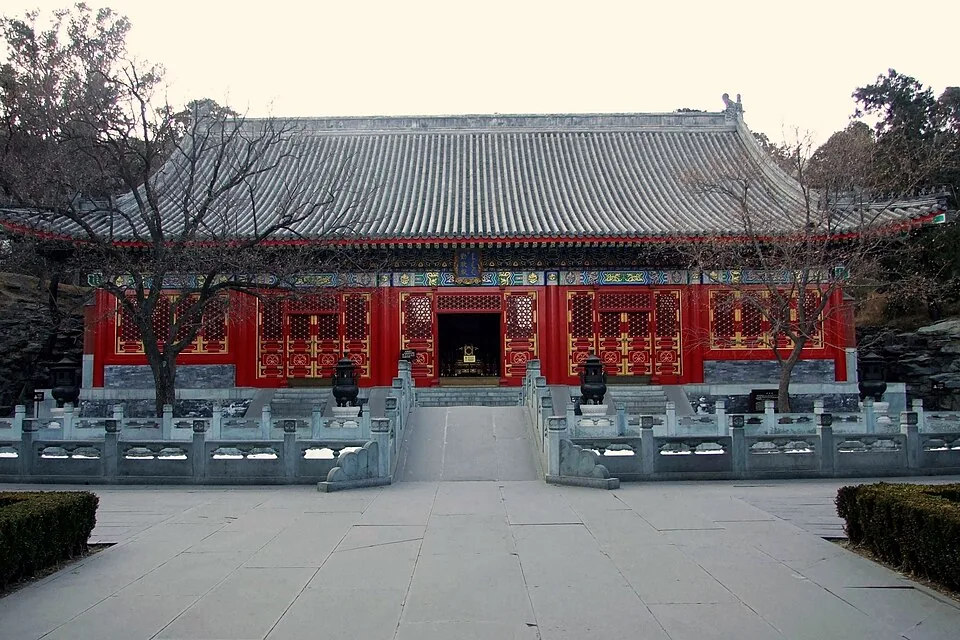
Start at the East Gate for the clearest south-side route into the garden. The official autumn walk links Qinzheng Hall, the reflecting water at Jingcui Lake, Shuangqing Villa, Xiangshan Temple, Rain Fragrance Hall and the summit path to Incense Burner Peak. It moves from garden architecture and water to hillside temple courtyards and, if you continue, a steep mountain ascent. The summit is a landscape destination rather than a building interior.
The park also preserves a modern-history route. Shuangqing Villa and nearby Laiqingxuan are among the revolutionary sites associated with the Communist Party and central-government offices in Beijing in 1949. Shuangqing Villa was Mao Zedong’s working and living place during this period. Read these as a group of historic sites embedded in the hillside, not as decorative garden pavilions.
For architecture without the summit climb, the northern garden route links Zhiyuan Studio, Zhaomiao and Jianxinzhai. Zhaomiao is a prominent Tibetan-style Buddhist complex; Jianxinzhai is a small, enclosed garden whose pond and pavilions offer a markedly different scale from the mountain paths. From the North Gate, visitors can continue to Biyun Temple, a distinct temple precinct founded in the Yuan period and later developed as an imperial monastery. The forestry authority also records its connection to Sun Yat-sen’s funeral history.
Pick a route to match your time and energy
Lower garden and northern sites — about 2–3 hours, editorial estimate. Enter at the East Gate and follow Qinzheng Hall, Zhiyuan Studio, Zhishong Garden, Maple Village, Holiday Garden, Spectacles Lake, Jianxinzhai and Zhaomiao, then return to the East Gate. A Beijing government 2026 guide presents this as a gentler circuit that avoids the summit ascent. It still involves walking through a large park; check the current map and on-site access signs.
Garden, heritage and Biyun Temple — about 3–4 hours, editorial estimate. From the East Gate, visit Zhiyuan Studio, Zhaomiao and Jianxinzhai, then leave by the North Gate and continue to Biyun Temple. This is a better choice if you want garden architecture and a substantial temple visit without climbing to Incense Burner Peak. Park admission and Biyun Temple have separate ticket prices, with a combined ticket also listed by the park.
Full south-to-summit walk — about 3.5–4.5 hours, editorial estimate. Enter at the East Gate and follow Qinzheng Hall, Jingcui Lake, Shuangqing Villa, Xiangshan Temple, Rain Fragrance Hall and Xiangwuku toward Incense Burner Peak. The park’s 2026 route description estimates 3.5–4 hours; allowing extra time is prudent for the climb, crowds and rest stops. As of 21 October 2026, the park’s cableway was undergoing a system upgrade and was temporarily suspended, so plan on walking rather than relying on a lift to the upper mountain.
These routes are planning choices, not guaranteed opening sequences. Restoration, weather and crowd-control measures may close individual buildings or paths. The park says its eight revolutionary sites, Xiangshan Temple scenic area and Biyun Temple scenic area generally close on Mondays, except statutory holidays; check its notice for holiday and special-event exceptions.
Tickets, opening hours and arrival
The park’s current published full-price admission is CNY 10 from 1 April through 15 November and CNY 5 from 16 November through 31 March; concession tickets are CNY 5 and CNY 2.50 respectively. Biyun Temple is listed at CNY 10 full price and CNY 5 concession. A combined park-and-temple ticket is listed at CNY 15 in peak season and CNY 14 in the off-season. On the fact-check date, 21 October 2026, the peak-season prices applied. Confirm the current ticket and entry arrangement through the park’s official service channels before setting out.
Published hours are 06:00 opening year-round. From 1 April to 15 November, last entry is 18:30 and the park closes at 19:30; from 16 November to 31 March, last entry is 18:00 and closing is 19:00. These are park-wide hours; the Monday closure of named scenic areas above is a separate restriction. The official Beijing visitor guide says international visitors can book through the “Fragrant Hills Park Services” WeChat account using a passport or permanent-residence permit.
The Xijiao Line’s Fragrant Hills Station is the rail approach named by the Beijing visitor guide. Continue from the station to the chosen gate on foot or by current local surface transport; the station is not itself a park entrance. Start at the East Gate for the south-side garden and summit routes. Use the North Gate if your plan finishes with the northern sites or Biyun Temple. Check the live transit map and park access notices for the day rather than assuming that entering and leaving are the same journey.
Combine your visit
Suggested order within this visit:
-
Spectacles Lake
Begin with the northern garden’s water and bridge setting.
-
Jianxin Zhai
Continue to the enclosed garden composition.
-
Zhaomiao
Finish with the surviving Tibetan-style architectural group.
This suggested sequence stays with the northern garden group. Incense Burner Peak is a separate, more demanding extension; no cable-car operation or climb duration is assumed.
Find Fragrant Hills
香山 · 海淀区
The pin marks the area, not the entrance.
More places nearby
Approximate straight-line distances between map pins, not travel distances.
Beijing Botanical Garden 国家植物园北园
3 km awayThe former Beijing Botanical Garden is now the North Garden of the China National Botanical Garden, below the Western Hills. Its appeal extends beyond flower beds: the conservatory brings tropical vegetation and succulents…
View guide →Badachu 八大处
4 km awayBadachu is a group of Buddhist temples and religious sites spread across hills at the western edge of Beijing. Its name refers to eight sites, so the attraction is a landscape of separate compounds rather than one temple…
View guide →Fahai Temple (Beijing) 法海寺
6 km awayFahai Temple preserves Ming murals in the Moshikou area of Shijingshan. The paintings reward close attention to faces, garments, and especially the delicate gauze around Water-and-Moon Guanyin. The temple setting also includes a…
View guide →Sources & visit information
Sources checked on 21 October 2026. Hours, tickets, reservations and transport can change; confirm with the operator before you go.
Image credits & notes (1)
- Qinzheng Hall in Fragrant Hills Park. Photo: 2009-01.Photo: Charlie fong 冯成 · Public domainResized for the web; the photo itself has not been edited.
