

Photo adjustments
Resized and WebP compressed; subject not altered.
Explore the region
About Beijing Capital International Airport
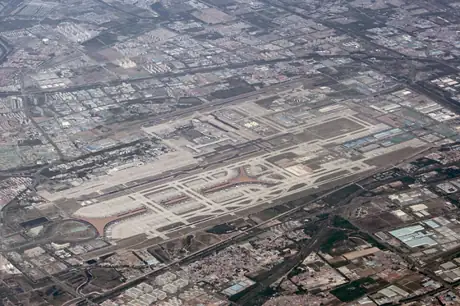
Its most distinctive building is Terminal 3, opened for the 2008 Olympics and designed by a team including Foster + Partners. The complex separates a main terminal from satellite concourses, so the terminal and concourse on a boarding pass matter as much as the airport name. This is primarily a transport stop: architecture is a bonus during a flight connection, while baggage, immigration and the onward rail or road journey determine the practical visit.
Capital Airport opened on 1 March 1958 as the first civil airport built after the founding of the People's Republic and the fourth airport in Chinese history to offer international flights. Its first terminal, a Soviet-style building of 10,138 square meters, opened later that year, on 1 October 1958; before Terminal 1 was built it was mainly used for VIP passengers and chartered flights, and it later served as Air China's headquarters until 2008.
Facing rising demand and, after the Sino-American rapprochement and Richard Nixon's 1972 visit, growing international traffic, the airport underwent a second expansion approved in 1973, adding an international terminal, a new west runway, and an aircraft maintenance base. The 3,200-meter west runway was built between 1974 and 1978, after which the east runway was extended by 600 meters and brought into use on 1 January 1982; a hangar able to hold a Boeing 707 was completed in 1977.
Because the site chosen for the airport lay in what was then Hebei province's Shunyi County, the land became an exclave of Beijing surrounded by Hebei; it remained administratively part of Chaoyang District even after Shunyi itself was transferred to Beijing, so Terminals 1 and 2 sit on a Chaoyang exclave while Terminal 3, built later, stands on Shunyi district land.
At the airport
- Terminal 3's expansive main hall and long-span airport architecture, when your journey uses that terminal.
- The relationship between T3's main terminal and satellite concourses, connected by the airport's internal passenger system.
Location & getting there
Getting to Beijing Capital International Airport
Use airport code PEK and the terminal stated by your airline; do not select Beijing Daxing (PKX) when planning the transfer.
- The Capital Airport Express serves Terminals 2 and 3 and connects with the urban network at Dongzhimen and Sanyuanqiao. Follow the airport's signs for your own terminal.
Plan your connection
Suggested arrival sequence:
-
Booked arrival terminal
Complete arrival formalities and collect baggage where required.
-
Terminal arrivals hall
Check onward transport and the correct city destination.
-
Airport Express or authorized road-transport area
Continue toward Beijing using the terminal's signed connection.
This is an airport arrival sequence, not a sightseeing circuit. Airside areas require the appropriate flight documents.
Find Beijing Capital International Airport
北京首都国际机场 · 朝阳区
The pin marks the area, not the entrance.
More places nearby
Approximate straight-line distances between map pins, not travel distances.
798 Art Zone 798艺术区
13 km away798 Art Zone occupies a former electronics-factory complex in Dashanzi, where industrial buildings have become galleries and art spaces. The factory architecture is part of the attraction: repeated roof curves and north-facing…
View guide →Shunyi Olympic Rowing-Canoeing Park 顺义奥林匹克水上公园
14 km awayShunyi Olympic Rowing-Canoeing Park preserves the water-sports setting built for Beijing’s 2008 Games. The long rowing water and the pumped slalom course were designed for very different kinds of competition, making their…
View guide →Chaoyang Park 朝阳公园
17 km awayChaoyang Park is a large urban green space between Beijing’s eastern ring roads, with lakes, flower planting, landscaped lawns, and recreation areas. Its scale allows a visit centered on walking and waterside views rather than…
View guide →Sources & visit information
The sources below support the place-specific description and arrival information. Suggested combinations are editorial planning ideas; confirm current opening, entry arrangements and transport services for your date.
- Wikipedia: Beijing Capital International Airport ↗
- Beijing Government: Capital Airport Express ↗
- Chinese Wikipedia: 北京首都国际机场 (revision 94187678, 2026-09-04) ↗
Visitor information adapted and edited from Wikipedia contributors · CC BY-SA 4.0. Source revision 1373203037.
Background paragraphs translated and condensed from Wikipedia contributors, "北京首都国际机场", Chinese Wikipedia · CC BY-SA 4.0. Source revision 94187678.