

Jinchuan Fire-Baked Bread 金川烧馍馍
Jinchuan Fire-Baked Bread (金川烧馍馍) is a Jinchuan-associated cooked-flour staple in Ngawa. Its interest lies in the word “烧”: regional Aba descriptions place the dough over dry heat and ash, producing a browned outside and a soft centre, but not one guaranteed recipe or fixed restaurant dish.
Tap any red Chinese text to hear it in Mandarin.
Jinchuan Fire-Baked Bread is the English name used for 金川烧馍馍, a food entry associated with Jinchuan County in Ngawa Tibetan and Qiang Autonomous Prefecture. It is best understood as a local name for a heat-cooked bread, not as a claim that every “烧馍馍” in Aba is made the same way or belongs only to Jinchuan.
What makes it interesting
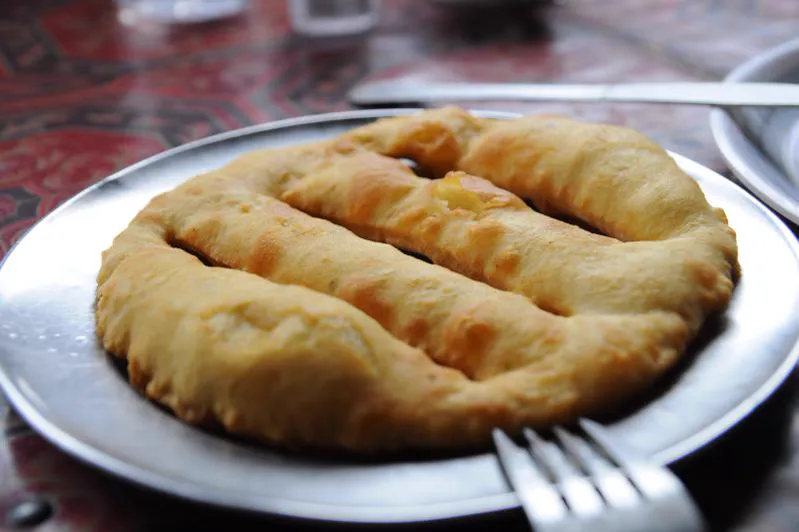
A recent account of Aba-style fire-pit bread describes old-leavened dough being kneaded into a round, set briefly on a hot iron plate, then buried in warm ash and turned until browned. The point of the method is practical: the fire makes a firm, toasted shell while the centre stays soft. That description is useful context for the name, but it is a regional account rather than a verified Jinchuan recipe.
Broader descriptions of 烧馍馍 in Sichuan and Tibetan areas also record wheat-flour versions, with other grains and seasonings appearing in local variations. The texture is commonly described as crisp or browned outside and tender within. Butter, honey, pork fat or pickled vegetables may be used as fillings or accompaniments, and tea is a natural partner; none of these should be assumed for every loaf.
How to eat it
If a fresh batch is available, ask for it warm and look for the contrast between the toasted surface and the bread inside. A plain loaf lets the grain and fire carry the flavour. If the seller offers a filling or topping, ask what it is before ordering: documented regional versions range from sweet additions to savoury or fatty ones.
Keep the full Chinese name 金川烧馍馍 Jīnchuān Shāo Mómo on your phone when asking. Names overlap within the prefecture: a Songpan account calls its local “穹锅馍馍” another form of 烧馍馍, with its own tool and preparation. That is a useful comparison, not proof that the Songpan and Jinchuan foods are the same item.
Practical tips
The available descriptions do not establish one standard ingredient list or allergen profile. Wheat flour is common in general accounts, while grains, fillings and toppings vary. If you avoid gluten, dairy, egg or meat, ask about the dough and everything brushed, mixed or tucked inside; do not infer that a plain-looking loaf is suitable.
Where to eat it
You can find Jinchuan Fire-Baked Bread all over Sichuan, so there is no need to seek out one particular restaurant. To find one near you, search for “金川烧馍馍” in Meituan (美团) or Amap (高德地图) and check recent reviews, distance and opening hours.
More dishes to compare
Explore related local specialties and compare their names, preparation notes and ordering guidance.
Mianyang rice noodles 绵阳米粉 →
Mianyang rice noodles (绵阳米粉) show the other half of Sichuan's everyday starch: a soft noodle served in a hot seasoned broth, against a bread cooked dry over heat. Setting the two side by side shows how differently the same province treats a staple at breakfast time.
Sources & reading
Image credits & notes (1)
- Tibetan bread, identified by the source as bread known in parts of the Annapurna region; used here as a clearly labelled regional visual reference for the broader Tibetan-area bread context, not as a Jinchuan or Aba photograph and not as a photograph of a named Jinchuan shop. Photo: they called me Lily (Flickr display name; account: LilyinNepal)Photo: CC BY-SA 2.0