

Xinjiang lamb skewers 烤羊肉串
Xinjiang lamb skewers (烤羊肉串) are a regional grilled-lamb snack: small pieces of lamb, rendered fat and cumin-led seasoning, served hot and varied by kitchen.
Tap any red Chinese text to hear it in Mandarin.
What the dish is
烤羊肉串 Kǎo Yángròuchuàn is a Xinjiang-style lamb skewer, and a dish you can look for in Ürümqi rather than a dish that belongs to one named restaurant. The current Ürümqi directory places it among the city’s local specialties. That listing is useful for finding the dish in the city, but it is not evidence that Ürümqi invented it. Xinjiang food sources present lamb skewers as a regional tradition rather than a single-city invention.
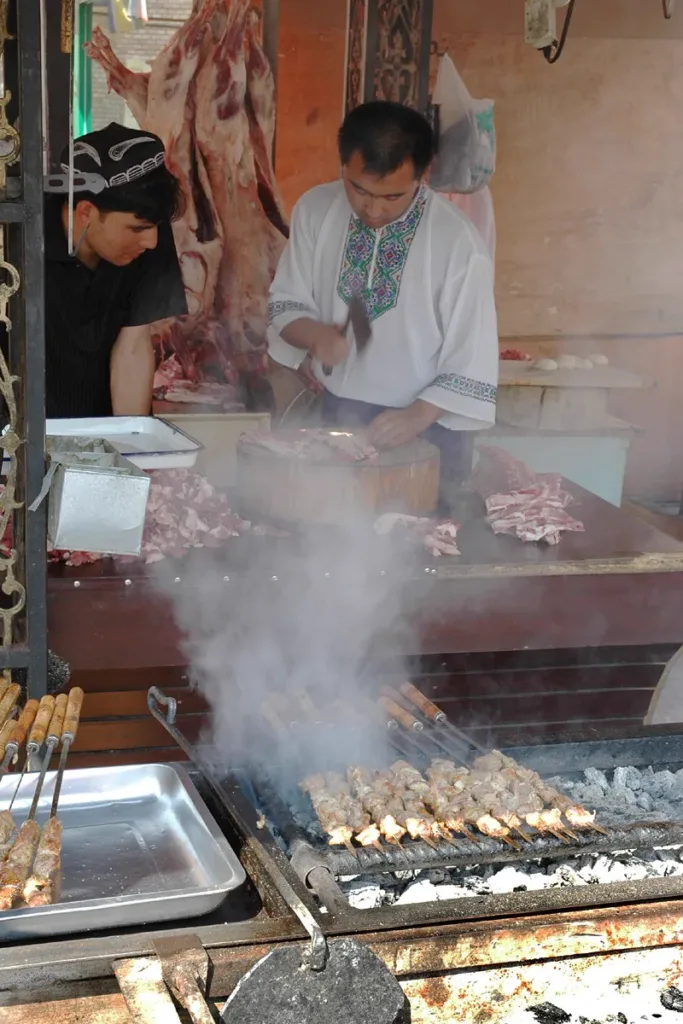
The basic idea is direct: pieces of lamb are threaded onto skewers, cooked over a hot charcoal fire, turned, seasoned and served. A Xinjiang culture-and-tourism feature describes local lamb grilled after being dipped in salt water. A contemporary English cooking reference describes a common street-style arrangement of lean lamb and small pieces of fat, with salt, cumin and optional chilli added around the grill. The fat renders at the edges and can leave crisp, juicy spots, while the cumin becomes warmer and more aromatic over the fire. These are useful markers of a familiar style, not a mandatory recipe for every Ürümqi kitchen.
How the flavour is built
The public description from Xinhua’s 2015 report is almost a working sequence: cut and thread the lamb; light the fire and put the skewers over the coals; turn them, add seasoning and serve. Direct heat and frequent turning matter because small pieces cook quickly. Alternating lean meat with fat is one documented way to keep the lean pieces from drying out, but the ratio, marinade and spice blend can change from one vendor to another.
This variation is part of the reason to treat 烤羊肉串 Kǎo Yángròuchuàn as a dish, not as a single protected formula. A September 2026 report says the Ürümqi Food and Beverage Service Industry Association issued a group standard for Xinjiang lamb skewers, effective 20 October 2026. The standard covers ingredient selection, processing, ratios, cooking, sensory quality and food safety. It creates a current reference for the trade, but it does not mean that every stall serves identical seasoning or that a menu, price or halal status can be inferred without asking.
How to try it in Ürümqi
Search the exact Chinese name 烤羊肉串 Kǎo Yángròuchuàn in Meituan (美团) or Amap/Gaode Maps (高德地图). Open nearby listings without treating a platform ranking as a recommendation. Check the current menu, recent reviews, opening status and whether the skewers are being served that day. Some listings may use 羊肉串 Yángròuchuàn or 烤串 Kǎo Chuàn as a shorter label; read the menu to confirm that the item is lamb skewers rather than another grilled dish.
Order a small number first and eat them hot, when the fat is still soft. You can show the staff: “烤羊肉串,少辣,可以吗?” (“Lamb skewers, less spicy, please?”) Ask whether the seasoning is applied during grilling or served separately if you need to control chilli. Different kitchens may use different cuts, marinades, oils and spice mixes, so do not treat one stall’s version as the citywide standard.
For allergies or dietary rules, ask about the lamb and lamb fat, marinade, spice mix, cooking oil and shared grill before ordering. The appearance of the skewers cannot prove halal status, vegetarian suitability or the absence of allergens. If a specific certification or ingredient exclusion matters to you, ask the individual restaurant directly.
Location, timing and transport
This is a dish rather than a venue. It has no fixed restaurant address, visitor entrance, ticket, reservation counter or dish-specific public-transport route. Once you choose a current listing, use that establishment’s Chinese address and live hours in Amap/Gaode Maps, and keep a return plan for your own accommodation. There is no citywide ticket or dish-wide opening timetable to quote; same-day supply and late-night service belong to the individual restaurant. The Meituan/Amap check is therefore part of ordering, not a substitute for a venue’s current information.
More dishes to compare
Explore related local specialties and compare their names, preparation notes and ordering guidance.
Baked samsa buns 烤包子 →
Wheat dough is wrapped around minced or diced lamb, onion and fat, then baked against the hot wall of an oven. The parcels are removed once the crust browns and the filling cooks. The shell is crisp and firm, while the center is juicy, onion-sweet and richly savory.
Peppery braised lamb trotters 胡辣羊蹄 →
Lamb trotters are cleaned and braised with pepper, chili and warm aromatics until the skin and connective tissue soften. They are served bone-in, often with a glossy seasoned coating. The texture is sticky, gelatinous and chewy rather than meaty like a lamb chop. Spices contribute a strong savory fragrance.
Sources & reading
Recipes and servings vary between kitchens.
Image credits & notes (1)
- Mutton BBQ being prepared and grilled at a street stall in Ürümqi, Xinjiang, photographed in August 2005; an archival Ürümqi scene, not evidence of current stall operations. Photo: YaoleileiPhoto: CC BY-SA 3.0