

Explore the region
Nanjing Fuzimiao is the Confucius temple, school and imperial examination complex on the north bank of the Qinhuai River in Qinhuai District. The temple halls, the school behind them and the former Jiangnan Examination Hall — now the China Imperial Examination Museum — are the historic core; the pedestrian streets and riverfront around them are a much larger commercial district that grew up around the temple. The outdoor area is free and open all day, while the halls and the museum charge separately.
What it is
Fuzimiao (夫子庙, “the Master’s temple”) is the local name for a group of buildings on the north bank of the Qinhuai River: the Confucius temple itself, with 大成殿 Dacheng Hall at its centre; the school behind it, 学宫, with 明德堂 Mingde Hall and 尊经阁 Zunjing Pavilion; and, immediately east, the former 江南贡院 Jiangnan Examination Hall. The three parts share a few blocks with ordinary shops, which is why the place can feel like a temple, a campus and a market at the same time.
The site’s own account of itself begins in 337, when the imperial university (太学) was moved to the south bank of the Qinhuai on the advice of the statesman Wang Dao; the Confucius temple was added in front of the school in 1034. English-language accounts push the start further back — an imperial university founded in 317 and a temple inside the school in 384 — and both versions describe the same institution. It burned during the Southern Song, was rebuilt in 1139 as the Jiankang prefectural school, served as the imperial college in the early Ming, then reverted to a prefectural school, and under the Qing held the county schools of Shangyuan and Jiangning. Almost everything standing today dates from the 19th century and later: the complex was rebuilt in 1869, damaged again in 1937, and restored from the mid-1980s.
Two things make it worth more than a photo stop. Chinese sources describe it as one of the country’s four great Confucian temples, and the examination hall beside it as the largest of the imperial testing centres, with 20,644 cells at its peak. The temple also answers a question that most Confucian temples cannot: how a river, a market street and a shrine were made to work as one piece of city.
What to look for
The Qinhuai River is not scenery here, it is part of the temple. Instead of the usual semicircular pond in front of a Confucian temple, the inner channel of the river serves as the 泮池 Panchi, the temple’s front pool — the only Confucian temple in China that uses a natural river this way. The frontage then reads as a sequence:
- The 大照壁 screen wall on the south bank, built in 1575, is 110 m long and the longest of its kind in China. It faces the temple across the water and is best seen lit at night from the north bank or from a boat.
- The stone balustrade along the north bank, built in 1514, is the best-preserved original element of the complex; the 天下文枢 paifang stands behind it, and this is where people stop to watch the river.
- 棂星门 Lingxing Gate is the temple’s first gate: three stone bays on six columns, with peony reliefs between the bays.
- 大成门 Dacheng Gate holds four old stelae, including the “Confucius asking about rites” stone.
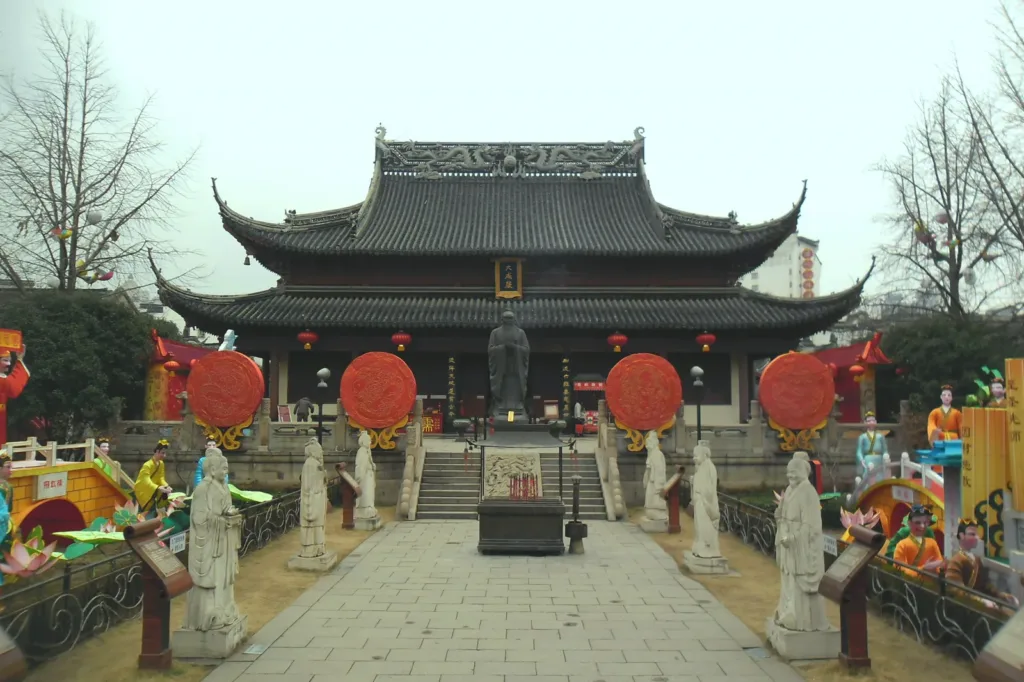
- 大成殿 Dacheng Hall is the main hall, 16.22 m high and 28.1 m wide on a raised terrace. Inside hangs the largest Confucius portrait in China, 6.5 m by 3.15 m; in front stands a bronze Confucius about 4.18 m tall, with twelve white marble disciples ranged along the steps. Look at the hall from the courtyard first — double eaves, bracket sets, glazed ridge — then walk up the central axis.
- Behind the hall, 明德堂 Mingde Hall keeps a plaque attributed to the Song official Wen Tianxiang, and 尊经阁 Zunjing Pavilion is the three-storey library and lecture building rebuilt in 1987; the lower floor has been used for lantern displays and the upper floors give a view over the roofs.
- The East and West Markets flanking the temple front are the old school passages turned into shopping lanes, rebuilt in the 1980s in a Ming–Qing street style.
- 江南贡院 Jiangnan Examination Hall / 中国科举博物馆 China Imperial Examination Museum, next door, preserves 明远楼 Mingyuan Tower, exam cells (号舍), 至公堂 and other remains at ground level, with a four-storey underground exhibition on the examination system in five sections and 33 galleries. If you have time for only one ticketed sight, choose between this and Dacheng Hall: they answer different questions — how the empire chose its officials, and what it worshipped.
A useful habit here: stand on 文德桥 Wende Bridge or at the north-bank balustrade and look at how the yellow roof of the hall, the low river wall, the screen wall on the far bank and the boats sit in one frame. Temple, river and market street layered together is the actual subject of this place.
Walking the precinct
This is not a walled attraction with a single gate. The temple faces the river, so most visitors arrive from the north — through the paifangs or from the metro — and walk south to the water.
A workable order: north paifang → 天下文枢 paifang and the balustrade → 棂星门 → 大成门 → 大成殿 → 明德堂 and 尊经阁 → back out to the river → 文德桥 → 乌衣巷 Wuyi Lane, a few dozen metres south-west, where the Eastern Jin statesmen Wang Dao and Xie An had their residences → east along 贡院街 Gongyuan Street to the examination museum → back to the riverbank in the evening for the lights and the boats.
The two ticketed sights sit at opposite ends of that line, so buy and enter them as you pass rather than doubling back. Toilets are inside the metro station, at the ends of the Line 3 and Line 5 platforms.
The registered addresses are worth keeping: Dacheng Hall is at 贡院街152号 and the examination museum at 贡院街95号, both on Gongyuan Street.
Tickets, hours and reservations
- The scenic area as a whole is free and open all day, all year; the individual sights inside it are ticketed and keep their own hours.
- Published prices: 大成殿 Dacheng Hall ¥30; 中国科举博物馆 江南贡院 China Imperial Examination Museum ¥50; 李香君故居 ¥16; outer-Qinhuai cruises ¥60 by day and ¥80 at night; combination tickets are listed at ¥70–150. These are the prices published by the Nanjing culture and tourism information centre; treat them as indicative and buy at the venue or through its own channels rather than trusting a resale listing.
- Published hours: Dacheng Hall 09:00–21:00, the examination museum 10:00–21:30. One widely copied source gives a 20:00 close for the temple, so confirm the closing time on the day if the hall is the main reason for your visit.
- Reservation. In peak windows — the Spring Festival and Lantern Festival, Qingming, Labour Day, National Day and the summer period from 20 July to 20 August — the core area admits visitors by free reservation only, daily 14:00–22:00. The core area is the ring bounded by the east, west and north paifangs, 文德桥 Wende Bridge, 文源桥 Wenyuan Bridge and 金陵路 Jinling Road. Book in the “南京夫子庙” mini-programme inside Alipay; one account can book five people at a time, and staff scan the code at one of six entrances on that boundary.
- The same peak windows bring traffic controls: private cars cannot enter the block bounded by 建康路 Jiankang Road, 中华路 Zhonghua Road, 长乐路 Changle Road and 平江府路 Pingjiangfu Road, and shared bikes cannot be picked up or left inside it.
- No reservation is needed by serving military personnel, people with disabilities, visitors aged 60 and over with ID, guests staying at hotels inside the core area who can show a booking, and residents or staff of the area; they use the green channel.
Getting there
Metro. 夫子庙站 (Fuzimiao), Line 3 and Line 5, stands at the junction of Pingjiangfu Road and Jiankang Road on the north-east side of the area. Exit 2, on the west side of Pingjiangfu Road, is the exit signed for the temple, the examination museum and the scenic belt; Exit 6, on the south side of Jiankang Road, is signed for the north paifang and the pedestrian street. 三山街站 (Sanshanjie), Line 1 and Line 5, is the other practical station, and 武定门站 (Wudingmen) on Line 3 serves the eastern end and 白鹭洲公园 Bailuzhou Park. The station opened with Line 3 on 1 April 2015 and became an interchange when Line 5 arrived on 6 August 2025.
From the railway stations. Line 3 runs through both 南京站 Nanjing Railway Station and 南京南站 Nanjing South Railway Station and stops at 夫子庙站, so either station reaches the temple on one line with no change.
Bus. 建康路·夫子庙, eastbound, is outside metro Exit 3, with routes 1, 4, 7, 40, 44, 202 and the night route Y1; 太平南路·夫子庙, southbound, is near Exit 1, with routes 1, 40 and Y1. The city’s culture and tourism listing also names 201, 4, 44 and 304 for 夫子庙 and 2, 26 and 202 for 中华路瞻园路. Read the board at the stop before boarding: Nanjing renumbers and reroutes city buses from time to time.
Shuttle loops. Three numbered shuttle lines link the outer car parks and the precinct during the control periods. G1 runs 光环花园城停车场 to 东牌楼·夫子庙, outbound 14:00–21:45 and returning 14:15–22:00; G2 loops the eastern side from 双桥门西, 14:00–22:00; G3 links 东牌楼·夫子庙 with 老门东 Laomendong, 14:00–21:45 and 14:15–22:00. They are ordinary city buses in operation — ¥2, electronic payment accepted, each leg under about 15 minutes — and ran free of charge from 15 to 23 February 2026.
Taxi and ride-hailing. During the control windows, cars cannot enter the block and stopping is barred on 中华路, 长乐路, 建康路, 平江府路 and 瞻园路 by electronic fence. Drivers use 13 designated stop-and-go points around the edge; the ones listed by the authorities include the west side of the 建康路夫子庙 bus stop on Jiankang Road, 金沙井 on both sides, and 平江府路琵琶街市民广场, though the last two are suspended during the control periods. Give the driver a Chinese point name rather than “Fuzimiao station”, and expect to walk the last few minutes.
Coach. Long-distance coaches are concentrated around Nanjing South Railway Station, where Line 3 starts its run north to 夫子庙站; the information on the scenic area’s own English site on this point dates from 2016, so check the coach station on your ticket before relying on it.
Practical notes
The lantern fair, 秦淮灯会, runs from the Spring Festival into early spring and is the busiest stretch of the year: on 18 February 2026 the area recorded 400,000 visitors in a day, and police impose one-way pedestrian flows when it saturates. The 2026 display was scheduled to run to 31 March. Outside those weeks the streets are merely busy, and mornings are calmer than evenings.
The river is the evening draw. Painted boats cruise the inner Qinhuai, and “夜泊秦淮” — mooring on the Qinhuai at night — is Nanjing’s classic water tour; the officially published fares are for the outer-Qinhuai cruise, while the inner-river boats sell tickets at the wharf, so check the fare and the return point where you board.
Surfaces in the courtyard, the streets and the riverfront are paved and level, but the halls stand on raised platforms reached by short flights of steps and surrounded by stone terraces, so getting into the buildings involves stairs. The metro station has a lift from street level at Exit 1.
The lanes around the temple — 贡院街 Gongyuan Street and the East and West Markets — are the city’s traditional snack quarter, which is why the area fills up at mealtimes as well as at dusk.
To continue, 瞻园 Zhan Garden lies west along 瞻园路, 老门东 Laomendong is a short shuttle or walk east, and 中华门 Zhonghua Gate is further south; return by metro from 夫子庙站 or 三山街站.
Combine your visit
A suggested sequence linking the specific features of this visit.
-
Confucius Temple precinct
Begin with the district’s scholarly and ceremonial identity.
-
Qinhuai riverfront
Compare the temple setting with the waterside urban landscape.
-
Surrounding pedestrian streets
Finish with the commercial district as a distinct part of the visit.
This order is editorial. Confirm access and any transfers between stops; it does not establish a walking route, same-day connection or common admission ticket.
Find Nanjing Fuzimiao
夫子庙 · 南京市
The pin marks the area, not the entrance.
More places nearby
Approximate straight-line distances between map pins, not travel distances.
City Wall of Nanjing 南京城墙
1 km awayNanjing’s Ming city wall follows the terrain in an irregular circuit shaped by hills and waterways. Surviving sections preserve the brick-clad earthwork and several different gate arrangements.
View guide →Nanjing Municipal Museum 南京市博物馆朝天宫
2 km awayNanjing Municipal Museum occupies Chaotian Palace, a compound transformed from a Daoist institution into Jiangning’s Confucian temple and school. The surviving main ensemble largely reflects reconstruction after the Taiping-era…
View guide →Presidential Palace (Nanjing) 南京总统府
3 km awayNanjing’s Presidential Palace is a layered political complex on Changjiang Road. It housed the office of the Republic of China’s president during the period when the government was based in Nanjing.
View guide →Sources & visit information
Sources checked on 22 October 2026. Hours, tickets, reservations and transport can change; confirm with the operator before you go.
- 南京夫子庙景区官方网站:景区介绍与历史沿革 ↗
- 南京市文化和旅游信息服务中心:夫子庙—秦淮风光带景区 ↗
- 南京市秦淮区人民政府:夫子庙展览馆大成殿 ↗
- 南京市秦淮区人民政府:南京中国科举博物馆江南贡院 ↗
- 关于实施夫子庙片区交通优化提升措施的通告(秦淮区人民政府、南京市公安局、南京市交通运输局,2026-02-04) ↗
- 新华网江苏:提前预约+免费接驳,去夫子庙的注意了 ↗
- 百度百科:夫子庙站(引南京地铁官网数据,2026年3月) ↗
- 维基百科:南京夫子庙 ↗
- 百度百科:南京夫子庙 ↗
- Wikipedia: Nanjing Fuzimiao ↗
- Wikipedia: Fuzimiao station ↗
- Wikipedia: Line 3 (Nanjing Metro) ↗
- TravelChinaGuide: Confucius Temple, Nanjing Fuzimiao ↗
- Nanjing Fuzimiao official English site: Transportation ↗
Image credits & notes (1)
- Dacheng Hall, the main hall of Nanjing Fuzimiao, with the bronze Confucius statue and the twelve marble disciples in the courtyard. Photo: 董辰兴 (Dong Chenxing)Photo: CC BY-SA 4.0