

Explore the region
Nanjing’s Ming city wall was never a rectangle. Laid out from the 1360s for Zhu Yuanzhang, who founded the Ming dynasty and made Nanjing his capital in 1368, the inner city wall took the Qinhuai river as its southern edge, the rocky hills around Shitou as its western one, Xuanwu Lake for the north and the flank of Purple Mountain (钟山) for the east. The finished circuit measured 35.267 km; about 25 km still stands, and roughly 22 km is open to visitors through some 25 wall entrances (登城口), 15 of them ticketed and 10 free.
Two things are worth knowing before you set out. The surviving wall is not one continuous walk — it is broken into separate stretches where gates, roads and demolition cut through it, so a sensible visit means picking one or two sections rather than attempting a full circuit. And the wall repays looking at closely: it is a brick-clad rammed-earth structure with stamped bricks you can actually read, and its gate designs change with the ground they were built on.
What you are looking at
Under the brick skin is earth. The builders piled and pounded a rammed-earth core and then faced it with bricks, which is why the wall can follow slopes and ridges without collapsing — “earth inside, brick outside”. Where the wall crosses high ground, as it does above the Qinhuai in the south and along Xuanwu Lake in the north, that core is doing real work.
Look at the bricks themselves. More than nine in ten of the wall’s bricks carry inscriptions: the kiln or county that produced them, the date, and the officials and workers responsible. The city’s wall management centre began a project in 2018 to photographically record and map every inscribed brick, because most of them are still set in the standing wall rather than in a museum case. On a walk you can usually find legible characters on the inner face of a parapet; short of time, the Nanjing City Wall Museum near Zhonghua Gate keeps reference bricks and explains the system.
The inner city originally had 13 gates. Four Ming-era gates survive in something close to their original fabric: Jubao Gate (聚宝门, renamed Zhonghua Gate in 1928), Shicheng Gate (石城门, also called Hanximen 汉西门), Shence Gate (神策门, now Hepingmen 和平门) and Qingliang Gate (清凉门). Everything else you pass is either a later opening in the same wall or a rebuilding: Jiqing Gate (集庆门) dates from 1991, Changgan Gate (长干门) from 2008, Biaoying Gate (标营门) from 2009, to give three examples. Distinguishing the Ming gate from the 20th-century gap is half the pleasure of walking the line.
The Zhonghua Gate section (south line)
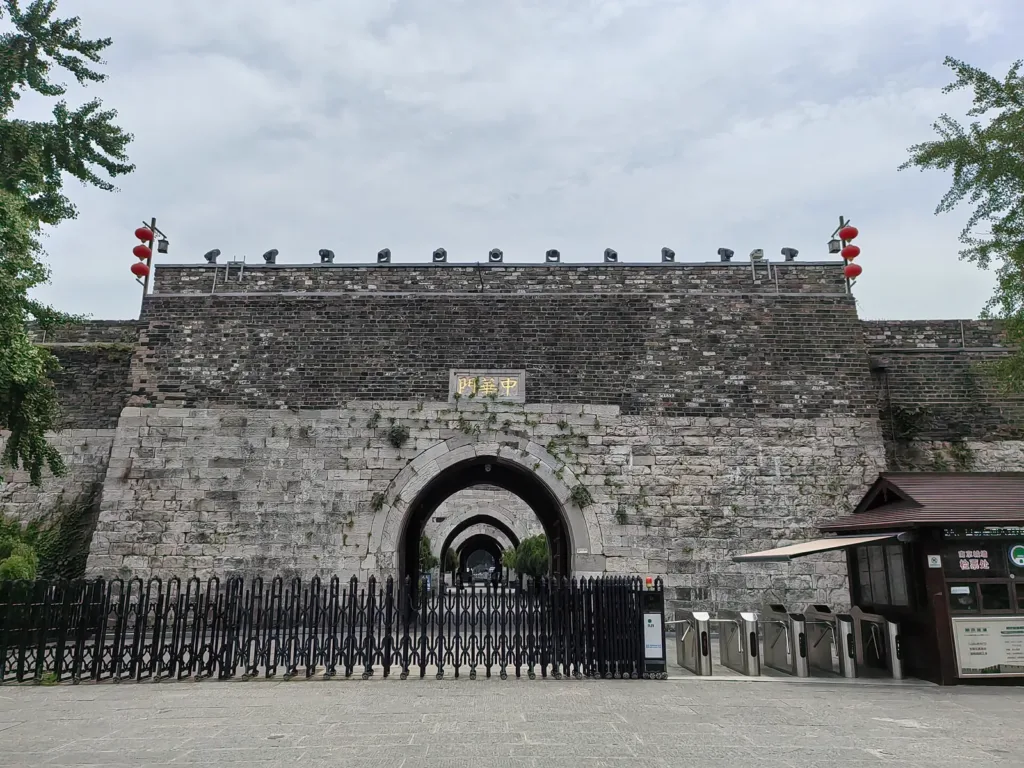
If you visit one place, make it Zhonghua Gate. It is the largest of the surviving gate complexes: 118.5 m east to west and 128 m north to south, covering 15,168 sq m, with a main archway and three more archways in a straight line and three enclosed courts (内瓮城) behind them. Laid out from above, the plan reads like the Chinese character 目 — a stack of closed spaces rather than a single doorway.
The design is the point. An attacker who got through the outer gate entered a courtyard that could be sealed: sluice gates (千斤闸) were kept raised in the gate towers above and could be dropped in seconds, while defenders shot and threw stones from the parapets and platforms above. Twenty-seven chambers (藏兵洞) were built into the platforms and beneath the horse ramps, enough to shelter a garrison and stores. Walk through and read it in sequence: outer archway, first court, second court, third court, then climb the horse ramp (马道) or the visitor stair built in the 1980s, and look back down the line of archways to see how the courts close behind each other. The gate’s timber tower was destroyed in December 1937 during the battle for Nanjing and has not been rebuilt, so the top is open sky above brick.
The ticketed south section runs about 6 km, from Dongshuiguan (东水关, where the inner Qinhuai enters the city) west past Wuding Gate, Yuhua Gate, the old Fuguilou platform, Zhonghua Gate, Changgan Gate and the Xigangchang lane to Jiqing Gate. Beyond the parapet you look down into the old city lanes of Laomendong on one side and over the outer Qinhuai and the Great Bao’en Temple site on the other.
The Taicheng section (north line)
The northern line runs along the outside of Xuanwu Lake and contains the wall’s most photographed views. It reopened along its full length on 26 August 2025, after a ten-month repair of the stretch between Jiefangmen and Xuanwu Gate.
- Shence Gate (神策门 / 和平门): unlike Zhonghua Gate, its one courtyard was built outside the gate line, and it is the best-preserved gate on the wall. It also has two features found nowhere else: the only pre-1949 gate tower still standing on the Nanjing wall — a late-Qing structure — and the only surviving iron-clad wooden gate leaf, made in the Republican period, which still carries a bullet strike from the fighting in December 1937. Bullet marks pock the inner face of the outer courtyard, and a small firing bunker was added against the wall.
- Xuanwu Gate (玄武门): not a Ming gate at all. It was cut through the wall in the early 20th century so that visitors to the Nanyang Exposition could reach Xuanwu Lake, was rebuilt with three archways in 1931, and gained its present gate-house in 1984; the wall above it was repaired and the gate-house recoloured in the 2024–2025 works.
- Jiefangmen (解放门) to Xuanwu Gate: 1,400 m of walkable rampart, averaging about 20 m above the outside ground, with the lake on one side, the roofs and pagoda of Jiming Temple below on the other and Purple Mountain behind. Inside the wall at this stretch is a small reading room, the Taicheng study (台城书房).
- Taiping Gate (太平门): the north-east exit of the line; the present gate is a 2014 reconstruction.
The north line has six entrances, north to south: Shence Gate, Xuanwu Gate, Dashugen, Jiefangmen, Linhu Hall (临湖厅) and Taiping Gate.
The east line and the free western stretches
East of the centre, a separate low-cost section runs along the Longbozi ridge and then from Zhongshan Gate (中山门) south to Guanghuadong Street, entered at Fuguishan, Zhongshan Gate, Biaoying Gate and Lanqi Street. It is quieter than the other two, with few facilities and long tree-lined straight runs.
The free stretches are in the west and north-west, where the wall climbs over the ridges instead of skirting a lake: Qingliang Gate to the National Defence Park (国防园), about 1.1 km above the cliffs of Shitou; Dinghuai Gate through Huayangang Gate and Yijiang Gate to Yifeng Gate, about 4.2 km; and Zhongfu Road to Central Gate (中央门), about 1.6 km. Two of the four surviving Ming gates belong to this part of the circuit. Qingliang Gate keeps a single archway and the remains of its courtyard on a hillside; at Shicheng Gate (Hanximen) two archways and part of the courtyard survive beside the Hanzhongmen plaza, with an interpretive sign in place.
Tickets, hours and opening days
- North line (Shence Gate to Taiping Gate): 30 CNY, concession 15 CNY.
- South line (Dongshuiguan to Jiqing Gate, including Zhonghua Gate): 50 CNY.
- East line (Longbozi; Zhongshan Gate to Guanghuadong Street): 5 CNY.
- Free: the western and north-western stretches listed above.
- Wall annual pass: 90 CNY, sold at the Xuanwu Gate, Jiefangmen and Zhonghua Gate ticket offices.
- Daytime opening: 8:30–17:00, tickets stop being sold at 17:00.
- Evening opening: Zhonghua Gate and Jiefangmen stay open in the evening — 17:00–22:00 from April to October with the last tickets at 21:30, and 17:00–21:00 from November to March with the last tickets at 20:30. The north line added an evening entrance at Xuanwu Gate in 2026.
- North-line visitor line: 025-83608359 on weekdays, 025-83217956 on holidays.
- Free-admission day: the Ming City Wall scenic area appears on the city’s 2026 list of government-guided-price attractions with a free-admission day of 13 June 2026.
- Nanjing City Wall Museum (南京城墙博物馆), beside Zhonghua Gate at 边营1号 (Bianying 1, Xinminfang Road, Qinhuai District): free; 9:00–17:00, last entry 16:00, closed Mondays; a national first-class museum, opened on 18 May 2022 as the successor to the earlier Ming city wall history museum on the Taicheng stretch.
Treat these as the operating framework, not a guarantee for your date. Sections close for conservation work — the 1,400 m Jiefangmen–Xuanwu Gate stretch was shut for ten months before reopening in August 2025 — and the wall’s own visitor page points readers to its WeChat account for daily changes. The museum has used real-name booking through the wall’s WeChat account since it opened, and the current reservation rule should be checked before you travel.
Getting there
Zhonghua Gate (中华门瓮城), south line. The north side of the gate is on 中华路; the south side faces 雨花路, between the inner and outer Qinhuai channels.
- Metro Line 1 to 中华门 Zhonghuamen: the station stands on the Zhongshan South Road viaduct at Yingtian Avenue, south of the gate rather than at it — allow more than ten minutes on foot.
- Metro Line 1 to 三山街 Sanshanjie, exit 4: this is the route the municipal culture bureau lists for the City Wall Museum, about 1.4 km on foot, and it suits a sequence of museum, Laomendong and then the gate from the north.
- Bus to the 中华门城堡 stop: routes 2, 16, 38, 202, 302, 701, 703 and 706.
- Taxi or ride-hailing: give the driver 中华门瓮城 or 中华门城堡; add 中华路 for the north entrance or 雨花路 for the south entrance.
- From Nanjing Railway Station (南京站) or Nanjing South Railway Station (南京南站), Line 1 runs directly to Zhonghuamen and Sanshanjie.
Shence Gate, Xuanwu Gate and Jiefangmen, north line.
- Jiefangmen: Metro Line 3 or Line 4 to 鸡鸣寺 Jimingsi, then walk north along 鸡鸣寺路 to the wall.
- Xuanwu Gate: Metro Line 1 to 玄武门 Xuanwumen; by bus, the 玄武湖公园 stop.
- Shence Gate (和平门): the gate sits at the south-east corner of the 中央门 interchange. Metro Line 1 or Line 3 to 南京站 (Nanjing Railway Station) puts you close by — the wall’s own guidance is that it is about ten minutes on foot from the Shence Gate courtyard to the station — and buses stop at 中央门东, also signed 和平门.
- Taiping Gate and Linhu Hall: bus to the 太平门 stop by Jiuhuashan Park; by taxi, 太平门 or 玄武湖公园 near the old naval review platform (古阅武台).
- For the return leg, leave at the opposite end of the stretch you walked — the Jiefangmen–Xuanwu Gate walk ends beside Xuanwumen metro station — or retrace your steps to the entrance you came in by.
East line. Buses stop at 明故宫 for Zhongshan Gate, 月牙湖 for Biaoying Gate and 蓝旗街东 for Lanqi Street; there is no metro station at these entrances, so plan on a bus or a taxi.
Free western stretches. For Qingliang Gate and the National Defence Park, buses 134, 21 and 502 stop at 国防园 and 134, 160, 21 and 560 at 虎踞路·清凉山; Metro Line 2 to 汉中门 Hanzhongmen, exit 2, is the listed metro option for Qingliangshan park, about 1.2 km on foot. The Shicheng Gate remains and the Hanzhongmen plaza area are best reached on foot from Hanzhongmen metro or by taxi to 汉中门广场. For the Dinghuai Gate–Yifeng Gate stretch, take a bus or taxi to 定淮门, 挹江门 or 仪凤门.
Practical notes
Every one of these entrances is reached by a flight of steps, and the top of the wall is brick-paved, uneven and often sloped, so wear shoes you can walk in rather than smooth soles. Much of the walk is exposed — the northern line has trees and the lake, but in July and August the heat on the rampart is the main thing you will remember — and after rain the brick surface turns slick. There are few services on the wall itself, so carry water.
Because the sections are separate, pair each one with what sits below it. Zhonghua Gate goes with the City Wall Museum, Laomendong and the Great Bao’en Temple site; Jiefangmen and Xuanwu Gate go with Xuanwu Lake, Jiming Temple and the Taicheng stretch; Shence Gate is a short walk from Nanjing Railway Station, which makes it a practical first or last stop of a trip.
Combine your visit
A suggested sequence linking the specific features of this visit.
-
Zhonghua Gate approach
Locate the gate in relation to the Qinhuai waterways.
-
Defensive courts
Read the successive enclosed spaces used to control entry.
-
Permitted rampart section
Compare the gate layout from the publicly accessible wall route.
This order is editorial. Confirm access and any transfers between stops; it does not establish a walking route, same-day connection or common admission ticket.
Find City Wall of Nanjing
南京城墙 · 南京市
The pin marks the area, not the entrance.
More places nearby
Approximate straight-line distances between map pins, not travel distances.
Nanjing Fuzimiao 夫子庙
1 km awayNanjing Fuzimiao centres on the Confucius Temple by the Qinhuai River. Its historical setting also includes institutions associated with education and the imperial examinations.
View guide →Nanjing Municipal Museum 南京市博物馆朝天宫
2 km awayNanjing Municipal Museum occupies Chaotian Palace, a compound transformed from a Daoist institution into Jiangning’s Confucian temple and school. The surviving main ensemble largely reflects reconstruction after the Taiping-era…
View guide →Presidential Palace (Nanjing) 南京总统府
4 km awayNanjing’s Presidential Palace is a layered political complex on Changjiang Road. It housed the office of the Republic of China’s president during the period when the government was based in Nanjing.
View guide →Sources & visit information
Sources checked on 22 October 2026. Hours, tickets, reservations and transport can change; confirm with the operator before you go.
- 南京明城墙 – 南京市文化和旅游信息服务中心 ↗
- 明城墙 – 南京市文化和旅游局 ↗
- 小课堂 | 天下第一瓮城——南京城墙中华门 – 南京市文化和旅游局 ↗
- 对市十七届人大一次会议第0058号建议的答复 – 南京市文化和旅游局 ↗
- 中国明清城墙申报世界文化遗产工作概况 – 南京市文化和旅游局 ↗
- 南京城墙博物馆 – 南京市文化和旅游局 ↗
- 南京城墙砖文信息采集项目 – 南京市文化和旅游局 ↗
- 环城健步·行走南京70里 – 南京市政府 ↗
- 市发展改革委关于公布2026年度南京市实行政府指导价管理景区免费开放日的通知 – 南京市发展和改革委员会 ↗
- 绝美视角回归 南京城墙北线完成修缮全线开放 – 人民网江苏(扬子晚报) ↗
- 南京官宣:免费!(城墙各线登城口交通一览) – 新华日报 via 光明网 ↗
- 南京城墙“最美1400米”,CityWalk走起 – 中国江苏网(来源:南京城墙) ↗
- 南京城墙 – 中文维基百科 ↗
- 中华门站 – 中文维基百科 ↗
- 南京城墙现存唯一铁皮大门:弹孔痕迹清晰可见 – 中国新闻网(扬子晚报、南京城墙保护管理中心) ↗
- 神策门公园 – 南京市花卉公园管理处 ↗
- Nanjing City Wall – China Discovery ↗
- 南京地铁1号线 – 中文维基百科 ↗
- 南京地铁3号线 – 中文维基百科 ↗
Image credits & notes (1)
- Zhonghua Gate seen from the north; the line of archways behind the first gate shows how the enclosed courts close one after another. Photo: YumetoPhoto: CC BY-SA 4.0