

Explore the region
City-card summary: A sea-facing hill in Qingdao’s Huangdao District, where excavations trace a Warring States ritual landscape and a monumental Qin platform later reused in the Han dynasty.
Langyatai is both a scenic hill and the name used for a much wider protected archaeological landscape. The protected site covers about 3.8 square kilometres in southern Huangdao, with the hill rising above the coast. Archaeology has identified an earlier Warring States landscape, a large Qin-period complex and later Han repairs and rebuilding; the modern scenic area is not the same thing as an open-air display of the entire site.
The most useful way to read the place is as a sequence of building phases, not simply as a monument attributed to one emperor. The “Small Terrace” preserves evidence of an earlier, large earthen platform associated by researchers with the Warring States period. The “Great Terrace” on the summit contains the monumental Qin-Han complex: a terraced rammed-earth platform, buildings and courtyards below, and a kiln area that supplied building materials. Han-period tiles and repairs show that the site continued to be used after the Qin.
Excavation reports give a sense of the engineering hidden in the hillside. Finds documented on the Great Terrace include hollow-brick steps, some with raised dragon patterns, and a drainage arrangement linking a perforated-brick inlet, joined ceramic pipes and a stone floor drain. These are archaeological features reported from excavated areas, not a promise that every trench or artefact is accessible on a visitor route. Follow the currently open route and barriers rather than entering work areas.
Visiting and access
The climb is part of the visit: the scenic area describes an uphill walk, so allow for sustained walking and do not plan it as a level waterfront stop. Start at the visitor entrance by the west gate, identified in the scenic area’s transport directions with the stop 琅琊台景区. The 2025 directions say buses 501 and 601 reach this stop and the west entrance. They also describe Line 13 of Qingdao Metro to Longwan (龙湾) station, followed by bus 501 or 710 toward the scenic area. No metro line runs directly to the entrance.
From central Qingdao, the same June 2025 directions list a longer public-transport chain: tunnel bus 6 or 8 to 灵山卫公交枢纽站, bus 306 to 西海岸汽车总站, then bus 501 to 琅琊台景区. For the return, go back to the scenic-area stop and take the west-coast-bound service; if using the central-city chain, reverse those connections. The notice does not give a timetable or last departure, so confirm the day’s service and return connection with the operator before setting out, especially before beginning the climb. No direct rail or passenger-boat connection to the visitor entrance was confirmed in the sources consulted.
A notice attributed to the scenic area and published on 5 June 2025 instructed visitors to reserve through the “青岛琅琊台景区” WeChat account and said all visitors needed real-name booking. That notice does not establish today’s opening hours, ticket price or current booking procedure. It also does not say whether the booking system accepts a foreign passport. Before travelling, call the scenic-area enquiry number published in the notice, 0532-87111111, to confirm current entry arrangements and how to book with your passport. Do not assume that an identity-card-only form will accept another document.
Combine your visit
A suggested sequence linking the specific features of this visit.
-
Langyatai Museum
Read the archaeological context before seeing the hill.
-
Platform hill
Relate the elevated setting to the documented Qin and Han complex.
-
Coastal outlook
Finish with the sea landscape that gives this imperial site its distinctive setting.
This order is editorial. Confirm access and any transfers between stops; it does not establish a walking route, same-day connection or common admission ticket.
Find Langyatai Platform
琅琊台 · 青岛市
The pin marks the area, not the entrance.
More places nearby
Approximate straight-line distances between map pins, not travel distances.
Wanpingkou 万平口
41 km awayWanpingkou is a long public beach landscape on Rizhao’s Yellow Sea coast, arranged around squares, planted areas and different stretches of sand. The main Ecological Square anchors the southern visitor area, while Zhulang Bridge…
View guide →Golden Beach (Qingdao) 黄岛金沙滩
45 km awayGolden Beach stretches in a broad crescent along the southern side of Huangdao’s Xuejiadao peninsula. Its fine yellow sand and open Yellow Sea setting give it a different character from the compact bathing beaches below…
View guide →Zhanqiao 栈桥
59 km awayZhanqiao projects from Qingdao’s old waterfront into the bay, turning a former landing pier into one of the city’s most recognisable public spaces. At the seaward end, Huilan Pavilion rises above a semicircular breakwater with…
View guide →Sources & visit information
Sources checked on 22 October 2026. Hours, tickets, reservations and transport can change; confirm with the operator before you go.
Image credits & notes (1)
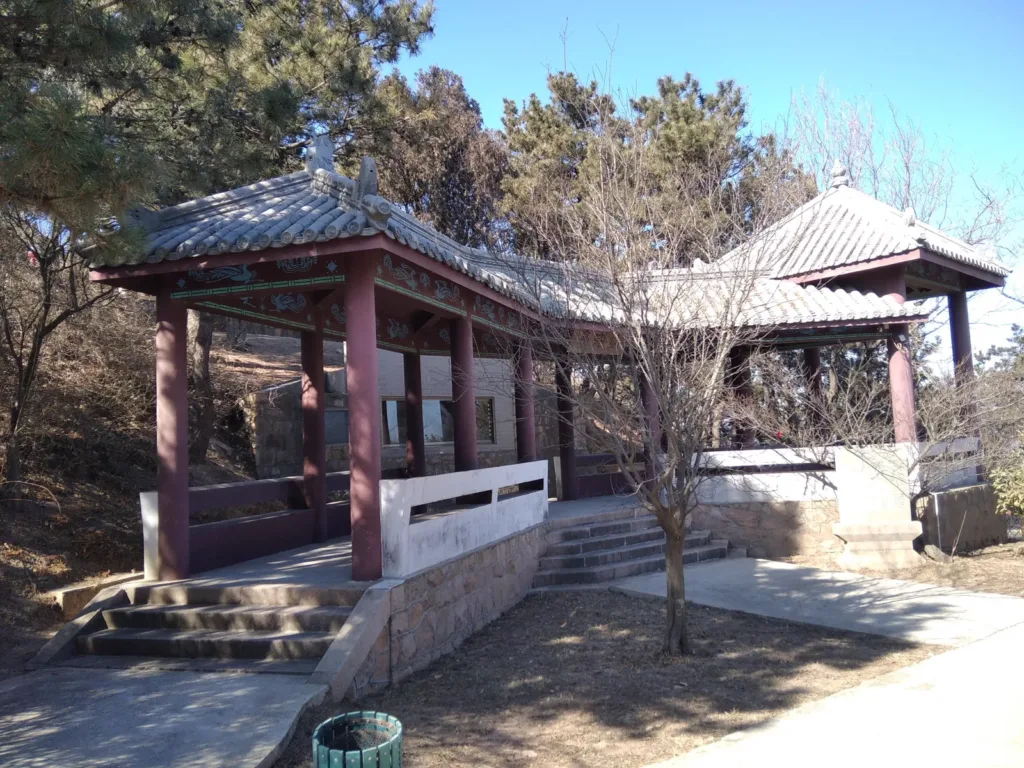
- The traditional-style Langya Pavilion among trees at Langyatai Scenic Area, photographed on 9 February 2025. This is a present-day scenic-area structure, not evidence of the ancient Qin platform. Photo: Sprt98Photo: CC BY-SA 4.0