

Explore the region
Tap any red Chinese text to hear it in Mandarin.
Guiyang is Guizhou’s hilly plateau capital: a city where the Nanming River, old scholarly towers, wooded urban hills and a serious breakfast culture meet. Its most distinctive visits move between riverside heritage, green parks and the wider municipal landscape rather than one compact old-town circuit.
A city of river, hills and everyday food
Guiyang sits on the eastern Yunnan–Guizhou Plateau and is the capital of Guizhou. The municipality includes six urban districts, three counties and Qingzhen, so “Guiyang” on a map covers much more than the central streets. The city’s character is easiest to read in the contrast between dense old-city lanes and hills that remain close to the built-up area. The official city profile gives an elevation of about 1,100 metres, an annual average temperature of 15°C and a summer average of 22.3°C—useful context for the city’s “cool summer” reputation, but not a promise of the weather on your dates.
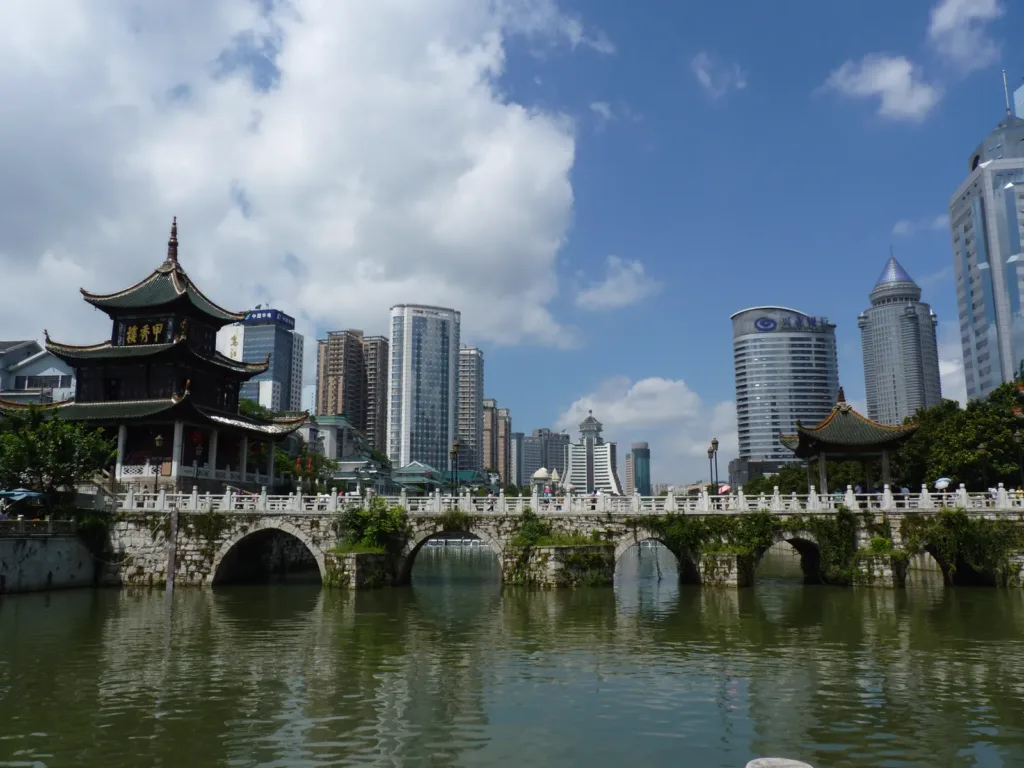
Begin in the Nanming River setting at Jiaxiu Tower (甲秀楼). The three-storey pavilion was first built in 1598, and the nearby Fuyu Bridge frames the water-and-architecture view that has come to symbolise Guiyang. The tower and bridge are best treated as a riverside cultural walk: look at the changing rooflines, the stonework and the relationship between the pavilion, bridge and water rather than expecting a large enclosed monument complex.
For a different city rhythm, set aside time for Qianling Park (黔灵山公园), where wooded slopes, Hongfu Temple, paths and a lake bring mountain scenery into the urban area. Huaxi Park (花溪公园) offers another kind of landscape, with hills, fields, paths and viewpoints arranged around a greener southern district. Qingyan Ancient Town (青岩古镇), also in Guiyang’s municipal area, is a stone-built historic town that began as a Ming-period military settlement; its gates, lanes and old buildings make it a separate outing, not an extension of a central walking route.
Guiyang is also a place to eat by dish rather than by restaurant name. Start with 肠旺面 (changwang noodles), whose noodles are served with pork intestine, blood curd and crisp pork bits in a rich, spicy broth. 贵阳糯米饭 Guì Yáng Nuò Mǐ Fàn is a compact sticky-rice breakfast made with assorted savoury toppings; the city government describes it as a traditional local breakfast, while the exact toppings vary and should be checked at the current listing. 丝娃娃 Sī Wá Wá is assembled at the table: wrap selected vegetable shreds in a soft rice wrapper and dip the roll into sour-spicy sauce. 花溪牛肉粉 Huā Xī Niú Ròu Fěn pairs resilient rice noodles with beef and a slow-cooked beef-bone broth; common components include braised beef, beef pieces and pickled cabbage. These dishes have different textures and ingredients, so ask about pork offal, blood curd, fish mint, beef and chilli if you have dietary, allergy or religious constraints.
To look for them without turning this guide into a shop list, copy the Chinese dish name into Meituan (美团) or Amap/Gaode Maps (高德地图) and search near where you are staying. Open more than one nearby result, inspect current menu photographs, read recent reviews for actual supply, check today’s opening information, and ask in Chinese whether the dish is available now. Platform order and “most authentic” claims are not endorsements; supply and opening hours can change.
How to plan the city
Group the central riverfront, Jiaxiu Tower and the older streets around them as one urban visit. Give Qianling Park its own park-and-temple block, and treat Huaxi, Qingyan and the museums in Guanshanhu as separate journeys. This avoids confusing municipal boundaries with walkable neighbourhoods. Wenchang Pavilion (文昌阁), another historic tower in the old city, is a useful additional stop when you want architecture and ordinary street life rather than a large scenic area. The city government’s current tourism guide gives Chinese addresses and named metro stops for several of these places; save the Chinese name and verify the route on the day.
Guiyang works in wet-weather and clear-weather modes. The plateau climate can make outdoor paths pleasant in summer, while rain changes the footing on hills and old stone streets. Carry a light rain layer and shoes with grip, and keep a museum or indoor cultural stop as a flexible alternative. No future festival, flower peak or seasonal performance is assumed here: check the venue or local government notice for your dates.
Getting there and getting around
- Air: Guiyang Longdongbao International Airport (贵阳龙洞堡国际机场) is the main air gateway. The airport operator currently lists Airport Bus Line 1 to Guiyang North Station and Jinyang Bus Station, Line 2 to Huaguoyuan, Line 3 via Guiyang East Station to Guiyang North, and Line 4 towards Huaxi and Qingyan. The same operator lists city buses including 216 between Guiyang Railway Station and the airport, 254 between Luoping and the airport via Huaxi Park, 275 between Guiyang East Station and the airport, and 258 towards Wudang. Check the operator’s live page for the service pattern, last departure and fare before travelling.
- Rail: Guiyang Railway Station (贵阳站), Guiyang North Station (贵阳北站) and Guiyang East Station (贵阳东站) are separate hubs. A 2026 Guiyang government overview places all three within the city’s high-speed-rail network, with major lines including the Guiyang–Guangzhou, Shanghai–Kunming, Chengdu–Guiyang and Chongqing–Guiyang corridors. Select the exact station printed on your ticket; “Guiyang” is not one interchangeable station.
- Metro and local connections: A published airport transport notice identifies Longdongbao Airport Station (龙洞堡机场站) on Metro Line 2 and the Line 1 interchange at Penshuichi (喷水池), but that notice is from 2021, so confirm the current first/last train and any station-access changes in Amap or the rail operator’s current notice. The municipal tourism guide currently identifies Line 3’s Qianling Park Station (黔灵山公园站) for Qianling Park and Line 1’s Provincial People’s Hospital Station (省医站) for Jiaxiu Tower; verify the destination entrance and return route rather than relying on a straight-line map pin.
- Outlying visits: Airport Bus Line 4 is a useful direct starting point for Huaxi and Qingyan, but Qingyan, Huaxi Park, Tianhetan and northern county attractions are not interchangeable central-city stops. Keep a return connection in view before leaving the centre. For any venue requiring an online reservation, confirm its current foreign-passport process directly with the venue; a domestic-ID booking flow should not be assumed to accept every passport.
Guiyang is worth more than a transfer night because the city’s identity is layered: a 1598 river pavilion, forested hills inside the urban fabric, stone-built history in the southern municipal area and breakfasts whose ingredients are recognisably local. The practical key is to choose one geographic cluster at a time, then let the food and weather decide how slowly you move.
Combine your visit
Suggested order for the visit:
-
Jiaxiu Tower riverfront
Begin with the Nanming River setting.
-
Qianling Mountain黔灵山
Make a separate park and temple outing.
-
Guizhou Provincial Museum贵州省博物馆
Reserve another visit for the provincial collections.
This is an editorial sequence of named spaces or places. It does not imply a verified walking connection or promise opening, ticket availability or a journey time.
Find Guiyang
贵阳 · 贵阳
The pin marks the area, not the entrance.
More places nearby
Approximate straight-line distances between map pins, not travel distances.
Guizhou Provincial Museum 贵州省博物馆
1 km awayGuizhou Provincial Museum’s main historical exhibition follows the province from prehistory through the Qing period. The collection includes bronze drums and an inscribed Ming bronze bell, objects that connect local material…
View guide →Guizhou Geological Museum 贵州地质博物馆
3 km awayGuizhou Geology Museum explains the province through fossils, karst landscapes and mineral resources. The entrance hall’s Guanling crinoid fossil slab is a useful first stop: its branching sea-lily forms reveal a marine world…
View guide →Qianling Mountain 黔灵山
7 km awayQianling Mountain brings wooded hills and a lake into the edge of central Guiyang. The winding Nine Turns route leads towards Hongfu Temple, whose decorated halls form the principal cultural stop. Higher paths offer views over…
View guide →Sources & visit information
Sources checked on 31 October 2026. Hours, tickets, reservations and transport can change; confirm with the operator before you go.
Image credits & notes (1)
- Jiaxiu Pavilion (Jiaxiu Tower) and Fuyu Bridge over the Nanming River, with Guiyang’s urban skyline behind. Photo: DWojtowiczPhoto: CC BY-SA 4.0