

Explore the region
Read the wall as a defensive system
The surviving wall is a near-rectangular circuit about 13.74 km long around Xi’an’s old urban core. Its present form was built in 1370–1378 under the Ming, extending and reusing earlier city defenses associated with the Sui and Tang imperial city and the Yuan-era Fengyuan city. The wall is part of the multi-city “City Walls of the Ming and Qing Dynasties” on China’s UNESCO World Heritage Tentative List; that is not the same as inscription on the World Heritage List.
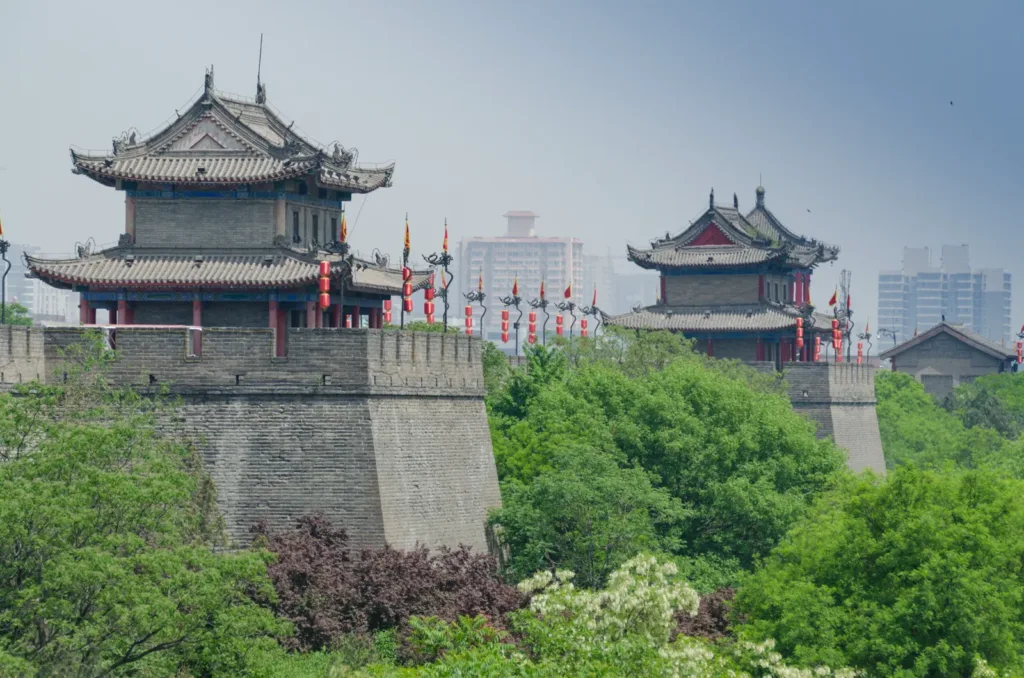
Look beyond the height of the brick face. The historic ensemble connects the rampart with an inner patrol corridor and the moat. At the gates, towers and enclosed gateway spaces made entry a sequence of controlled thresholds. The wall began as rammed earth; in 1568, blue bricks were laid on its top and outer face, and a major 1781 repair added or altered features including drainage and crenellations. These changes help explain why the fabric is layered rather than one untouched building phase.
How to explore
Yongning Gate (永宁门), the South Gate, is a strong starting point because its gate complex makes the defensive sequence easy to read. From outside, notice the moat-side approach and the successive gate structures; once on top, compare the broad rampart with the projecting platforms and crenellated parapet. Walk a short section in either direction and look back at the towers, then look inward and outward to see how the old enclosure meets present-day streets. The wall and its towers are the attraction; the broad circuit is not necessary to understand the main features.
Walking lets you pause at the masonry and views. If bicycle rental is operating on the day, it can help cover a longer stretch, but check the rental point’s return location and closing arrangements before setting out. Choose an exit in advance: the available gates and return arrangements may differ from the entrance you used. At ground level, a walk along the moat-side park gives another angle on the wall’s height and its relationship to the modern city.
Getting there
For Yongning Gate, take Metro Line 2 to Yongningmen (永宁门) Station. A visitor guide identifies exits A1 and D1; follow station signs toward the South Gate welcome avenue, then walk north along it to the South Gate’s south entrance. Allow about five minutes for this final approach.
Buses 12, 184, 193, 208, 221, 600 or 603 serve Nanmenli (南门里) Stop; walk south toward the South Gate’s north entrance. Buses 11, 12, 16, 184, 187, 193, 203, 204 or 208 serve Nanmenwai (南门外) Stop; walk north toward its south entrance. Routes and stop arrangements can change, so check the day’s service before boarding.
For a taxi or ride-hail, enter 西安城墙南门(永宁门),西安市碑林区南大街2号 as the destination. Continue on foot to the signed visitor entrance; use only a lawful curbside drop-off permitted by current traffic controls, rather than asking the driver to stop in a bus lane or on a pedestrian approach.
The official visitor site lists the South Gate as open 08:00–22:00. Entry is ticketed, but the current standard price and live booking conditions could not be confirmed from the accessible official ticket page; check the official site or contact the operator before visiting. Published hours do not guarantee access during a temporary closure or event.
Combine your visit
Suggested order within this visit:
-
Yongning Gate
Begin with the layered gate defences.
-
Adjacent wall-top section
Compare towers, projecting platforms and views into the city.
-
Moat-side park
Finish at ground level to see the wall’s outer face.
This sequence is an editorial suggestion based on the features described in the sources. Access to individual buildings or areas should be checked locally; no travel time or shared admission is implied.
Find Xi'an City Wall
西安城墙 · 碑林区
The pin marks the area, not the entrance.
More places nearby
Approximate straight-line distances between map pins, not travel distances.
Shuyuanmen Cultural Street 书院门
Less than 1 km awayShuyuanmen is an art-supplies and calligraphy street just inside Xi’an’s South Gate. Its name comes from Guanzhong Academy, established here in the Ming period. Today’s shopfronts largely reflect a modern rebuilding in…
View guide →Wolong Temple 卧龙禅寺
Less than 1 km awayWolong Temple is an active Chan Buddhist monastery in Xi’an’s Baishulin neighborhood. Its name recalls a monk known as the ‘reclining dragon,’ but the material interest lies in the temple courts and inscribed stone monuments…
View guide →Sources & visit information
Sources checked on 21 October 2026. Hours, tickets, reservations and transport can change; confirm with the operator before you go.
Image credits & notes (1)
- Xi’an City Wall’s tiled gate towers and brick ramparts. Photo: Xiquinho SilvaPhoto: CC BY 2.0