

Explore the region
What to notice, and how to explore
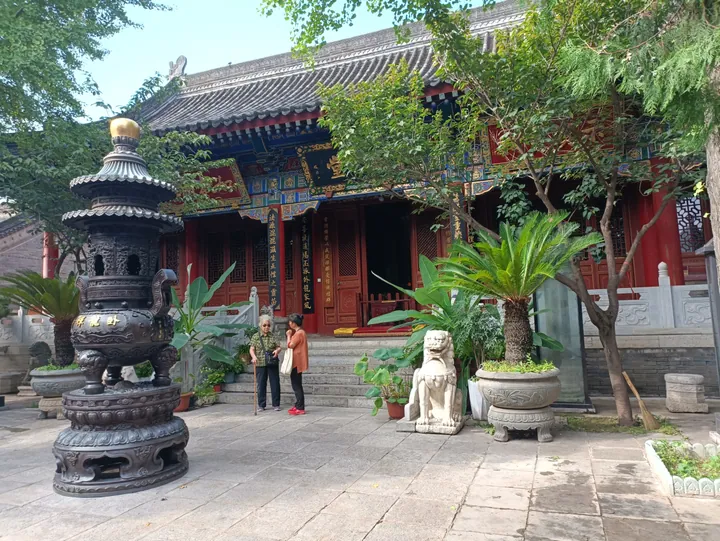
Wolong is an active Buddhist monastery, not a reconstructed theme attraction. The contrast is part of the visit: step in from the busy lanes around Baishulin and the temple’s courtyards become a place of worship and daily monastic life. The Shaanxi Buddhist Association identifies it as a nationally designated key monastery in the Han Buddhist tradition and a protected Shaanxi heritage site.
Begin at the public entrance and follow the visitor-accessible route through the courtyards. A 2025 local report describes the Maitreya Hall at the entrance, then the first court, where the Ksitigarbha and Guanyin halls stand to either side; farther in are the Heavenly Kings Hall, bell and drum towers, and the main Mahavira Hall. The report also describes a western courtyard with a large Chan meditation hall. These are active religious spaces, so access to buildings can vary; stay within areas open to visitors and do not enter monks’ residential quarters.
Look for the stone inscriptions and carved Buddhist imagery in the accessible areas. The Buddhist Association records a group of sixteen significant stone inscriptions from the Tang through Republican periods. A 2025 account describes a gallery of inscribed stones, including a stone image of Guanyin associated with the Tang painter Wu Daozi, and a Buddha-footprint stele. Some relics, including the monastery’s palm-leaf manuscripts, are not routinely displayed; do not expect every object mentioned in historical accounts to be on view.
Take time to notice the modest scale and layered character of the site: devotional halls, old trees, incense and the carved stones sit within a working monastery in the modern city. Keep voices low, dress respectfully, and follow signs or staff instructions about photography, worship and restricted areas. The quiet should not be mistaken for a performance scheduled for visitors.
Practical visit and arrival
The monastery’s published institutional address is Wolong Chan Monastery, 66 Kaitong West Lane (开通西巷66号), Baishulin Subdistrict, Beilin District, Xi’an. The Shaanxi Buddhist Association lists the monastery guest office at +86 29 8751 7573.
The monastery was open to visitors during a local newspaper’s 2025 visit, but I could not confirm a current standard daily timetable, admission rule or reservation policy from a current official visitor notice. Confirm before setting out with the monastery guest office, especially around services or holidays. Do not rely on older web listings for hours or free entry.
For public transport, take Xi’an Metro Line 4 to Hepingmen (和平门). No dependable source confirmed the best station exit, a direct bus stop at the monastery or a verified walking route, so this guide does not guess any of them. From Hepingmen, use a licensed taxi or ride-hail for the final leg, or ask station staff for current pedestrian directions before walking. For a direct car journey, show the driver 西安市碑林区开通西巷66号 卧龙禅寺. Use a lawful public-road drop-off and finish any lane approach on foot; do not assume cars may enter the monastery grounds.
Combine your visit
Suggested order within this visit:
-
Temple entrance and first court
Move from the surrounding lanes into the monastic setting.
-
Main worship hall
Visit the principal devotional space respectfully.
-
Stone monuments
Look for the inscriptions and carvings in accessible parts of the grounds.
This sequence is an editorial suggestion based on the features described in the sources. Access to individual buildings or areas should be checked locally; no travel time or shared admission is implied.
Find Wolong Temple
卧龙禅寺 · 碑林区
The pin marks the area, not the entrance.
More places nearby
Approximate straight-line distances between map pins, not travel distances.
Stele Forest 碑林博物馆
Less than 1 km awayThe Beilin Museum preserves stone texts and sculpture in the setting of Xi’an’s former Confucian temple. The Kaicheng Stone Classics turn canonical books into carved monuments, while later steles reveal the development of…
View guide →Shuyuanmen Cultural Street 书院门
Less than 1 km awayShuyuanmen is an art-supplies and calligraphy street just inside Xi’an’s South Gate. Its name comes from Guanzhong Academy, established here in the Ming period. Today’s shopfronts largely reflect a modern rebuilding in…
View guide →Xi'an City Wall 西安城墙
Less than 1 km awayXi’an’s city wall encloses the later imperial city in a near-rectangular circuit. Its main fabric dates from the Ming period, built partly on earlier city foundations. The interest is in the whole defensive system: projecting…
View guide →Sources & visit information
Sources checked on 21 October 2026. Hours, tickets, reservations and transport can change; confirm with the operator before you go.
Image credits & notes (1)
- The courtyard of 卧龙寺: a hall with red doors, painted blue-and-gold brackets and a grey tiled roof on a raised stone terrace, a huge tiered bronze incense burner with a gilt finial in the left foreground, a stone lion on a pedestal at the right, potted cycads and two visitors in the middle.Photo: Kcx36 · CC BY-SA 4.0Resized for the web; the photo itself has not been edited. Thumbnails may show a cropped view.
