

Explore the region
Tap any red Chinese text to hear it in Mandarin.
What to see and how to explore
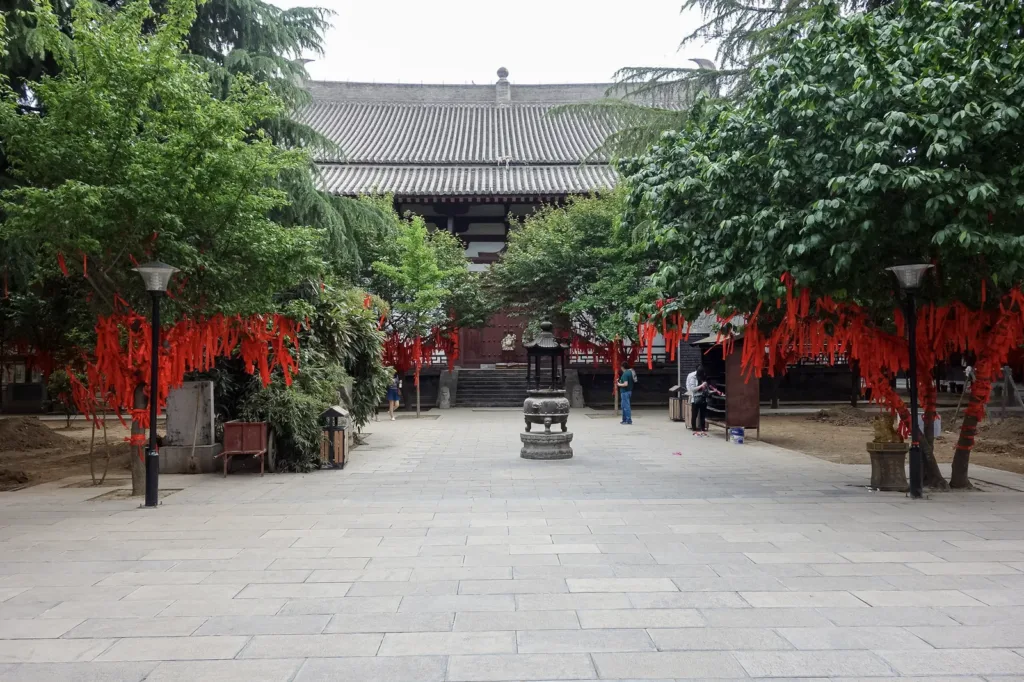
This is the Qinglong Temple ruins precinct in Yanta District, not simply a surviving, untouched Tang monastery. The temple was founded in the Sui period and flourished in the Tang. It is especially remembered as a place where Huiguo taught esoteric Buddhist teachings to Kūkai, who later founded Japan’s Shingon tradition. The present visitor grounds combine the archaeological heritage site with later museum, memorial and reconstructed buildings.
Start with the Qinglong Temple Ruins Museum (青龙寺遗址博物馆) for objects excavated at the site, including architectural pieces, images and ritual implements, alongside documentary material about Huiguo, Kūkai and medieval cultural exchange. Then follow the garden paths to take in the temple precinct and its memorial features; allow time to pause with the displays rather than treating the grounds as only a blossom garden. In spring, cherry trees frame the buildings and paths. Flowering dates and intensity vary, so blossoms are a seasonal bonus rather than a year-round sight.
Plan your visit
The site’s 2026 visitor notice lists the scenic grounds as open 08:30–18:00, with entry stopping at 17:00, and the museum as open 09:00–17:00, with entry stopping at 16:30. The same notice says the museum’s usual Monday closure was suspended from 12 March through 31 October 2026. These are published 2026 schedules, not a guarantee for later dates; check the official “西安市青龙寺遗址” account before travelling.
The notice’s timed, free online reservation requirement applied to the spring blossom period, 12 March–12 April 2026. That seasonal window has passed; a continuing standard reservation rule or regular ticket charge could not be confirmed from a current notice. Check the site’s official account for the date you plan to visit instead of relying on old blossom-season instructions.
Getting there
The visitor site is in Yanta District (雁塔区), at 西安市雁塔区西影路铁炉庙村北1号. It has east and north visitor gates.
- Metro: Xi’an Metro Line 3 or 5 to Qinglongsi (青龙寺); use Exit G and follow signs to the East Gate. The published directions place that gate 350 m north of the Xiying Road–Yanxiang Road junction. Alternatively, Line 5 to Yanxiang Road North (雁翔路北口), Exit B, then walk west to the North Gate, 150 m from the Yanxiang Road–Qinglong Road junction. No walking-time estimate is published.
- Bus: Routes 19, 25, 41, 45, 48, 118, 221, 237, 242, 400, 521, 525, 526, 606, 607 or 游6 serve Qinglongsi (青龙寺) or Tielumiao (铁炉庙); continue to the East Gate. Routes 31, 33, 252 or 612 serve Qinglong Beilu Dongkou (青龙北路东口) for the North Gate. Confirm the route is still operating on your travel day.
- Taxi or ride-hail: Enter 青龙寺遗址景区东门 (East Gate) or 青龙寺遗址景区北门 (North Gate) as the destination; the address is 西安市雁塔区西影路铁炉庙村北1号. Ask for a legal public-road drop-off near the named visitor gate, not a stop in the junction or inside the pedestrian grounds. The visitor notice identifies the gates but does not designate a taxi lay-by.
Combine your visit
Suggested order within this visit:
-
Temple buildings
Start with the Huiguo and Kūkai connection before exploring the grounds.
-
Cherry-tree garden
Continue through the planting surrounding the reconstructed monastery; flowering depends on the season.
This sequence is an editorial suggestion based on the features described in the sources. Access to individual buildings or areas should be checked locally; no travel time or shared admission is implied.
Find Qinglong Temple
青龙寺 · 雁塔区
The pin marks the area, not the entrance.
More places nearby
Approximate straight-line distances between map pins, not travel distances.
Xingqing Palace Park 兴庆宫公园
2 km awayXingqing Palace Park occupies part of the site of Emperor Xuanzong’s Tang palace, but its lake, pavilions and public-garden layout largely belong to the twentieth century and later. Chenxiang Pavilion and the lakeside buildings…
View guide →Giant Wild Goose Pagoda North Square 大雁塔北广场
3 km awayThe North Square frames the Giant Wild Goose Pagoda from outside the temple walls. A central water axis rises in terraces towards the tower, with garden areas and cultural walkways on either side. Its design uses the change in…
View guide →Tang Paradise 大唐芙蓉园
3 km awayTang Paradise is a modern interpretation of Tang court culture, opened in 2005 beside the historic Qujiang area. Furong Lake organizes a landscape of large halls, gardens and theatrical architecture. Ziyun Tower provides its…
View guide →Sources & visit information
Sources checked on 21 October 2026. Hours, tickets, reservations and transport can change; confirm with the operator before you go.
Image credits & notes (1)
- Temple hall and forecourt at Qinglong Temple, Xi’an. Photo: KQuhenPhoto: CC BY-SA 4.0