

Photo adjustments
Converted to WebP and resized without changing the subject or cropping the source frame.
Explore the region
About Tang Paradise
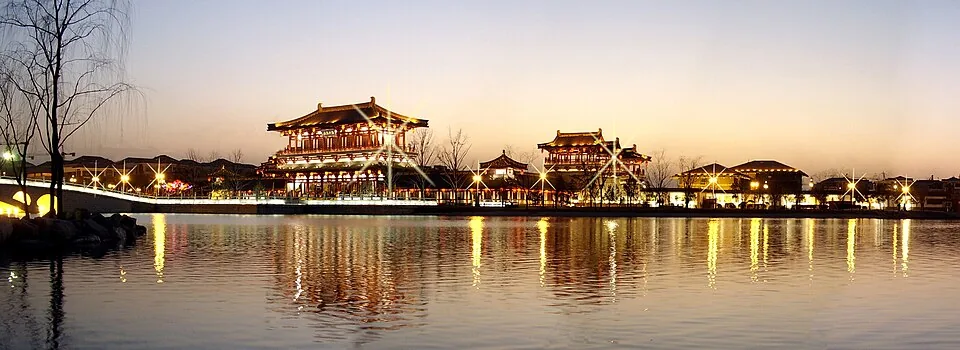
Furong Lake organizes a landscape of large halls, gardens and theatrical architecture. Ziyun Tower provides its monumental centerpiece, while the eastern Tang Poetry Gorge presents a more literary side of the theme. Treat the park as a contemporary cultural garden: its buildings evoke Tang forms but are not surviving imperial palaces.
In the Qin dynasty, the Qujiang area contained an imperial garden, Yichun Garden (宜春苑), and a detached palace, Yichun Xiayuan (宜春下苑). An account of the Furong name links it to Emperor Wen of Sui's (隋文帝) move into the new capital in 583: chancellor Gao Jiong (高颎) proposed naming the garden after the red lotus, or furong, flowers on the pool.
During the large-scale development of Qujiang New District by 2000, Chang'an Furong Garden (长安芙蓉园) was the initially proposed name. Datang Furong Garden (大唐芙蓉园) was ultimately chosen to emphasize Tang culture. The park covers an area of 1,000 mu (亩) in Yanta District's Qujiang New District, near the Giant Wild Goose Pagoda (大雁塔) and the historic Qujiang Pool (曲江池). Furong Lake (芙蓉湖), also called Qujiang North Lake (曲江北湖), accounts for 300 mu (亩) of the park's area.
What to look for
- Ziyun Tower and the broad lake-facing composition of halls and terraces.
- Tang Poetry Gorge and the sculptural features in the eastern part of the park.
Location & getting there
Getting to Tang Paradise
Head to Tang Paradise in Qujiang New District, southeast of the Giant Wild Goose Pagoda.
- Choose the park entrance before arranging your drop-off; the lake separates widely spaced attractions.
Combine your visit
Suggested order within this visit:
-
Ziyun Tower
Orient yourself at the park’s central architectural landmark.
-
Furong Lake shore
Follow the lake to see the buildings in their garden setting.
-
Tang Poetry Gorge
Finish with the eastern literary and sculptural features.
This sequence is an editorial suggestion based on the features described in the sources. Access to individual buildings or areas should be checked locally; no travel time or shared admission is implied.
Find Tang Paradise
大唐芙蓉园 · 雁塔区
The pin marks the area, not the entrance.
More places nearby
Approximate straight-line distances between map pins, not travel distances.
Tang Everbright City 大唐不夜城
Less than 1 km awayTang Everbright City is a modern pedestrian district extending south from the Giant Wild Goose Pagoda. Its Tang-inspired streetscape combines shops and cultural venues with a long outdoor sculpture sequence. Kaiyuan Square is…
View guide →Giant Wild Goose Pagoda 大雁塔
1 km awayThe Giant Wild Goose Pagoda stands inside Great Ci’en Temple, closely associated with Xuanzang’s translation of Buddhist scriptures brought from India. Its present seven-storey brick form reflects rebuilding and repairs after…
View guide →Giant Wild Goose Pagoda North Square 大雁塔北广场
1 km awayThe North Square frames the Giant Wild Goose Pagoda from outside the temple walls. A central water axis rises in terraces towards the tower, with garden areas and cultural walkways on either side. Its design uses the change in…
View guide →Sources & visit information
The linked encyclopedia sources support background and place descriptions. Current opening hours, ticket prices, booking rules and transport schedules have not been independently verified for this guide. Confirm them with the venue or operator before travelling.
Visitor information adapted and edited from Wikipedia contributors · CC BY-SA 4.0. Source revision 94116079.
Background paragraphs translated and condensed from Wikipedia contributors, "大唐芙蓉园", Chinese Wikipedia · CC BY-SA 4.0. Source revision 94116079.