

Explore the region
Tap any red Chinese text to hear it in Mandarin.
Caotang Temple stands in Caotang Subdistrict at the northern foot of Mount Guifeng, within Xi’an’s Huyi District—not at another temple or campus that happens to use the name “Caotang.” The monastery is associated with the early-fifth-century work of Kumārajīva, whose translation of Buddhist texts helped shape Chinese Buddhist literature. Its name recalls a thatch-roofed hall linked to this translation tradition.
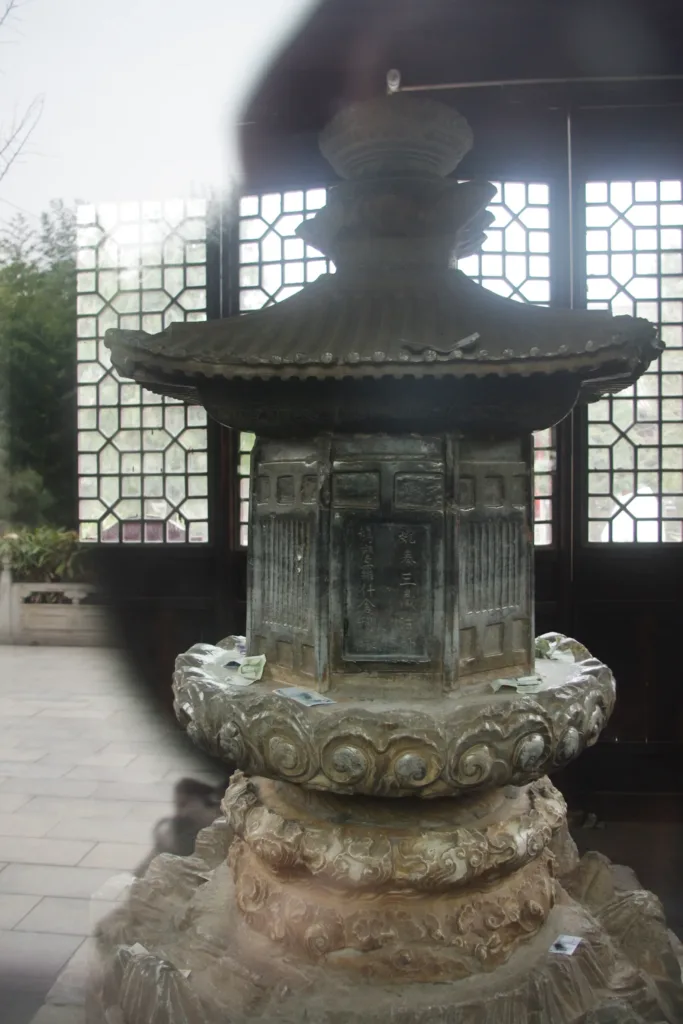
The most distinctive object is the small stone relic stupa dedicated to Kumārajīva. The Shaanxi local gazetteer describes it as a Tang-period work made from eight-colored marble and jade, with twelve tiers of carefully carved motifs. Look for the changes in stone color and for miniature architectural details—lotus forms, clouds, waves, doors and windows—rather than expecting a large tower. The stupa is a protected heritage object; viewing distance or access may be restricted to safeguard it.
Explore at a quiet pace. Enter through the visitor gate and follow the main sequence of temple halls and courtyards; then look for the stupa and the inscribed stele area, which connect the site’s later monastic history with Guifeng Zongmi, a Tang Buddhist teacher associated with the temple. Treat the halls as places of worship, not just photo settings. Keep voices low, avoid blocking worshippers, and ask before photographing people or any restricted interior. The accessible route and opening of individual buildings can change, so do not assume every hall or relic enclosure will be open.
The temple is at the foot of the Qinling foothills, beyond Xi’an’s central sightseeing area. One published route listing names a stop called Caotang Temple 草堂寺 on Huan Shan Tourism Bus Line 1, which runs from the North Square of the Giant Wild Goose Pagoda to Louguantai. To start from central Xi’an, take Metro Line 3 or 4 to Dayanta 大雁塔; Exit B or C leads to the North Square. Follow the plaza signs for the Huan Shan Tourism Line 1 stop and get off at Caotang Temple 草堂寺. The published bus listing does not establish a dependable current timetable or the precise walk from the stop to the gate; confirm the service and return departure locally before setting out, and identify the Xi’an-bound stop for the return.
For a taxi or ride-hail, enter 草堂寺 Cǎotáng Sì and the listed address 陕西省西安市鄠邑区草寺路与草寺东路交叉口 Shǎnxī Shěng Xī’ān Shì Hùyì Qū Cǎosì Lù yǔ Cǎosì Dōng Lù jiāochākǒu. Ask to be dropped only at a signed public visitor drop-off by the temple gate; the exact authorized curb was not confirmed in the sources checked, so do not ask a driver to stop in a traffic lane or enter a restricted area. No metro station serves the temple itself.
Current visitor listings identify the temple as open to visitors, but their hours conflict: Trip.com lists 09:00–17:00, while a local map listing shows 07:30–17:30. Trip.com says to consult the venue about admission charges. Check directly before travelling; neither a ticket price nor advance-booking rule could be confirmed from a current primary source.
Combine your visit
Suggested order within this visit:
-
Main worship halls
Establish the layout of the working temple.
-
Kumārajīva relic stupa
Examine the small monument’s carved stone construction.
-
Zongmi stele
Continue to the inscribed record of the temple’s Tang Buddhist connections.
This sequence is an editorial suggestion based on the features described in the sources. Access to individual buildings or areas should be checked locally; no travel time or shared admission is implied.
Find Caotang Temple
草堂寺 · 鄠邑区
The pin marks the area, not the entrance.
More places nearby
Approximate straight-line distances between map pins, not travel distances.
Shaanxi Archaeology Museum 陕西考古博物馆
16 km awayShaanxi Archaeology Museum explains how the province’s history is recovered, using excavations and conservation as the organizing thread. Finds such as the carved stone heads from Shimao and Shangguan Wan’er’s epitaph sit within…
View guide →Xiangji Temple 香积寺
18 km awayXiangji Temple in Chang’an District is associated with Shandao and the development of Pure Land Buddhism. The strongest historic landmark is Shandao Pagoda, an eleven-storey surviving brick tower in the western courtyard. The…
View guide →South Wutai Temple Area 南五台寺庙区
21 km awaySouth Wutai is a cluster of steep, temple-crowned heights on the Qinling’s northern edge. The five named terraces include Guanyin, Wenshu, Qingliang, Lingying and Sheshen. Lingying’s narrow rocky profile is especially…
View guide →Sources & visit information
Sources checked on 21 October 2026. Hours, tickets, reservations and transport can change; confirm with the operator before you go.
- Shaanxi Local Gazetteer Office, Shaanxi Ancient Pagodas ↗
- Encyclopedia of Buddhist Arts, Caotang Temple Kumarajiva Relic Stupa ↗
- Trip.com, Caotang Temple visitor listing ↗
- China Xi’an Tour, Getting to the Giant Wild Goose Pagoda North Square ↗
- Baidu Baike, Xi’an Huan Shan Tourism Bus Line 1 ↗
- 360 Maps, Caotang Temple listing ↗
- Wikipedia contributors, Caotang Temple ↗
Image credits & notes (1)
- The multicolored stone relic stupa dedicated to Kumārajīva at Caotang Temple. Photo: AcstarPhoto: CC BY-SA 4.0