

Explore the region
Why this bridge matters
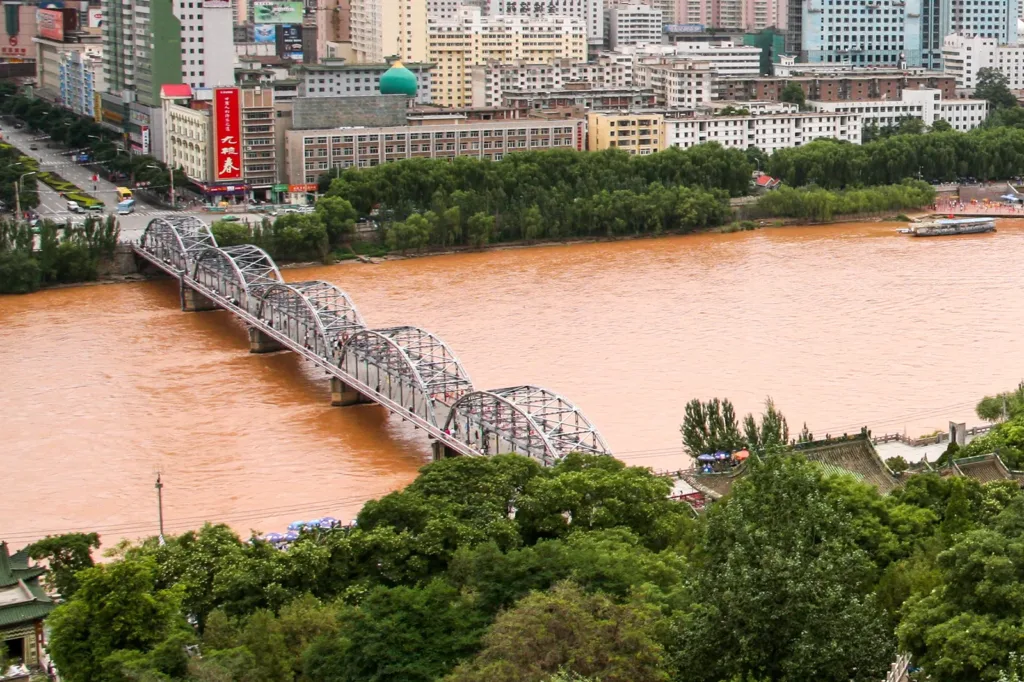
Zhongshan Bridge was completed in 1909, after Lanzhou had long relied on floating crossings over the Yellow River. The project used American bridge-design technology, German contracting, and Chinese construction labour. Its completion created a permanent bridge for the city and changed how the two banks were connected.
The bridge is a five-span steel truss, about 233.5 metres long and 8.36 metres wide. Look closely at the repeated lattice members and rivets, then compare them with the five curved strengthening arches above the deck. Those arches were added during a 1954 strengthening project, so the bridge reads as both an early twentieth-century steel structure and a later layer of engineering maintenance.
In 2006 it was listed as a National Key Cultural Relic Protection Unit. Motor vehicles were permanently stopped in 2013, and the bridge is now used as a pedestrian sightseeing bridge rather than as a road crossing. That change is central to the visit: the bridge is not just a viewpoint, but a protected piece of Lanzhou’s transport history that can still be crossed on foot.
How to look at it
Start on the south bank at the north side of the Zhongshan Road–Nanbinhe East Road junction. From the riverfront, take in the whole span against the northern hillside before crossing. On the deck, look through the steelwork at the Yellow River and the changing relationship between the narrow river valley, the city and Baita Mountain. The five arches are easiest to understand when you view them as a strengthening layer above the older truss, rather than as a separate bridge design.
The north end leads toward the Baita Mountain and Jincheng Pass area. Crossing the bridge does not itself mean that you have entered the mountain park, a museum, or another paid attraction; plan any hill ascent or separate venue visit under that venue’s own current arrangements. Stay on public paths and the bridge deck. Do not climb on the structure or treat the river edge and boats below as places to enter without an operator’s instruction.
The bridge can become very crowded during holiday peaks. A 2026 local report described crowd control by police, traffic officers and cultural-tourism volunteers at the bridgeheads and on both banks. Allow extra space for other pedestrians, especially when stopping to photograph the trusses.
Practical visit
The sources read for this article confirm the bridge’s pedestrian use but do not provide a current operator notice for ticketing, daily hours or temporary closures. Check local notices on the day of your visit, particularly if you are continuing to Baita Mountain or another nearby attraction. Do not assume that a boat seen below the bridge is a scheduled sightseeing transfer or a return service.
Getting there
Metro. Lanzhou Metro Line 1 serves Xiguan (西关) Station. From the station, continue toward Zhongshan Road and walk north toward Nanbinhe East Road and the south bridgehead. The metro operator’s current service page confirms the line and station, but does not publish a bridge-specific exit; check the exact exit and any temporary pedestrian routing in Amap after emerging.
Bus. The China Railway station guide for Lanzhou Station lists routes 6 and 9 passing through 中山桥. A visitor-information page also lists 中山桥站 on the south-bank approach and 白塔山公园站 on the north-bank side. Bus route pages can change, so confirm the stop, direction and same-day service before boarding rather than relying on every number in an older list.
Rail arrival and return. If you arrive at Lanzhou Station (兰州站), the 12306 station guide provides a direct station-to-中山桥 relationship for routes 6 and 9. For the return, use the stop and direction shown in the current local transit search back toward 兰州站. This guide does not establish a direct rail connection from every other Lanzhou station, so check the live route if you arrive elsewhere.
Taxi or ride-hailing. Give the driver the Chinese destination: “中山桥南桥头,兰州市城关区南滨河东路与中山路路口北侧.” The address identifies the bridge just north of that junction. If traffic controls prevent a vehicle from approaching the bridgehead, ask for a legal drop-off on the south-bank side and walk the final section.
There is no verified regular public water-transport connection in the sources used here. River craft may pass below the bridge, but they should not be treated as a transport link for reaching or leaving Zhongshan Bridge.
Combine your visit
A suggested order for the documented features and stops.
-
South-bank riverside
Read the bridge’s complete profile against the northern hillside.
-
Bridge crossing
Observe the metal structure and the river from within the span.
-
White Pagoda Mountain entrance area
Continue to the north-bank setting, with any hill ascent planned separately.
This is an editorial sequence. Check access and any road or boat transfers; it does not establish a walking route, common ticket or guaranteed same-day connection.
Find Zhongshan Bridge
中山桥 · 兰州
The pin marks the area, not the entrance.
More places nearby
Approximate straight-line distances between map pins, not travel distances.
White Pagoda Mountain 白塔山
Less than 1 km awayWhite Pagoda Mountain rises directly above the north bank of the Yellow River. Its white brick pagoda combines a rounded lower form with an octagonal, seven-tiered upper tower. Terraces and temple buildings climb the slope below…
View guide →Lanzhou Stele Forest 兰州碑林
Less than 1 km awayLanzhou Stele Forest presents calligraphy in a garden setting on the western side of White Pagoda Mountain. Caosheng Pavilion is its architectural centre, with carved versions of works associated with the Chunhua model-book…
View guide →Lanzhou Waterwheel Expo Park 兰州水车博览园
2 km awayLanzhou Waterwheel Expo Park explains how large wooden wheels lifted Yellow River water into irrigation channels. The riverside wheel line is the main visual feature, while other waterwheel forms broaden the comparison between…
View guide →Sources & visit information
Sources checked on 1 November 2026. Hours, tickets, reservations and transport can change; confirm with the operator before you go.
Image credits & notes (1)
- Zhongshan Bridge crossing the Yellow River, viewed from an elevated riverside viewpoint in Lanzhou; the full steel-truss span and the city approach are visible. Photo: WindmemoriesPhoto: CC BY-SA 4.0