

Explore the region
Why visit
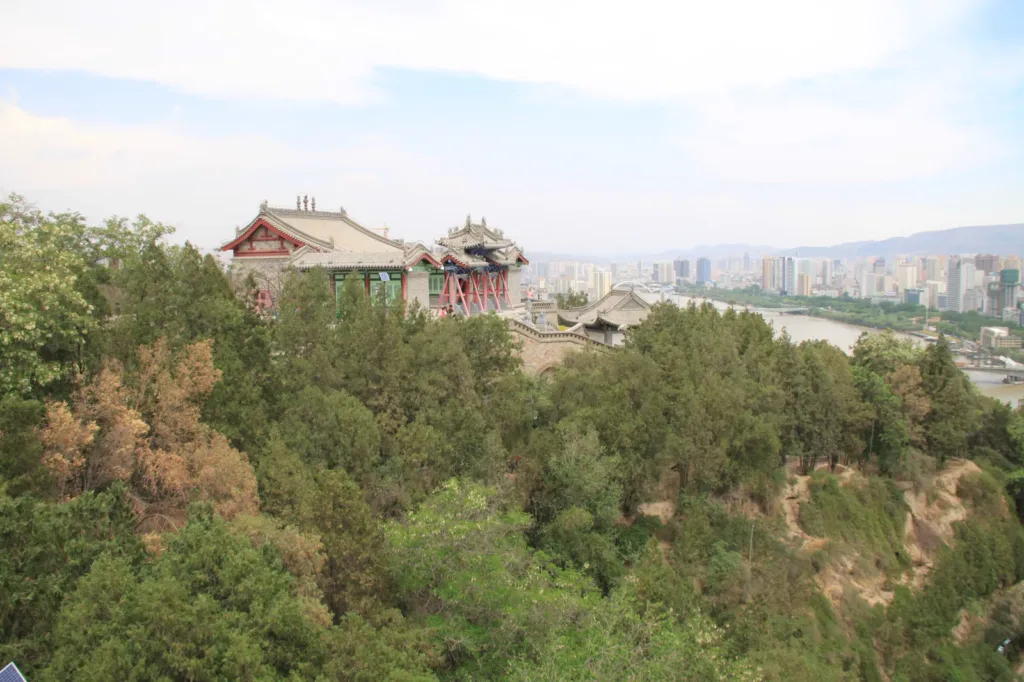
White Pagoda Mountain gives Lanzhou a particularly clear meeting point between river, bridge and hillside. From Zhongshan Bridge, the park rises in stepped terraces, so the view changes as you climb: the bridge becomes a line across the Yellow River, while the city opens out behind it. Local reporting describes the present white pagoda as a Ming-dynasty reconstruction on an older site, and places it within the park’s historic temple landscape.
The mountain is worth treating as a sequence of spaces rather than a quick photo stop. Begin with the bridge and the lower entrance, read the slope through its courtyards and pavilions, and decide at each rise whether to continue. The summit precinct is the visual focus, but the changing angles over the river are a large part of the visit.
What to look for
- The white pagoda and its court. Look closely at the tower’s compact white body and the way it sits above the layered buildings. A local account says that the pagoda court also displays three objects known locally as the “three treasures of the mountain”: an elephant-skin drum, a bronze bell and a Chinese scholar tree.
- The bridge–river–hill relationship. Pause on the lower terraces and look back toward Zhongshan Bridge before climbing farther. The bridge is not just an arrival landmark; it explains why this hillside has become one of Lanzhou’s most recognizable river views.
- Lanzhou Stele Forest. A branch from the mountain path leads toward the stele forest, whose reported displays include calligraphy associated with Zhang Zhi and inscriptions from different periods of Gansu’s history. Treat it as a separate venue and check its opening arrangements if it is part of your plan.
A practical visit
The principal visitor approach is the entrance at the north end of Zhongshan Bridge, on the north-bank side of the Yellow River. The address used by a current visitor listing is No. 1 Baitashan, Beibinhe Middle Road, Chengguan District; the entrance landmark is more useful than a broad map pin. Cross the bridge from the south-bank centre, enter the park, and climb only as far as you want. A current Trip.com listing suggests allowing about two to three hours, but the actual time depends on how many terraces and side paths are open.
Park admission is listed as free in the local guide and the current visitor listing. Published hours are not consistent: the 2023 local page lists 07:30–20:00, the 2024 guide lists 08:00–18:00, and the current Trip.com listing shows 07:00–20:00. Check the entrance notice on the day rather than treating any one of these times as a permanent schedule. The sources read for this guide do not establish a separate passport procedure for overseas visitors, or whether every temple room and exhibition space is open; ask at the entrance before relying on access to a particular building.
The Yellow River cableway and river cruises should be treated as separate services, not as part of the park admission. A 2026 municipal report describes White Pagoda Pier as one of the operating night-cruise piers and notes upgraded ticketing, but routes, departure times, seasonal operation and fares can change. The same report describes visitor-service facilities around the wider Zhongshan Bridge area, though this does not guarantee a particular service at the mountain entrance on your date.
Getting there
A 2024 Lanzhou local guide lists buses 20, 35, 53 and 131 for 白塔山公园站 (Baitashan Park stop), described as the stop for the park entrance. It also lists buses 9, 11, 15, 26, 34 and 136 for 黄河铁桥站 (Yellow River Iron Bridge stop); from there, walk across Zhongshan Bridge to the north-bank entrance. Keep the Chinese stop names because bus arrangements can change.
No directly applicable metro station was confirmed in the sources used for this guide. By taxi or ride-hailing car, use 白塔山公园(中山桥北端入口) as the destination and show 兰州市城关区北滨河中路白塔山1号; ask to be left at the visitor entrance on the north end of Zhongshan Bridge rather than at an approximate hillside pin.
White Pagoda Pier is beside the river at the foot of the mountain. If you choose a night cruise, confirm the same-day boarding pier, route, ticket, season and return arrangement with the operator; a cruise is an optional river experience, not a dependable substitute for the park’s pedestrian entrance.
Combine your visit
A suggested order for the documented features and stops.
-
Zhongshan Bridge中山桥
View the hill’s relationship with the river before entering the park.
-
Lower terraces
Follow the rising sequence of courts and viewpoints.
-
White Pagoda precinct
Examine the tower’s form from the accessible grounds.
This is an editorial sequence. Check access and any road or boat transfers; it does not establish a walking route, common ticket or guaranteed same-day connection.
Find White Pagoda Mountain
白塔山 · 兰州
The pin marks the area, not the entrance.
More places nearby
Approximate straight-line distances between map pins, not travel distances.
Zhongshan Bridge 中山桥
Less than 1 km awayZhongshan Bridge is a metal river crossing framed by the Yellow River below and White Pagoda Mountain beyond. Its latticework and curved strengthening arches distinguish it from the older floating bridges that once served this…
View guide →Lanzhou Stele Forest 兰州碑林
Less than 1 km awayLanzhou Stele Forest presents calligraphy in a garden setting on the western side of White Pagoda Mountain. Caosheng Pavilion is its architectural centre, with carved versions of works associated with the Chunhua model-book…
View guide →Lanzhou Waterwheel Expo Park 兰州水车博览园
2 km awayLanzhou Waterwheel Expo Park explains how large wooden wheels lifted Yellow River water into irrigation channels. The riverside wheel line is the main visual feature, while other waterwheel forms broaden the comparison between…
View guide →Sources & visit information
Sources checked on 1 November 2026. Hours, tickets, reservations and transport can change; confirm with the operator before you go.
Image credits & notes (1)
- White Pagoda Park on Lanzhou's north bank, with temple courtyards above the Yellow River and the city beyond (photographed 10 May 2013). Photo: Gary Todd (Gary Lee Todd)Photo: CC0 1.0