

Explore the region
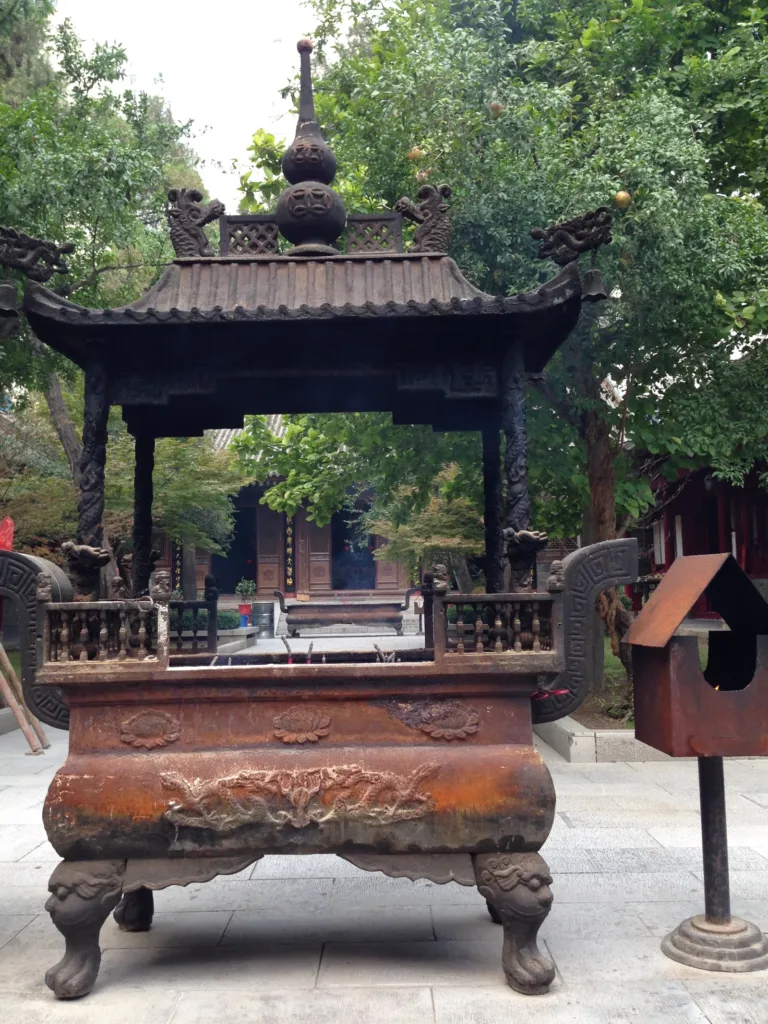
Wangji Temple is associated with the Tang imperial family. It was founded in 705 by Princess Taiping for her mother, Empress Wu Zetian. Its name comes from the Classic of Poetry phrase “昊天罔极,” expressing a child’s boundless gratitude to a parent. Rebuilding over many centuries means today’s buildings are a layered religious site, not a preserved Tang-period complex.
Enter, if visitor access is available, through the south-facing gate and follow the temple’s central sequence. The guardian hall, also called the Weituo Hall, leads toward the Mahavira Hall, where the principal images are Shakyamuni, Amitabha and Medicine Buddha. A Dharma Hall and bell and drum towers are also part of the compound. Notice the changing rooflines, carved details and stone inscriptions as you move through the small courtyard; access to particular halls can vary with worship and temple use.
The temple remains a place of worship. Keep voices low, do not interrupt prayers, and ask before photographing people or interior devotional activity. Do not enter rooms or courtyards marked as closed.
Getting there
The address is 49 Dongguan Paofang Street (东关炮房街49号), Beilin District. From Xi’an Metro Line 6, leave at Changlemen (长乐门) station, Exit D, and walk north toward Paofang Street to the temple’s south-facing gate; a 2026 local route guide gives a walk of about 5–8 minutes. Bus 139 is listed at Xinle Road–Changlefang intersection stop (新乐路长乐坊路口站), about 300 metres away; that stop information comes from a 2021 local guide, so confirm the stop and service before setting out.
For a taxi, enter “罔极寺,西安市碑林区东关炮房街49号” as the destination. Use a legal public-roadside drop-off near the south-facing gate; do not ask the driver to enter temple grounds or block residential access. The temple contact number published by the Shaanxi Buddhist Association is +86 29 8365 1571.
Current walk-in access, visiting hours, admission and reservation rules could not be confirmed from a current temple notice. Call ahead before making a dedicated visit; published third-party hours differ.
Combine your visit
Suggested order within this visit:
-
Paofang Street entrance
Locate the temple within the old East Gate neighborhood.
-
Main hall sequence
Follow the small temple axis through its accessible worship areas.
-
Stone animals
Examine the surviving carvings without disturbing worship.
This sequence is an editorial suggestion based on the features described in the sources. Access to individual buildings or areas should be checked locally; no travel time or shared admission is implied.
Find Wangji Temple
罔极寺 · 碑林区
The pin marks the area, not the entrance.
More places nearby
Approximate straight-line distances between map pins, not travel distances.
Eight Immortals Palace 八仙宫
Less than 1 km awayEight Immortals Palace is a working Daoist temple outside Xi’an’s East Gate. Its three principal courtyards lead from the Lingguan guardian hall to the Eight Immortals Hall and Doumu Hall. Brick archways, inscribed steles and…
View guide →Yongxingfang Food and Culture Quarter 永兴坊
Less than 1 km awayYongxingfang is a modern food-and-culture quarter inside Zhongshan Gate, designed to introduce traditions from across Shaanxi in a compact space. Its Guanzhong, northern Shaanxi and southern Shaanxi lanes make regional…
View guide →Xi'an Incident Memorial Museum · Zhang Xueliang Residence 西安事变纪念馆·张学良公馆
Less than 1 km awayThis branch of the Xi’an Incident Memorial occupies Zhang Xueliang’s former residence on Jianguo Road. Three parallel, three-storey buildings preserve the layout of a 1930s compound that became a center of negotiations during…
View guide →Sources & visit information
Sources checked on 21 October 2026. Hours, tickets, reservations and transport can change; confirm with the operator before you go.
Image credits & notes (1)
- A courtyard incense burner with a temple hall behind it at Wangji Temple. Photo: WolfgangMichelPhoto: CC0 1.0