

Explore the region
Xi’an City God Temple (西安都城隍庙) is the city’s historic Taoist shrine to its guardian deity, in Lianhu District. It is a specific temple complex, not a generic name for the nearby Muslim Quarter or other City God temples. The shrine was founded in 1387 and moved from the eastern city gate to West Avenue in 1433. The historic complex is listed among China’s National Key Cultural Relics Protection Units.
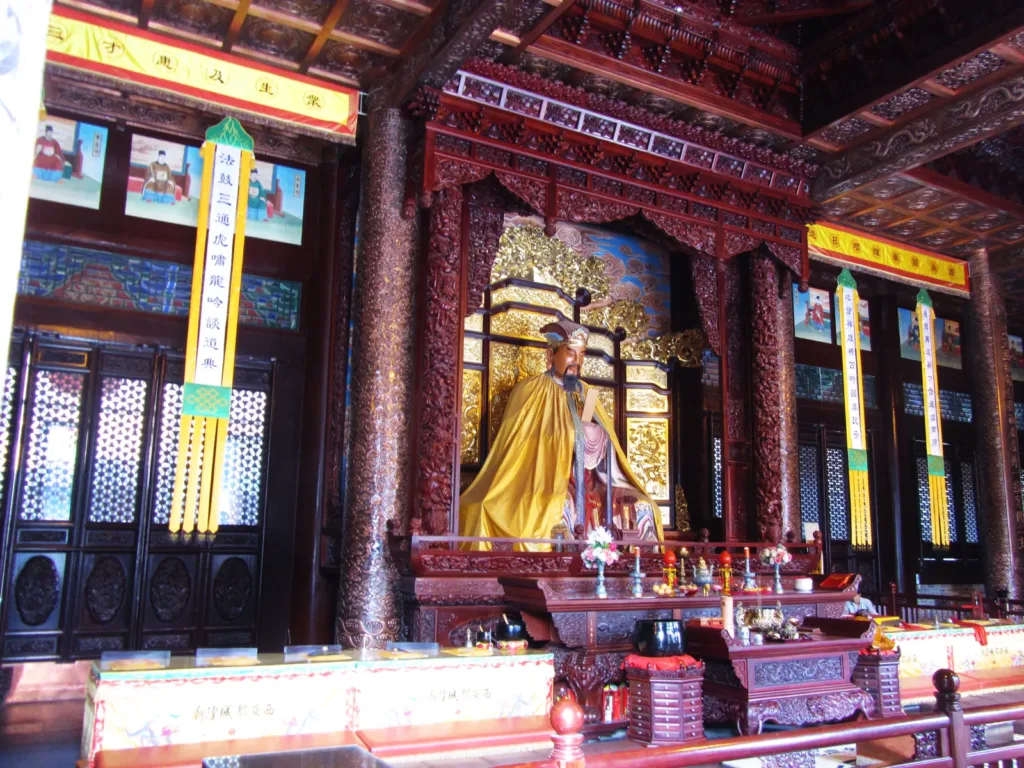
The temple is most rewarding as a small architectural sequence. Enter from West Avenue and follow the public courtyard axis toward the principal hall. Look back at the entrance structures, then compare the rooflines of the opera-and-music stage and the main hall across the courtyard. The main hall was rebuilt in the Qing period in 1723; it is five bays wide and three deep, with a single-eaved hipped roof. The stage, rebuilt in 1887, has a more elaborate double-eaved hip-and-gable roof. Timber brackets, carved and painted details, and the changing roof silhouettes are the details to notice at close range.
The shrine venerates Ji Xin (纪信), a Han general remembered in local tradition as having given his life to protect Liu Bang. If worshippers are present, leave their route clear, keep your voice low, and ask before photographing people or a ceremony. The historical complex includes more than the buildings that may be open to visitors; follow current on-site instructions rather than assuming every hall or side room can be entered.
Visiting and getting there
The address is No. 129 West Avenue (西大街129号), on the east side of Daxuexi Lane (大学习巷) in Lianhu District. A current Trip.com attraction listing displays free admission and hours of 08:30–17:30, with last entry at 17:00. These are third-party listing details, not a venue-confirmed guarantee; check locally before setting out, especially for access to the inner halls.
Take Metro Line 6 to Guangjijie (广济街) station and use Exit A1 for the West Avenue area. From street level, follow West Avenue toward Daxuexi Lane and the signed temple gateway; the temple is just west of the Guangjijie intersection. Exit numbering and station works can change, so follow station signs if A1 is closed. No bus route is listed here because a current operator source for a specific route and stop was not confirmed.
For a taxi or ride-hail, enter 西安都城隍庙(西安市莲湖区西大街129号,大学习巷东侧). Use only a legal curbside set-down on West Avenue where signs permit, then walk to the signed street-front entrance; do not ask a driver to stop in a restricted lane or at a guessed gate.
Photograph by 猫猫的日记本 (Cat’s diary), unchanged, CC BY-SA 3.0.
Combine your visit
Suggested order within this visit:
-
West Avenue archway
Begin with the transition from the street into the temple.
-
Performance stage
View the roof and its relationship to the ceremonial courtyard.
-
Main hall
Finish at the principal City God shrine and Qing-period architecture.
This sequence is an editorial suggestion based on the features described in the sources. Access to individual buildings or areas should be checked locally; no travel time or shared admission is implied.
Find Xi’an City God Temple
西安都城隍庙 · 莲湖区
The pin marks the area, not the entrance.
More places nearby
Approximate straight-line distances between map pins, not travel distances.
Great Mosque of Xi'an 西安清真大寺
Less than 1 km awayXi’an’s Great Mosque unfolds through courtyards along an east–west axis in Huajue Alley. Its main surviving layout is Ming and Qing, using timber halls, gateways and pavilions while orienting worship towards the west. Chinese…
View guide →Drum Tower of Xi'an 西安鼓楼
Less than 1 km awayXi’an’s Drum Tower stands west of the Bell Tower at the edge of the Beiyuanmen quarter. Built in the Ming period, it combines a massive brick platform with a timber upper structure and layered roofs. The modern set of solar-term…
View guide →Muslim Quarter 回民街
Less than 1 km awayXi’an’s Hui neighbourhood is a network of residential and commercial lanes northwest of the Bell Tower, rather than a single food street. Beiyuanmen is its best-known visitor approach, with other streets such as Xiyangshi and…
View guide →Sources & visit information
Sources checked on 21 October 2026. Hours, tickets, reservations and transport can change; confirm with the operator before you go.
Image credits & notes (1)
- Interior of the principal hall, showing the carved altar screen and painted timberwork. Photo: 猫猫的日记本 (Cat’s diary)Photo: CC BY-SA 3.0