

Explore the region
Explore the lanes, not just the main street
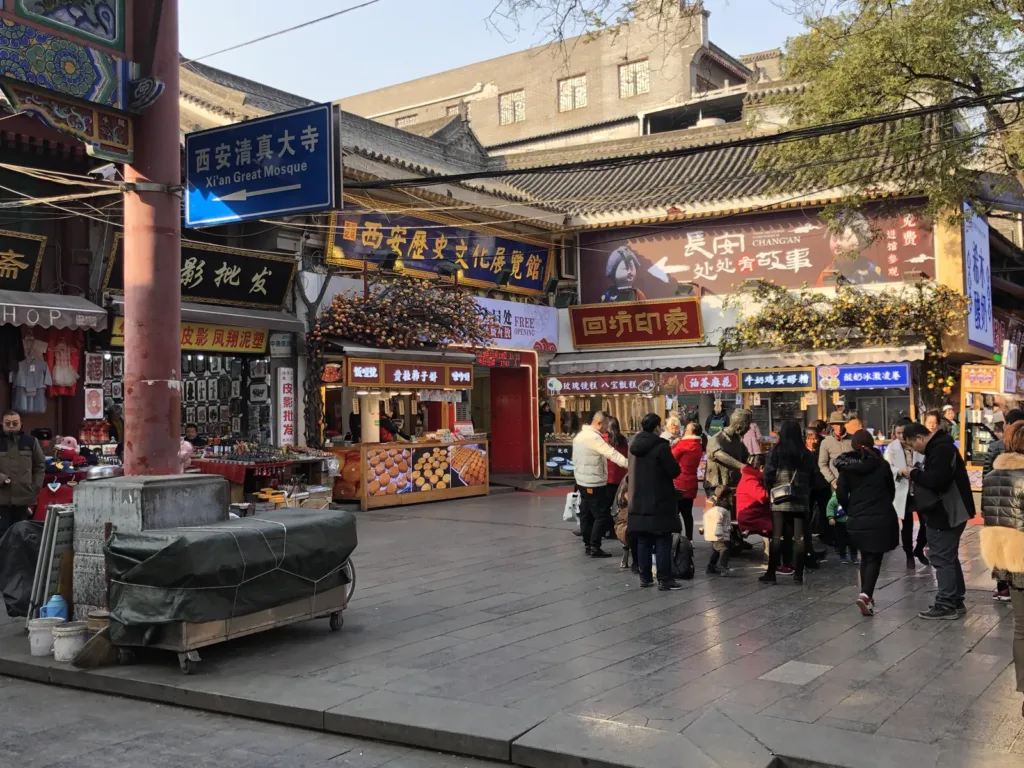
“Muslim Quarter” (回民街, Huímín Jiē) is a convenient visitor name for a connected neighbourhood, not one gated attraction or a single street. Beiyuanmen (北院门) is the best-known approach just north of the Drum Tower. From there, wander into Xiyangshi (西羊市) and Dapiyuan (大皮院), then follow the smaller lanes toward Huajue Lane (化觉巷). The main food street is lively and commercial; a few turns away, the street scale becomes quieter and more residential. Treat the neighbourhood as a place where people live and worship, not a themed set.
The Great Mosque of Xi’an (西安清真大寺) is a separate religious compound reached from Huajue Lane, not a synonym for the whole quarter. If it is open to visitors, take time to notice how Chinese courtyard planning, timber halls, layered eaves and blue-green glazed roof details shape the complex. The courtyards provide a marked change of pace from the crowded food streets. A Ministry of Culture and Tourism account of an Italian visitor group describes walking from the busy lanes to the mosque and points out its layered brackets and blue-glazed roof. Respect prayer and worshippers: dress modestly, keep voices low, and ask before photographing people. Visitor access, admission and opening times for the mosque are separate from access to the public streets and should be checked locally.
Taste the neighbourhood
Food is a major reason to linger, but menus and recipes vary from shop to shop. For yangrou paomo (羊肉泡馍), diners commonly crumble a firm wheat flatbread into a bowl and hand it back to the kitchen, where hot lamb broth and tender meat are added. The bread softens while retaining some chew; the broth is savoury and aromatic. A national intangible-heritage record for the Tongshengxiang tradition describes careful selection of ingredients, cooking meat, simmering broth, seasoning and soaking the bread, and characterizes the result as rich, fragrant, tender and springy.
Other street-side choices include roujiamo (肉夹馍), a baked wheat bun filled with chopped braised beef; liangpi (凉皮), cool slippery starch noodles dressed with chilli oil and other shop-specific seasonings; and jinggao (甑糕), sticky steamed glutinous rice layered with dates for a dense, sweet finish. Roasted meat skewers offer a savoury alternative. Persimmon pastries and osmanthus-scented sweets bring a fragrant, softer contrast. These are examples to look for rather than a fixed neighbourhood menu; ingredients and methods differ among vendors.
A useful way to eat is to share small portions, watch how a dish is assembled, and ask what is in it before ordering. Hui foodways are part of the living culture here, not a guarantee that every business or recipe is the same. If you want halal food, check the individual vendor’s current sign and preparation practice rather than assuming from the street name alone.
Arrival
For the Beiyuanmen entrance, take Xi’an Metro Line 2 or Line 6 to Zhonglou (钟楼, Bell Tower) Station. Exit at B and walk west toward the Drum Tower; enter the quarter from the pedestrian approach immediately north of the tower. The published route takes about six minutes from the exit, but allow extra time in crowds.
Useful buses include routes 15, 32, 43, 45, 201, 215, 218, 221, 222, 251, 252, 286, 300, 604, 611, 618 and 622 to Bell Tower West (钟楼西) stop; from there walk around the Drum Tower and enter Beiyuanmen to its north. For the north end, a 2025 local traffic guide also lists routes 32, 102, 182, 601 and 236 to Xihuamen (西华门), followed by a westward walk to the north entrance; it lists routes 4, 15, 43, 45, 201, 215, 221, 222, 252, 286, 300, 604, 611 and 622 to Guangji Street (广济街), from which the quarter is north. Bus services can change, so use the stop names and route numbers as the planning reference rather than relying on a schedule here.
For a taxi or ride-hail, set the Chinese destination as 西安鼓楼(西安市莲湖区北院门74号). The Beiyuanmen pedestrian entrance is immediately north of the Drum Tower; do not ask a driver to enter the pedestrian lane. A local May 2025 traffic plan named temporary ride-hail stops on Xihuamen Street near Shaanxi Provincial Hospital and west of the Xihuamen–Beidajie intersection, but that holiday arrangement is not confirmation of a currently operating everyday pickup point. Follow live traffic controls and alight only at a lawful curb; the current routine designated curb has not been confirmed.
The quarter itself is a public street district rather than a ticketed enclosure. Shops and food stalls keep their own hours and are not guaranteed to be open at any particular time; the Great Mosque and other individual venues have separate access arrangements.
Combine your visit
Suggested order within this visit:
-
Drum Tower and Beiyuanmen
Begin at the neighbourhood’s most legible southern approach.
-
Xiyangshi
Continue through the connected food and commercial streets.
-
Great Mosque西安清真大寺
Finish with the quieter religious courtyard complex when visitor access permits.
This sequence is an editorial suggestion based on the features described in the sources. Access to individual buildings or areas should be checked locally; no travel time or shared admission is implied.
Find Muslim Quarter
回民街 · 莲湖区
The pin marks the area, not the entrance.
More places nearby
Approximate straight-line distances between map pins, not travel distances.
Great Mosque of Xi'an 西安清真大寺
Less than 1 km awayXi’an’s Great Mosque unfolds through courtyards along an east–west axis in Huajue Alley. Its main surviving layout is Ming and Qing, using timber halls, gateways and pavilions while orienting worship towards the west. Chinese…
View guide →Drum Tower of Xi'an 西安鼓楼
Less than 1 km awayXi’an’s Drum Tower stands west of the Bell Tower at the edge of the Beiyuanmen quarter. Built in the Ming period, it combines a massive brick platform with a timber upper structure and layered roofs. The modern set of solar-term…
View guide →Sources & visit information
Sources checked on 21 October 2026. Hours, tickets, reservations and transport can change; confirm with the operator before you go.
Image credits & notes (1)
- Entrance area of Xi’an Muslim Quarter, with a sign pointing to Xi’an Great Mosque, shops and pedestrians. Photo: QianealPhoto: CC BY-SA 4.0