

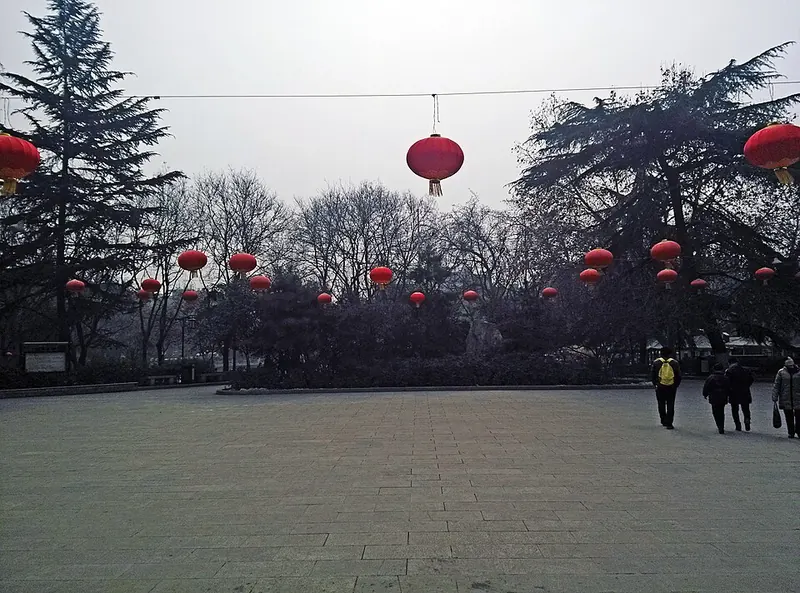
Photo adjustments
Full frame retained; proportionally resized and converted to WebP. No retouching or changes to the photographed subject. Card displays may crop the view.
Explore the region
About Lianhu Park
Its lotus pond traces a long history of cultivation and later public-park use, giving the surrounding district its name. Today, winding bridges, rockwork and pavilions create a compact lakeside circuit. The Qiyuan Teahouse memorial adds a twentieth-century layer, recalling a wartime communications station once operating in the park.
The park's origins date to the eleventh year of the Hongwu era (洪武), when Zhu Shuang (朱樉), Prince of Qin and second son of the Hongwu Emperor, began rebuilding Xi'an, adding the city wall, the Prince of Qin's mansion, the Dongyue Temple (东岳庙), the Chenghuang Temple (城隍庙) and the Lotus Pond (莲花池) itself. It was formed by digging an artificial lake and channeling water from the Zao River (皂河) north through the Zhangba ditch (丈八沟) and Liuhe canal (柳河渠) into the city.
During the Ming and Qing dynasties the pond was repeatedly dredged and maintained; in the seventh year of the Kangxi era (康熙), governor Jia Fuhan (贾复汉) renamed it Fangsheng Pool (放生池) and restricted entry to distinguished guests. It once covered more than 120 mu (亩) of water and garden, divided into north and south lakes with a temple and an arched bridge, but it fell into ruin around 1949 and disappeared during the Cultural Revolution, when it was known only as Beiwutai (北五台).
The park today covers about 60,000 square meters, with water making up roughly one third of that area, and serves as a place for local residents to view lotus flowers, cool off in summer and relax; its lake remains the only lake within Xi'an's city walls.
What to look for
- The lotus-water landscape with curved bridges, rockwork and waterside pavilions.
- The Qiyuan Teahouse memorial marking the former wartime liaison station.
Location & getting there
Getting to Lianhu Park
The park is at 18 Lianhu Road in Lianhu District, beside the northern part of the Hui neighborhood.
- Use the Lianhu Road entrance for a straightforward visit to the compact garden.
Combine your visit
Suggested order within this visit:
-
Lotus pond
Begin with the water feature that gave the park its name.
-
Bridges and pavilions
Follow the garden edge for changing views across the pond.
-
Qiyuan Teahouse memorial
Finish with the site’s more recent historical layer.
This sequence is an editorial suggestion based on the features described in the sources. Access to individual buildings or areas should be checked locally; no travel time or shared admission is implied.

Find Lianhu Park
莲湖公园 · 莲湖区
The pin marks the area, not the entrance.
More places nearby
Approximate straight-line distances between map pins, not travel distances.
Muslim Quarter 回民街
Less than 1 km awayXi’an’s Hui neighbourhood is a network of residential and commercial lanes northwest of the Bell Tower, rather than a single food street. Beiyuanmen is its best-known visitor approach, with other streets such as Xiyangshi and…
View guide →Great Mosque of Xi'an 西安清真大寺
Less than 1 km awayXi’an’s Great Mosque unfolds through courtyards along an east–west axis in Huajue Alley. Its main surviving layout is Ming and Qing, using timber halls, gateways and pavilions while orienting worship towards the west. Chinese…
View guide →Xi’an City God Temple 西安都城隍庙
Less than 1 km awayXi’an’s City God Temple opens from West Avenue into a sequence of gates, a theater and a substantial main hall. Much of the surviving architecture reflects Qing rebuilding, including the main hall reconstructed with materials…
View guide →Sources & visit information
The linked encyclopedia sources support background and place descriptions. Current opening hours, ticket prices, booking rules and transport schedules have not been independently verified for this guide. Confirm them with the venue or operator before travelling.
Visitor information adapted and edited from Wikipedia contributors · CC BY-SA 4.0. Source revision 94136841.
Background paragraphs translated and condensed from Wikipedia contributors, "莲湖公园", Chinese Wikipedia · CC BY-SA 4.0. Source revision 94136841.