

China Family Visas: Choose Q1, Q2, S1 or S2
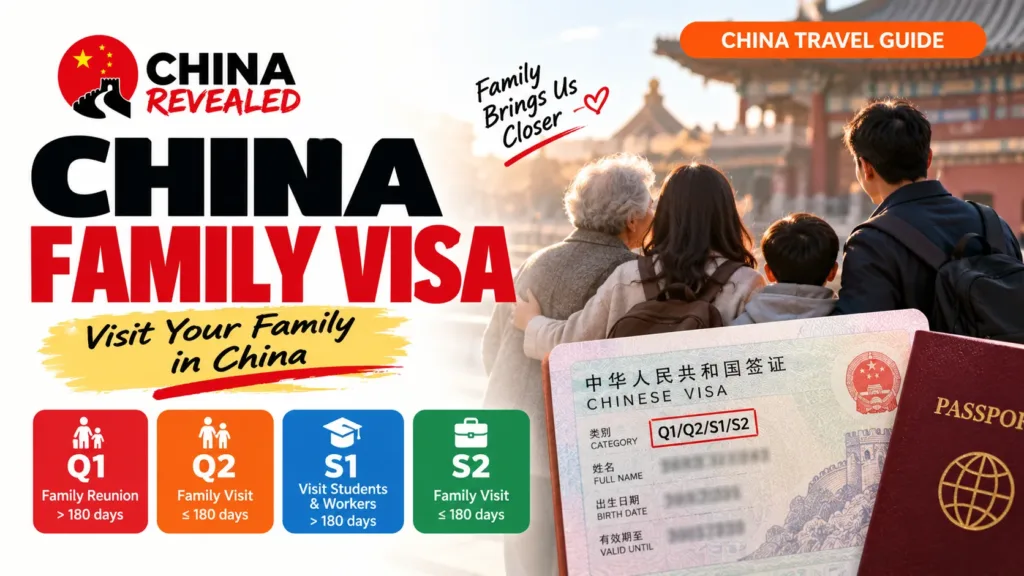
China family visa selection comes down to two questions: who are you joining in China, and will the planned stay exceed 180 days? Start there, then prepare the invitation and relationship documents with your host.
Quick takeaways
- Q: join a Chinese citizen living in China, or a foreigner with Chinese permanent residence living in China.
- S: visit a foreigner working or studying in China; S also covers certain private affairs.
- 1 means longer-term: Q1/S1 generally lead to a residence-permit application within 30 days of entry.
- 2 means short-term: Q2/S2 are for planned stays of 180 days or less; the issued visa sets your actual stay.
- Check originals, translation and authentication requirements before sending documents abroad.
1. Choose the route
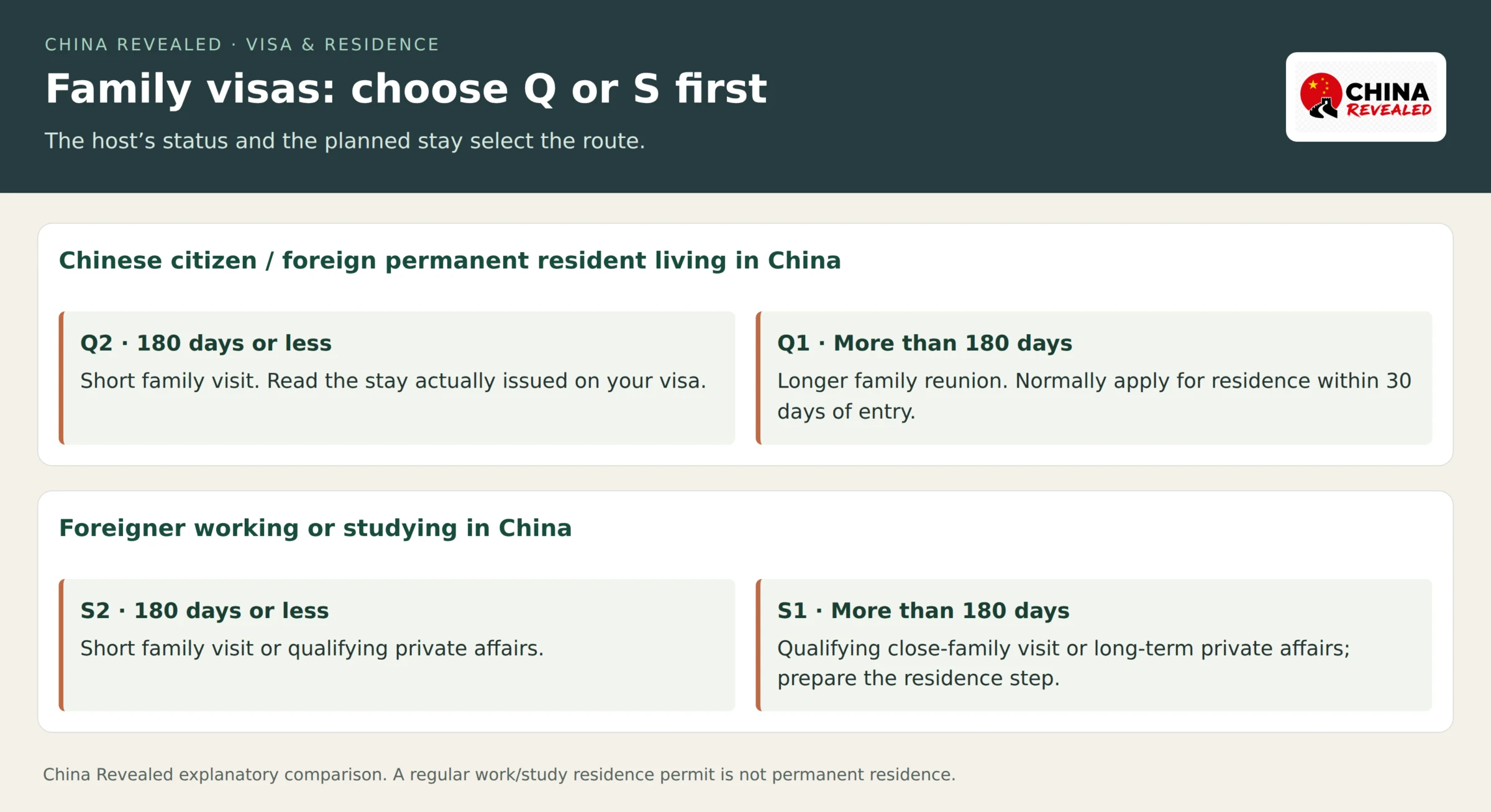
| The person you are joining | Planned stay of 180 days or less | Planned stay exceeding 180 days |
|---|---|---|
| Chinese citizen living in China | Q2 family visit | Q1 family reunion |
| Foreign permanent resident living in China | Q2 family visit | Q1 family reunion |
| Foreigner working or studying in China | S2 family visit | S1 qualifying close-family visit |
A foreign worker with an ordinary work residence permit is not a permanent resident. That distinction is why the spouse of a Chinese citizen normally looks at Q, while the spouse of a foreign employee normally looks at S.
S1 family visits cover qualifying close relatives, including a spouse, parents, children under 18 and parents-in-law. S2 and Q-category family definitions can be broader. For an adult child, sibling or less straightforward relationship, check the mission’s category wording before preparing the whole file. Q1 also has a foster-care route; S has private-affairs routes with their own supporting evidence.
The 180-day boundary selects a category. It does not mean every Q2 or S2 applicant receives 180 days, or that a calendar “six-month” visit always fits the short-term route.
2. Build the invitation file
Get the host’s identity evidence
For Q, the host normally supplies an invitation and a copy of the Chinese ID, front and back; for a foreign permanent resident, the passport identity page and permanent-residence card are the relevant documents.
For S, the host normally supplies an invitation, passport identity page and Chinese residence permit. Some short-term S2 checklists accept additional visa evidence; use the actual receiving mission’s list.
Write the invitation clearly
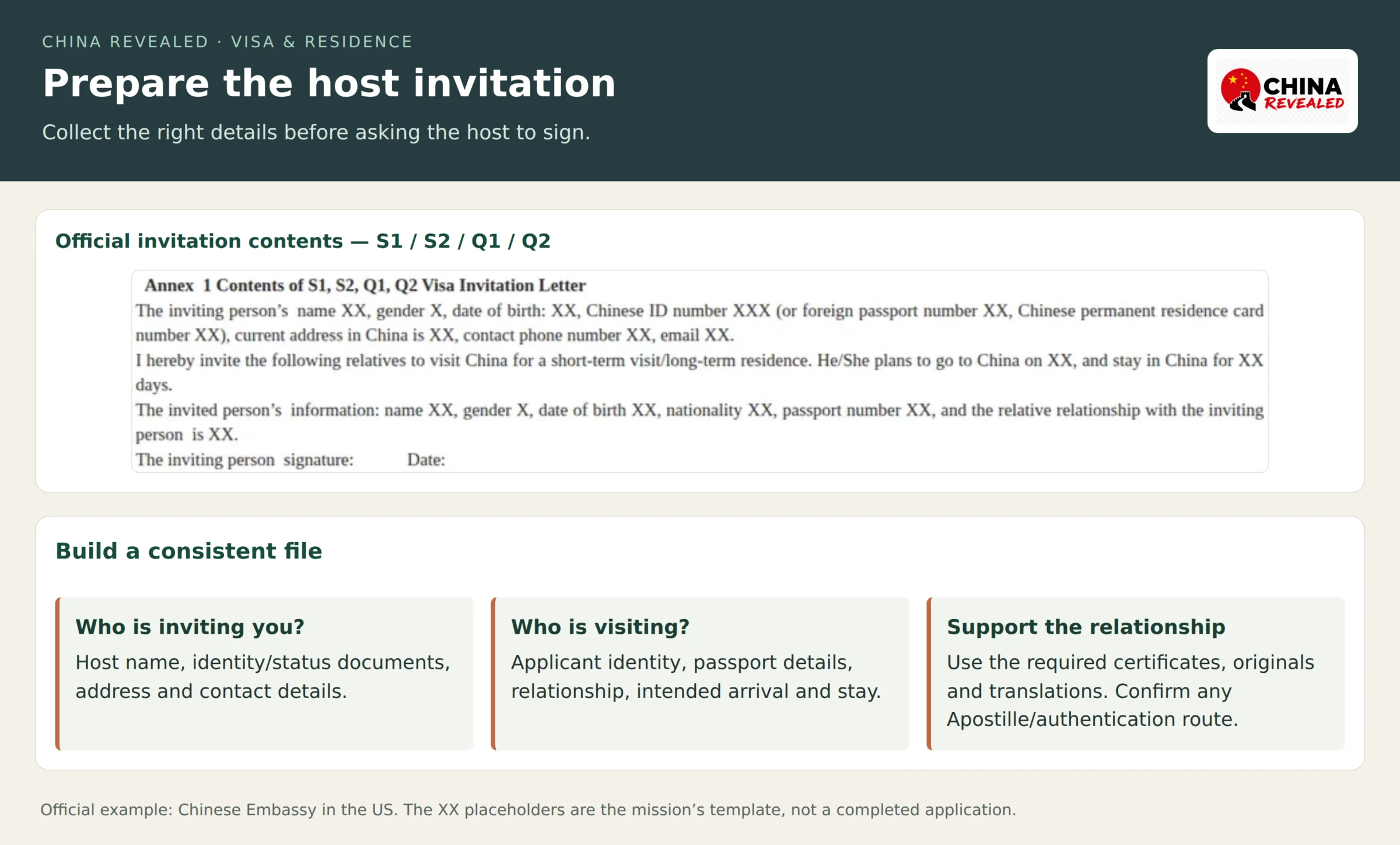
Include both people’s names, dates of birth and identity/passport details, the relationship, reason for the visit, intended arrival and stay, address in China, contact details and the inviter’s signature and date. Use the mission’s current template where it provides one. The official example below shows the information to gather, not a completed application.
Keep relationship originals available
A marriage certificate, birth certificate, adoption document or other accepted kinship evidence may be needed. Q1/S1 applications commonly require original relationship evidence for inspection, even when the online stage starts with scans. A short Q2 application may have a lighter list; do not assume all four categories have identical requirements.
Name changes deserve attention: if a marriage certificate and passport show different surnames, include the connecting evidence.
For foreign public documents, confirm the applicable Apostille or consular-authentication route and Chinese translation requirements. I recommend checking both the overseas mission and, for long-term plans, the Chinese city’s residence-permit checklist before ordering services. A certificate accepted for the entry visa may still need additional preparation for use inside China.
3. Apply and check the visa
Apply through the Chinese embassy, consulate or visa centre responsible for the place where you legally live. Where it uses the China Online Visa Application portal, complete the form, upload the scans, follow correction/status messages and submit the passport and originals as instructed.
Check the local fingerprints, fees, appointment or walk-in rules. Keep the application number and any submission/collection receipt. Do not book a non-refundable trip around a generic “four-day” estimate: online review and passport processing are separate stages.
When collecting the passport, check the issued Q/S category, entry validity, number of entries and stay instructions. For Q1/S1, schedule the next stage in China rather than treating the visa as the finished long-term document.
4. Complete the arrival steps
At a hotel, ask the front desk to complete accommodation registration. At a relative’s home or rented apartment, registration is due within 24 hours. The nationwide NIA service, launched on 21 September 2026, is available through its website and 移民局12367 app or mini-programs. Have the host assist with the first registration and save the completed record.
Q1/S1 holders normally apply for a residence permit at the local Exit-Entry Administration / 出入境管理 within 30 days of entry. Prepare the passport, application/photo materials, host identity/status, relationship evidence, accommodation record and any locally required health documents.
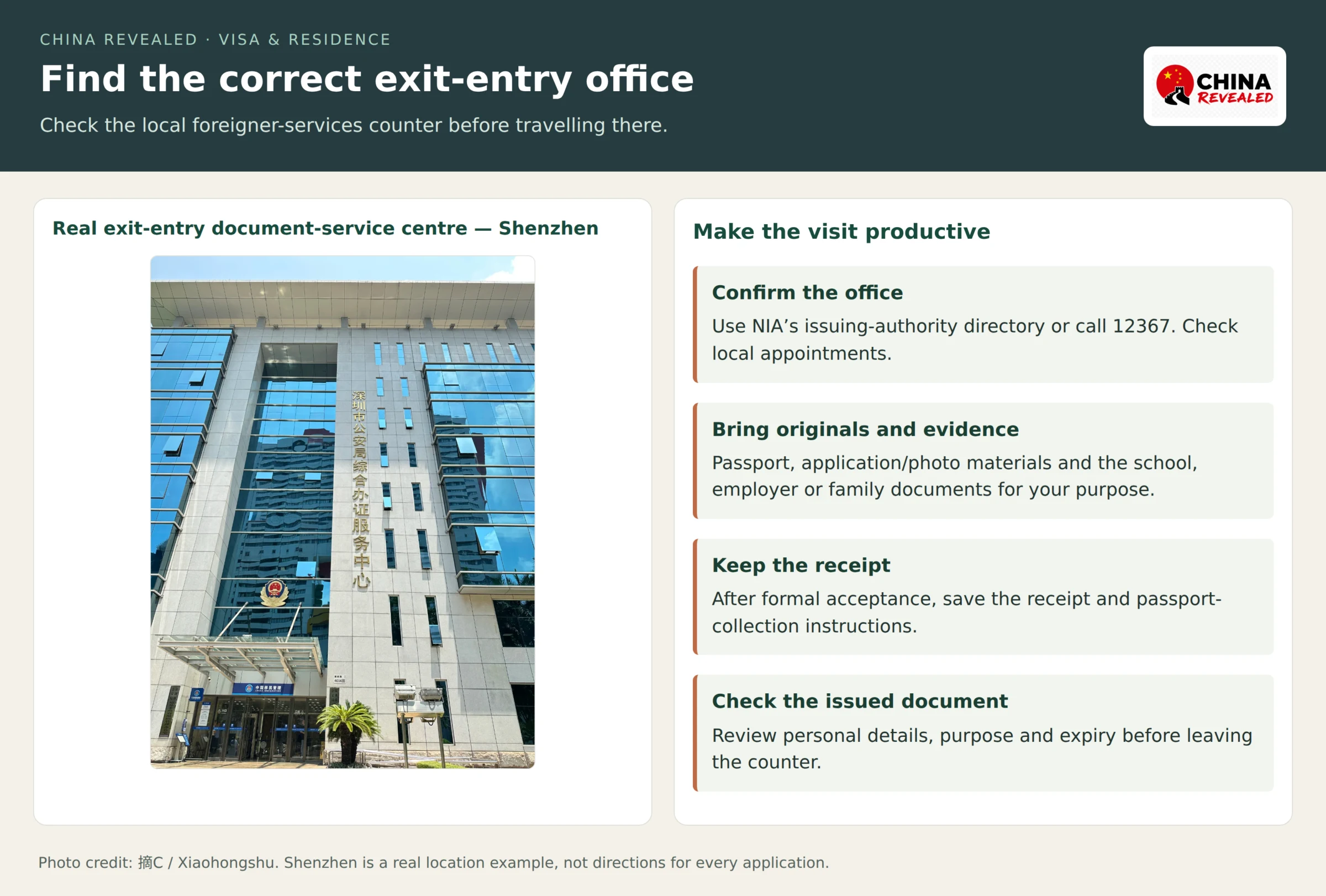
Start early enough to obtain translations or missing host papers. If the authority retains your passport, keep the acceptance receipt and its collection instructions. After issuance, check the permit purpose and expiry. An S1 family permit may be linked to the host’s residence period; it is not automatically a lifetime or permanent-residence document.
For Q2/S2, watch the permitted stay on the visa. Short-term family visitors do not automatically need or receive a residence permit.
Book hotels, flights, train tickets, attractions and other travel services on Trip.com.
5. Handle changes and renewals
For a longer Q2/S2 stay, approach Exit-Entry Administration at least seven days before the permitted stay expires, with a documented reason and current host evidence. The published ceilings differ by category and private-affairs purpose; ask for the period needed rather than assuming a fresh 180 days.
For a residence renewal, begin at least 30 days before expiry. If the host’s job, school or residence status changes, check how it affects your family permit. Family status itself does not provide general work permission.
For genuinely short family visits, your nationality may also have an applicable visa-free route; check the allowed purpose and stay in our China visa and entry guide. For longer plans and passport changes, read extending your stay and renewing residence permits. Hosts can use the work-visa guide or student-visa guide for their own paperwork.
About China Revealed
China Revealed is an independent English-language travel guide dedicated to China.
We bring together China travel guides, destination information, local insights and practical travel resources in one place.
Our travel database covers China's provinces, cities, famous attractions, hidden gems, local cuisine, transportation, accommodation, visa requirements, digital payments, mobile connectivity and the other practical details travelers need to explore China.
We focus on depth, careful research and accuracy. Our guides combine official sources, detailed destination data, local knowledge and regularly updated information to give reliable, practical travel advice.
Whether you're visiting China for the first time or exploring beyond the popular destinations, China Revealed is an all-in-one resource for discovering the real China.
China Revealed — Your practical guide to China.
Some links on China Revealed, such as Trip.com booking links, are affiliate links. If you book through them, we may earn a commission at no extra cost to you. This does not change what we recommend.