

China Work Visa: From Job Offer to Residence Permit
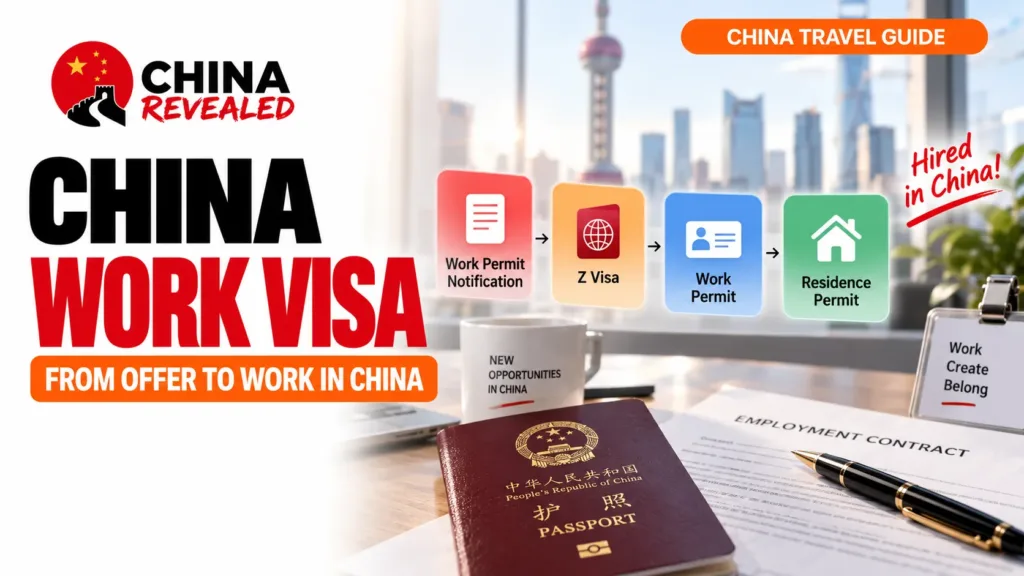
China work visa preparation starts with your employer. For a regular long-term job, the sequence is work-permit notification → Z visa → work permit → work-type residence permit. The passport sticker is only one part of it.
Quick takeaways
- Ask the employer to check your work-permit eligibility before paying for document authentication.
- For a regular long-term job, obtain the work-permit notification before applying for Z.
- Complete the post-arrival work permit and residence application promptly; the residence application is due within 30 days of entry when required by the visa.
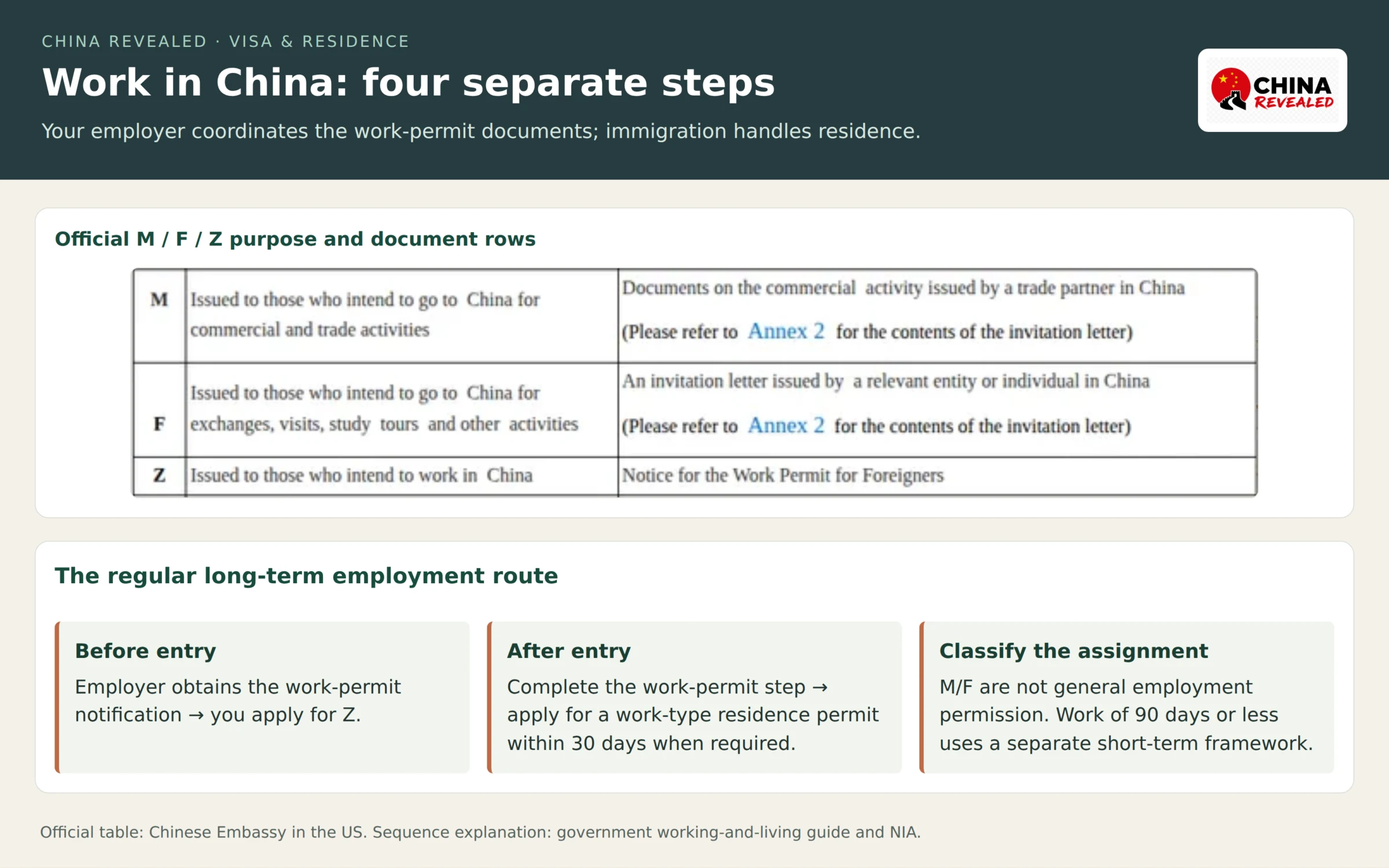
- Business meetings on M or exchanges on F are not general employment permission.
- Choose the document-authentication route with the employer’s local authority, not an old generic checklist.
1. Start with the employer
The practical starting point is a written offer or contract identifying the Chinese employer, job, workplace and term. Ask who in HR handles foreign employees and which local work-permit authority processes the case.
The employer submits the foreign-worker application. It needs more than an invitation letter: the position, qualifications and employer documents must support the requested work permission. I recommend asking HR for a written checklist and a scan pre-check before ordering translations, police certificates or authentication services.
For work exceeding 90 days, the government’s standard workflow leads from a Notification Letter of Foreigner’s Work Permit to the Z visa and post-arrival permits. Work of 90 days or less has a separate short-term work framework; ask the employer to classify the assignment rather than using a business visa as a shortcut. This 90-day distinction is different from the 180-day boundary used for student and family visa categories.
2. Prepare the documents
The standard work-permit file can include your passport, photograph, employment contract or appointment letter, qualifications and work-experience evidence, highest degree or professional qualification, police-clearance certificate and health examination documents.
The exact eligibility and document rules depend on the job and local authority. Ask HR to confirm the required certificate dates, the acceptable issuing body and how names should be translated. A mismatch between a degree name and passport name can take longer to solve than the online application itself.
Apostille or consular authentication?
For qualifying public documents issued in a country covered by the Hague Apostille Convention, the applicable Apostille route can replace traditional consular authentication. Other documents or countries may require a different route. Foreign-language material generally needs Chinese translation in the required format.
Do this in order: identify the document, confirm the receiving authority’s requirements, obtain it, authenticate as required, translate and send scans for review. Do not pay for every possible certification “just in case.” An Apostille authenticates a document’s origin; it does not approve your employment eligibility.
Keep a set of originals and scanned copies. Check whether the health report needs local verification after arrival, and avoid ordering a time-limited police certificate so early that it expires before submission.
3. Apply for Z
When the employer obtains the Notification Letter of Foreigner’s Work Permit, use it with your passport and the remaining visa materials at the responsible Chinese embassy, consulate or visa centre.
Where the mission uses the China Online Visa Application portal, fill in the form, upload scans and respond to any requested corrections. Follow the status instructions for passport submission and originals. Online review is a preparation stage; collect the issued passport visa before treating the process as complete.
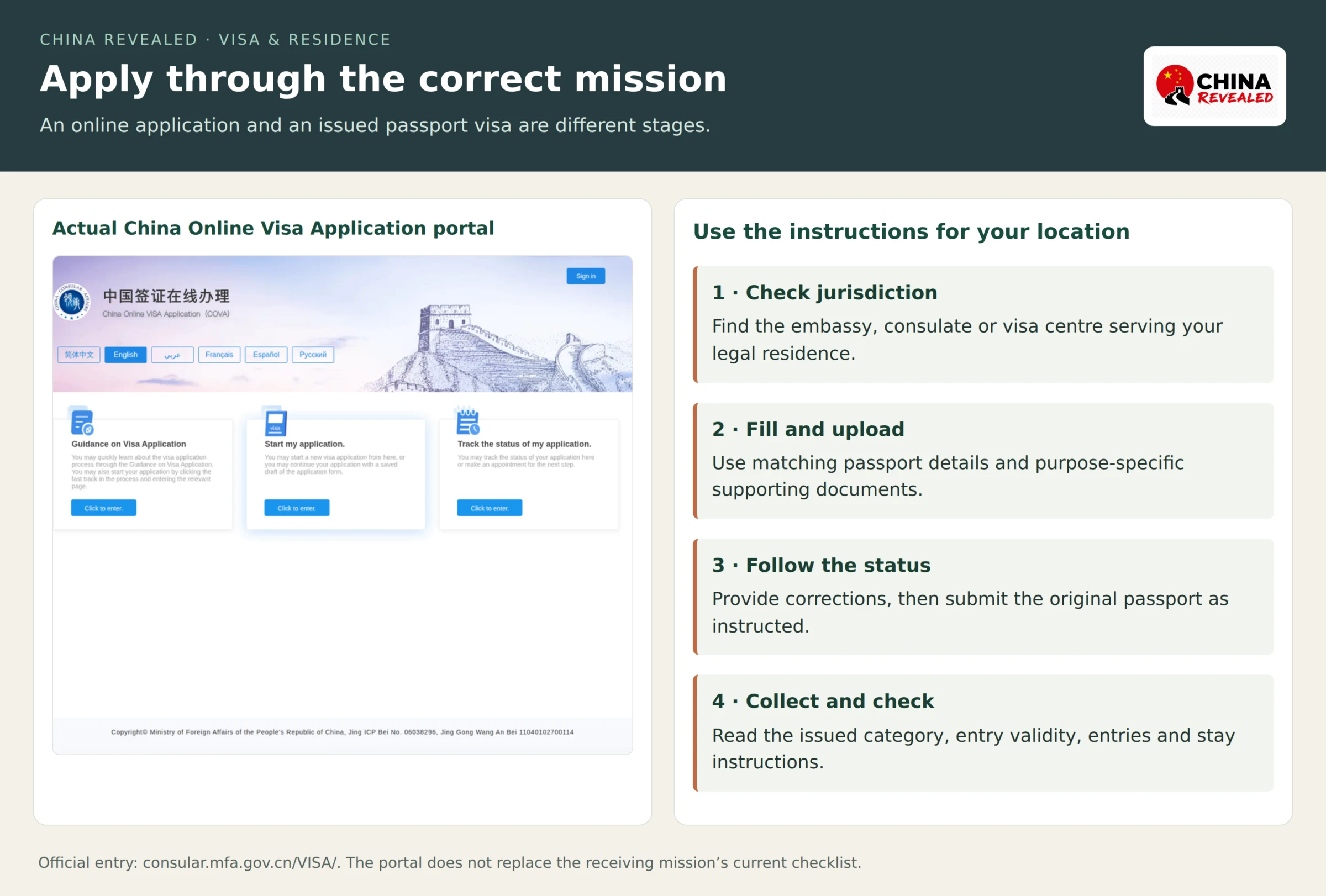
Check the visa category, entry window, entries and post-arrival instructions. A Z visa tied to one employment route does not give permission to take any job anywhere in China.
4. Finish the first 30 days
Register the address and arrange HR appointments
Hotels normally report accommodation. For a rented apartment or other non-hotel address, complete registration within 24 hours. Nationwide NIA online registration has been available since 21 September 2026 through the service website and 移民局12367 app or WeChat/Alipay mini-program; have the host assist with a first registration. Keep the completed record.
HR should arrange the post-entry work-permit step and any required health examination or verification. Then submit the work-type residence-permit application at the Exit-Entry Administration / 出入境管理 in your intended place of residence, within 30 days of entry when required by the visa.
Take the original passport, application/photo materials, work-permit evidence, employer certification and the locally required accommodation and health documents. Ask HR which appointment is first and whether you need to attend in person. Work permits and residence permits are handled by different authorities.
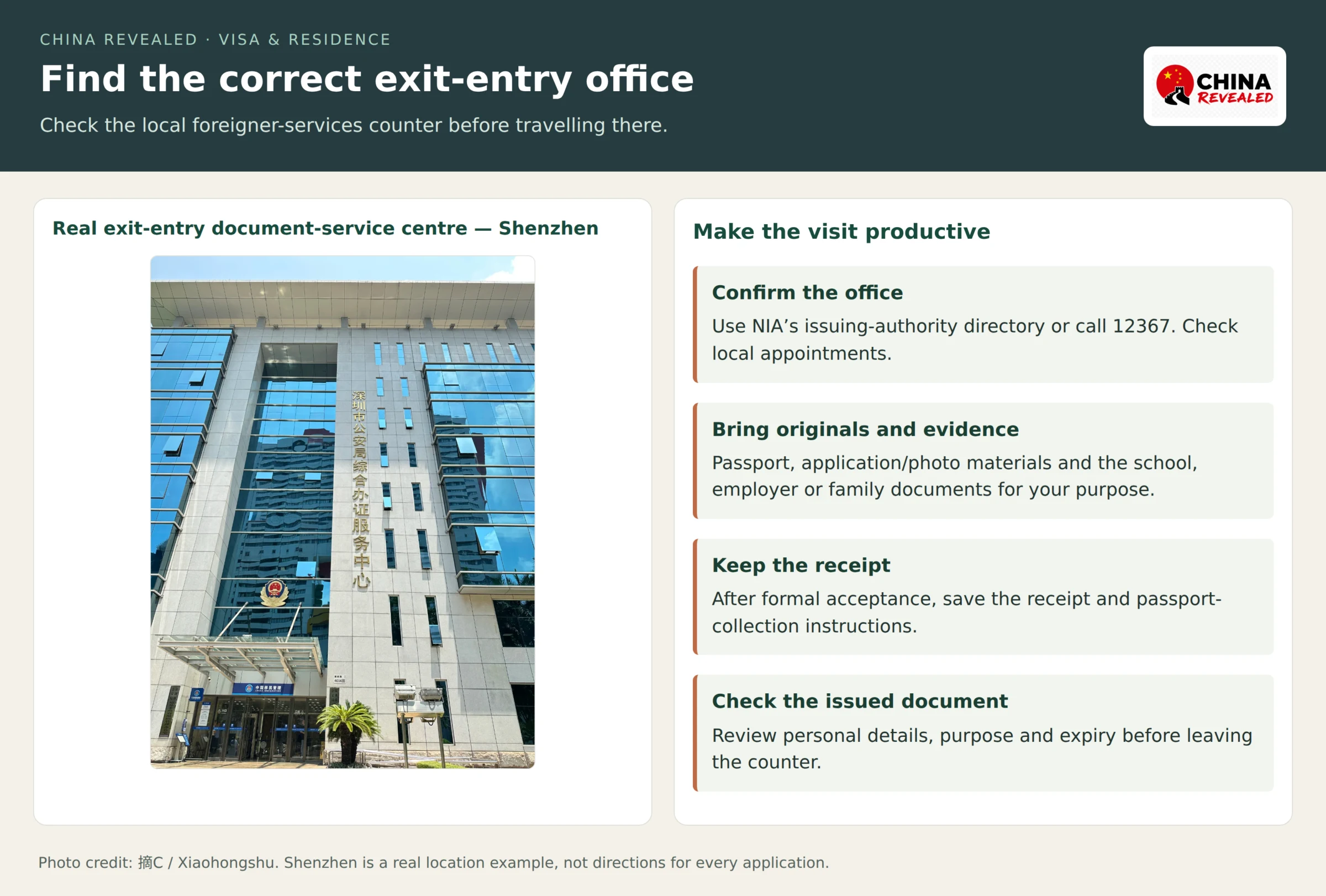
If your passport is retained, keep the acceptance receipt and collection instructions. Allow time for issuance before booking an international trip that needs the passport.
Work-permit information and the social security card
From December 2024, work-permit information began integrating with physical and electronic social security cards. Local systems may use the electronic record for verification and related services. This changes how the work-permit information is displayed, not the need for immigration permission: the card is not your Z visa or residence permit. Ask HR how its city verifies the current record.
Book hotels, flights, train tickets, attractions and other travel services on Trip.com.
5. Maintain the permits
Check the employer, work details and expiry of the work permission, and the passport details and expiry on the residence permit. Begin renewals about a month ahead, in line with the authority’s deadlines; do not wait until the final week. Work-permit changes and residence-permit changes have different reporting rules.
Changing employer, taking a second job or changing the position can require fresh or amended work permission. Clear the change with HR and the authority before starting the new work.
For a genuinely short commercial visit, M may fit trade meetings or negotiations; F fits appropriate exchanges and visits. Neither replaces employment permission. The newer K category for qualifying young science and technology talent is also not a blanket work authorisation.
Next read residence renewal and passport changes. For accompanying relatives, see Q and S family visas. Our published China visa and entry guide covers tourism and arrival procedures.
About China Revealed
China Revealed is an independent English-language travel guide dedicated to China.
We bring together China travel guides, destination information, local insights and practical travel resources in one place.
Our travel database covers China's provinces, cities, famous attractions, hidden gems, local cuisine, transportation, accommodation, visa requirements, digital payments, mobile connectivity and the other practical details travelers need to explore China.
We focus on depth, careful research and accuracy. Our guides combine official sources, detailed destination data, local knowledge and regularly updated information to give reliable, practical travel advice.
Whether you're visiting China for the first time or exploring beyond the popular destinations, China Revealed is an all-in-one resource for discovering the real China.
China Revealed — Your practical guide to China.
Some links on China Revealed, such as Trip.com booking links, are affiliate links. If you book through them, we may earn a commission at no extra cost to you. This does not change what we recommend.