

China Student Visa: X1, X2 and Your First Month
China student visa planning is easiest when you start with your school, not the application form. Get the admission documents, confirm whether the course exceeds 180 days, then organise the visa and your first month in China together.
Quick takeaways
- X1: study for more than 180 days, followed by a study residence-permit application within 30 days of entry.
- X2: study for 180 days or less; follow the stay period actually issued on your visa.
- Ask the school for the correct admission and study forms before applying.
- After arrival, complete accommodation registration, school enrolment and any required health check promptly.
- Off-campus internships need school approval and the appropriate residence-permit endorsement before you start.
1. Choose X1 or X2
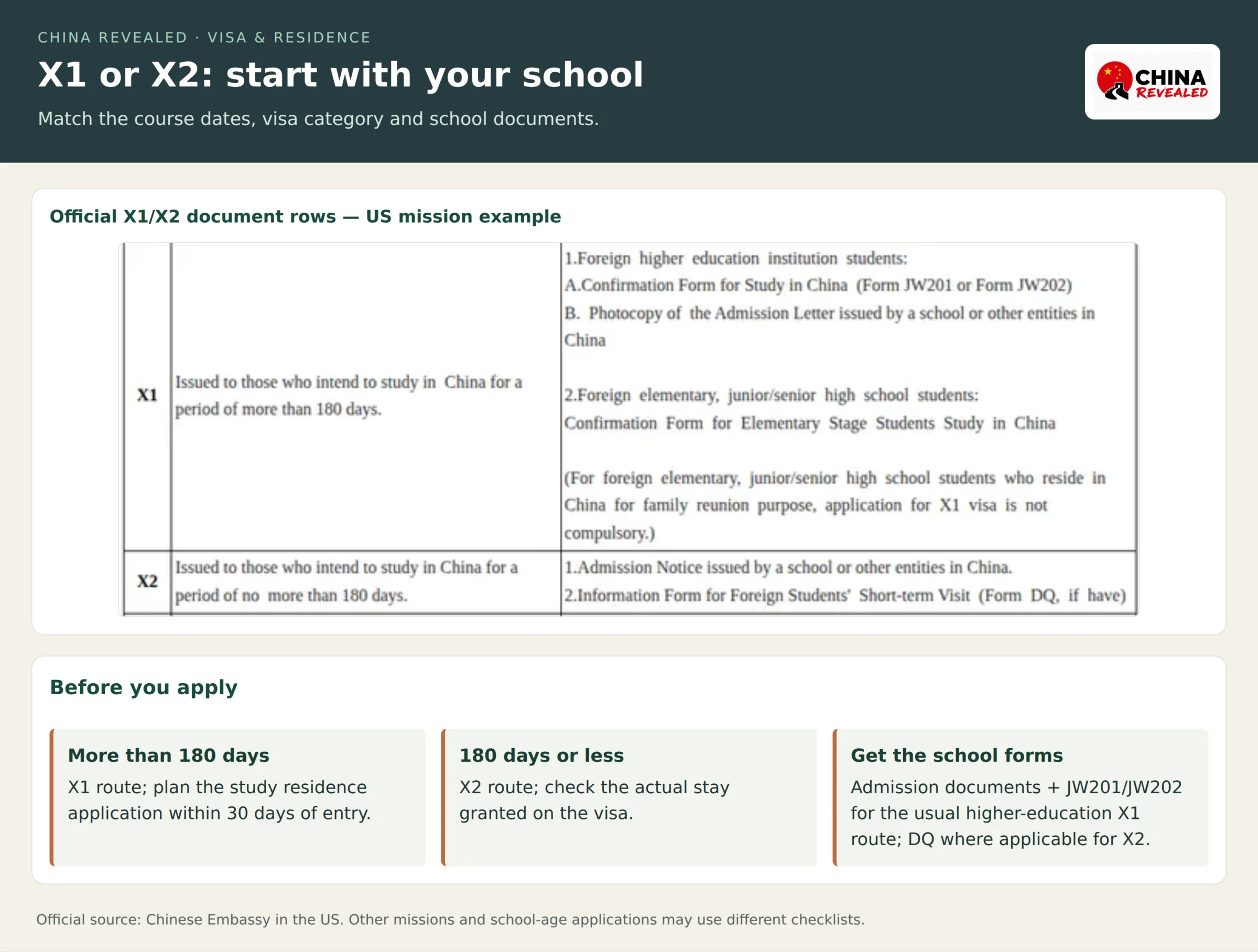
For a degree or longer programme, X1 is normally the route. For a short course of no more than 180 days, X2 is the usual route. Use the dates on the school’s documents: “one semester” and “six months” are not precise substitutes for the 180-day boundary.
| Your course | Usual visa route | What happens after arrival |
|---|---|---|
| More than 180 days | X1 | Apply for a study residence permit within 30 days of entry |
| 180 days or less | X2 | Study within the permitted stay printed on the visa |
For higher-education X1 applications, expect an admission letter and JW201 or JW202 study documentation. An X2 application centres on the admission notice; the school may also issue a DQ short-term student form. Ask the international admissions office which form it will provide and whether the receiving mission wants an original, copy or electronic verification. School-age applications can use different documentation.
2. Prepare and apply
I recommend sending your school a scan of your passport early. Your name, nationality and passport number should agree across the passport, admission letter and study forms. Resolve date or spelling differences before uploading anything.
Use the Chinese embassy, consulate or visa centre responsible for the place where you legally live. Its current checklist sets the passport validity, photo, supporting documents, fingerprints, fees and submission method. If applying outside your nationality country, check the required evidence of legal residence or stay there.
Where your mission uses the China Online Visa Application portal, create an account, choose the correct mission, fill in the form and upload the requested scans. Watch the application status for corrections and passport-submission instructions. In the current US-embassy workflow, Passport to be submitted means take the passport, application information page and required originals to the visa office. It is not the visa itself. Other missions may use a different submission sequence.
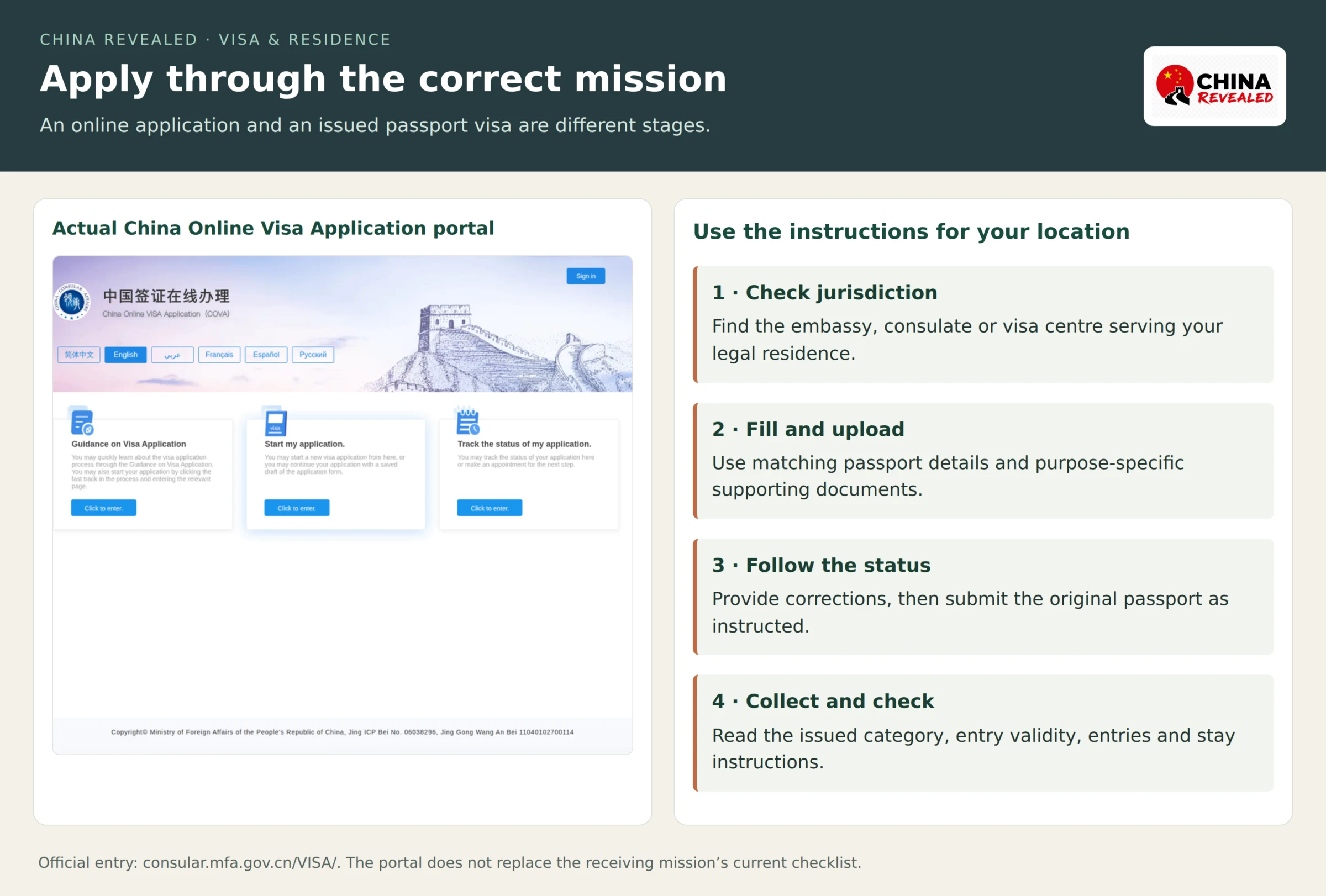
Collect the issued visa and check X1/X2, Entries, Enter Before and Duration of Each Stay before travelling. For an X1, plan around the post-entry residence-permit requirement rather than assuming the visa covers the whole degree.
3. Complete your first month
Register your accommodation
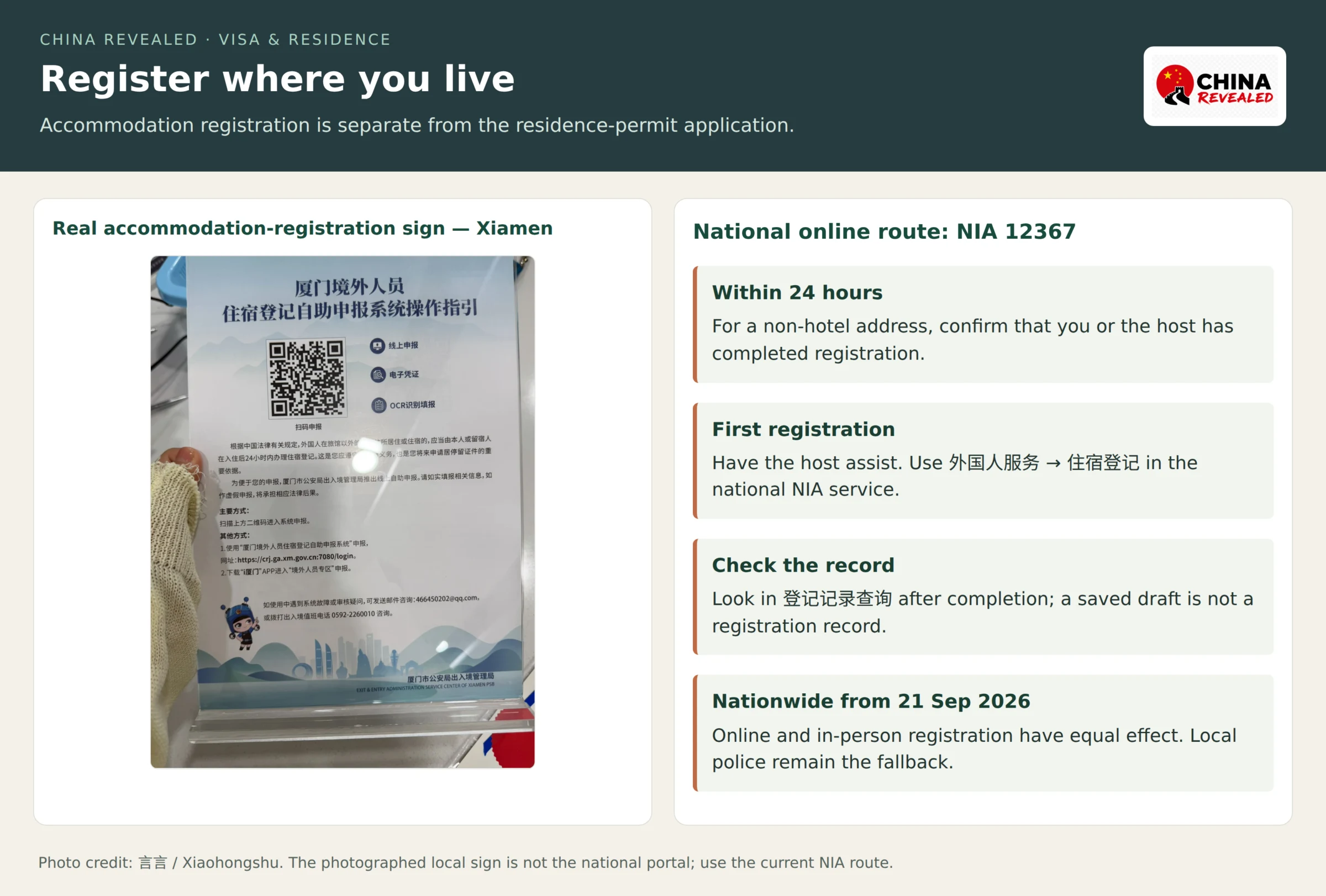
A hotel normally reports your accommodation. In a dormitory, rented apartment or another non-hotel address, registration is required within 24 hours of moving in. Ask the school, dormitory or host who will complete it and obtain the record.
Since 21 September 2026, non-hotel registration has been available nationwide through the NIA service website and the 移民局12367 app or WeChat/Alipay mini-program. Enter 外国人服务 → 住宿登记. For a first registration, have your host help with the address and submission; the national guidance specifies host assistance for a first registration. When completed, look in 登记记录查询 for the registration record. A local police station remains the fallback if the online process stalls.
Enrol, complete the health paperwork, then apply
Report to the school’s international office as soon as its enrolment period opens. It normally supplies the enrolment certificate or study-duration letter needed for your residence application. Before flying unusually early, check when the school can issue those documents.
Ask which international travel health centre or accepted medical provider handles your examination or verification. An overseas medical report may need local verification. NIA requires a health certificate for residence permits valid for more than a year; local first-application instructions may also require a check.
Then apply at the Exit-Entry Administration / 出入境管理 in your intended city of residence, within 30 days of entry for the X1 route. Bring the original passport, photo/application materials, accommodation record, school documents and required health evidence. I would arrange the school and appointment steps in the first week, not leave them to day 29.
Book hotels, flights, train tickets, attractions and other travel services on Trip.com.
4. Check the permit and plan ahead
Keep the acceptance receipt if the office retains your passport. Follow its collection date and check the residence permit’s personal details, purpose and expiry when you collect it. The receipt supports legal stay during processing; plan international trips after the passport and permit are returned.
A study permit is not a general work permit. For off-campus work-study or an internship, obtain school approval first, then have the workplace and duration endorsed on the residence permit by Exit-Entry Administration. A company offer alone is insufficient.
For X2, watch the stay period on the visa. If the course genuinely changes, contact the school and local authority before it expires rather than assuming it becomes X1 automatically. For continuing X1 study, begin residence renewal at least 30 days before expiry.
Next read extending your stay and renewing residence permits. If relatives will accompany you, see Q and S family visas. For tourism and arrival basics, use our published China visa and entry guide.
About China Revealed
China Revealed is an independent English-language travel guide dedicated to China.
We bring together China travel guides, destination information, local insights and practical travel resources in one place.
Our travel database covers China's provinces, cities, famous attractions, hidden gems, local cuisine, transportation, accommodation, visa requirements, digital payments, mobile connectivity and the other practical details travelers need to explore China.
We focus on depth, careful research and accuracy. Our guides combine official sources, detailed destination data, local knowledge and regularly updated information to give reliable, practical travel advice.
Whether you're visiting China for the first time or exploring beyond the popular destinations, China Revealed is an all-in-one resource for discovering the real China.
China Revealed — Your practical guide to China.
Some links on China Revealed, such as Trip.com booking links, are affiliate links. If you book through them, we may earn a commission at no extra cost to you. This does not change what we recommend.