

Explore the region
Read the garden as a landscape, not a single palace
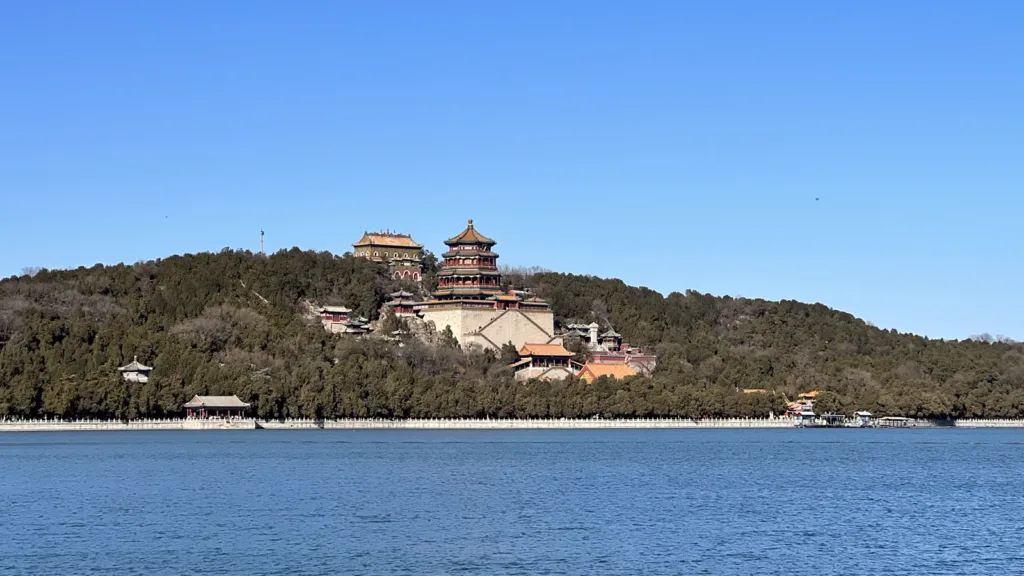
The Summer Palace occupies Beijing’s northwestern Haidian District. The official address is No. 19 Xinjiangongmen Road. Its dominant forms are Longevity Hill and Kunming Lake; water covers roughly three quarters of the 3.09-square-kilometre site. This scale matters when planning: the gates sit on different sides of the garden, and a route focused on the hill is not the same outing as a full circuit of the lake.
The garden began in 1750 as Qingyi Yuan, or the Garden of Clear Ripples. Its designers used the existing hill and lake as a framework, then joined halls, temples, pavilions, bridges and covered walks to that terrain. The result is not a palace building surrounded by incidental greenery: views across open water and toward the hill are part of the architecture. UNESCO describes the garden as combining political and administrative, residential, spiritual and recreational uses within the mountain-and-lake setting.
The complex was heavily destroyed in 1860 and rebuilt on its original foundations beginning in 1886. It was renamed Yihe Yuan in 1888 and later served as a public park. UNESCO inscribed it on the World Heritage List in 1998.
What to notice on the ground
Begin on the east side for the court and residential sequence. From East Palace Gate, the route passes the Hall of Benevolence and Longevity, the administrative centre, then continues among the halls and courtyards associated with imperial residence. The Hall of Happiness in Longevity, the Jade Ripples complex and Yiyun Hall occupy the residential zone. Their placement against Longevity Hill gives the rooms and terraces a direct relationship to the lake views rather than isolating them as a freestanding palace interior.
The Great Stage at the Garden of Virtue and Harmony gives this side of the grounds a performing-arts story as well as a court one. Treat these enclosed attractions as separate visits within the park: several have their own admission charges and shorter hours than the grounds, and their interiors may close on Mondays.
Use the Long Corridor to read the transition from buildings to landscape. The covered walkway runs along the southern foot of Longevity Hill beside the lake. Its painted beams and framed openings turn a long walk into a succession of views: look back across the water, then look up toward the buildings rising along the hillside. At its western end, the Gate that Dispels the Clouds and the hill route lead toward the Tower of Buddhist Incense, the most prominent structure on the slope. The climb is steep in places; visitors can enjoy the lakeside garden without completing it.
The Tower of Buddhist Incense is set above the lake, within the ascending architectural group on the south face of Longevity Hill. From the upper paths, the composition becomes clear: tiled roofs step down the slope, while Kunming Lake opens below. Check the pavilion’s separate ticket and entry hours; a park admission ticket does not include every paid enclosure.
Give the lake its own time. The Seventeen-Arch Bridge links the eastern shore to Nanhu Island, extending the walk across the water rather than up the hill. From there, the long shoreline and the West Dike offer a different pace and a changing view back toward the hill. The West Dike’s sequence of bridges is a key part of the garden’s design; a full lake-side circuit is much longer than a short central visit. UNESCO identifies the three islands and the West Dike’s six bridges as important elements of the composition.
Choose an entrance for the route you want
The official visitor guide lists three useful approaches. East Palace Gate is served by Xiyuan Station on Metro Lines 4 and 16 and suits the administrative and residential courtyards. North Palace Gate is served by Beigongmen Station on Line 4 and places the visitor by the north-side approach to Suzhou Street and the hill paths. West Gate is served by the Xijiao line and is a practical starting point for a west-side or lake-focused walk. New Palace Gate is another official route starting point, beside the eastern lakeshore. Follow current signs and the live park map for the precise gate-to-path approach; no station exit letter is needed to plan these routes.
For a first visit, an editorial 2.5–3.5-hour route is to enter at East Palace Gate, see the east-side court and residential area, follow the Long Corridor west, then climb toward the Tower of Buddhist Incense if mobility and time allow. Allow 4–6 editorial hours if adding Nanhu Island and a substantial lakeside section. A north-gate start is a better fit when Suzhou Street and a descending hill-to-lake walk are the priority. These estimates leave room for walking, queues and rest; the park’s size, crowding, weather and accessible openings can change the day.
The gates are not interchangeable starting points for a quick in-and-out visit. Decide first whether your priority is the east-side buildings, the hill, or the lake, then select the corresponding gate and check where you plan to finish. Boat services may connect selected shores in their operating season, but sailing depends on current service notices and weather; do not use an unconfirmed boat timetable as your only return plan.
Tickets, separate sights and opening hours
On 21 October 2026, the official park guide lists the grounds as open 06:00–20:00 from 1 April through 31 October, with last entry at 19:00. From 1 November through 31 March, hours are 06:30–19:00, with last entry at 18:00. The Tower of Buddhist Incense, Garden of Virtue and Harmony, Summer Palace Museum and Suzhou Street have shorter hours: 08:00–18:00 in peak season, last entry 17:30; 08:30–17:00 in off-season, last entry 16:30. These enclosed sights close on Mondays except statutory holidays. Other courtyards have their own schedules, so check the live notice for the specific place you want to enter.
The listed general-admission ticket is CNY 30 in peak season and CNY 20 in off-season. A combined ticket is CNY 60 and CNY 50, respectively; the official guide defines it as park admission plus the ticketed sights. Individually listed charges are CNY 10 for the Tower of Buddhist Incense, CNY 10 for Suzhou Street, CNY 5 for the Garden of Virtue and Harmony, and CNY 20 for the Summer Palace Museum. Eligible visitors may qualify for half-price tickets. Confirm the items included in the ticket you select, since the separate attractions do not all share one admission arrangement.
The Summer Palace Management Office provides an official online ticketing mini-program with live ticket purchase and electronic-ticket checks. Use the official account or the gate ticketing information rather than an unofficial reseller, and check live inventory and notices for the date of travel.
Combine your visit
Suggested order within this visit:
-
Eastern court area
Begin with the formal palace setting near the Eastern Palace Gate.
-
Long Corridor
Follow the painted lakeside link toward Longevity Hill.
-
Longevity Hill
Finish with the ascending architectural group, adjusting the climb to your mobility and current access.
This sequence is an editorial suggestion based on the features described in the sources. Access to individual buildings or areas should be checked locally; no travel time or shared admission is implied.
Find Summer Palace
颐和园 · 海淀区
The pin marks the area, not the entrance.
More places nearby
Approximate straight-line distances between map pins, not travel distances.
Old Summer Palace 圆明园
2 km awayThe Old Summer Palace, or Yuanmingyuan, preserves the landscape and ruins of a vast Qing imperial garden complex in Haidian. Its best-known stone remains belong to the Western Mansions, where European-influenced palaces and…
View guide →Beijing Botanical Garden 国家植物园北园
5 km awayThe former Beijing Botanical Garden is now the North Garden of the China National Botanical Garden, below the Western Hills. Its appeal extends beyond flower beds: the conservatory brings tropical vegetation and succulents…
View guide →Wanshou Temple 万寿寺
7 km awayWanshou Temple combines a historic Buddhist compound with the Beijing Art Museum in Haidian. Founded to house Buddhist scriptures, it later acquired imperial ceremonial associations, and its present museum collections extend…
View guide →Sources & visit information
Sources checked on 21 October 2026. Hours, tickets, reservations and transport can change; confirm with the operator before you go.
Image credits & notes (1)
- Longevity Hill and the Tower of Buddhist Incense above Kunming Lake, in a photograph made at the Summer Palace in 2022. Photo: Charlie fongPhoto: CC BY-SA 4.0