

Huangshan crisp mini pastries 黄山烧饼
A bite-sized Huangshan pastry, 5–6 cm across, with a thin flaking shell and a filling of diced pork fat and dark sun-dried preserved greens; the fat renders into the greens as it bakes against the wall of a charcoal barrel oven. Sold by the bag from street ovens and by the box as a souvenir, and best judged on the first fresh one.
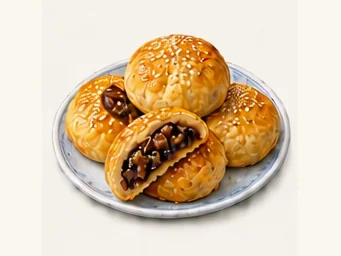
A Huangshan shaobing is a small baked pastry, 5–6 cm across, sold by the bag from street ovens and by the box as a souvenir. Its shell is thin, layered and shatters rather than bends. Inside is a dense filling of diced pork fat and dark preserved greens: the fat renders in the oven and soaks into the greens, which is what makes the filling taste rich rather than sharp. The warm bag from the oven and the printed box from a shop are, in practice, two different products.
Names, and one name that misleads
The pastry is 黄山烧饼 (Huangshan shaobing) or 徽州烧饼 (Huizhou shaobing). For its colour and shape it is also 蟹壳黄烧饼, “crab-shell yellow”, and for the oven 火炉饼, “stove cake”. Two imperial stories attached the nicknames 救驾烧饼, “the pastry that rescued the emperor”, and 皇印烧饼, “imperial seal pastry” — local retellings tie the first to Zhu Yuanzhang and the second to the Qianlong emperor’s reception by the Huizhou salt merchant Jiang Chun. Versions of the Zhu Yuanzhang story circulate with different dates, so both are best treated as legend rather than history.
English renderings vary: Huangshan pancake, Huizhou shaobing, crab-shell yellow pastry. The last one needs care. In Shanghai and the Jiangnan region, 蟹壳黄 is a separate teahouse pastry, baked to the same golden colour but filled with anything from scallion oil and pork to sugar, rose or bean paste; it is not this pastry. 烧饼 itself is a family rather than a recipe: Beijing’s sesame rounds are split and stuffed, Shaanxi’s roujiamo bread is baked to hold braised pork, Xinjiang’s naan is a different loaf altogether, and Zhejiang’s larger Jinyun shaobing is the closest relative.
A provincial intangible heritage, and a city standard
In May 2014 the Anhui provincial government gazetted 徽州烧饼制作技艺, the Huizhou shaobing making technique, as item Ⅷ-84 of the fourth batch of its provincial intangible cultural heritage list, declared by Huangshan City. It is a provincial listing; the national list carries 徽菜烹饪技艺 (Hui cuisine cooking technique) and Zhejiang’s Jinyun shaobing, not this project.
The pastry also appears in the province’s list of 200 “You must eat in Anhui” specialities, where Huangshan City’s snack entries include a “Huangshan traditional snacks” line — 蟹壳黄烧饼, 顶市酥, 嵌字豆糖 and 徽墨酥 — under Tunxi District. Small workshops that make it are additionally covered by a city-level production standard: Huangshan’s market regulator approved 《黄山烧饼(徽州烧饼)小作坊生产规范》 in December 2021, and listed the same standard among 29 withdrawn local standards in August 2026.
How flour, greens and pork fat become the pastry
Recorded recipes for the pastry list wheat flour, 肥膘肉 (pork fat), 梅干菜 (preserved dried greens), sesame, maltose syrup, salt and rapeseed oil, with starter dough, chopped spring onion, alkali and sesame oil in some versions.
梅干菜 is not a fresh vegetable. It is mustard-type greens — potherb mustard, 雪里蕻, or other brassicas — salted, pressed, sun-dried and often steamed and dried again until the leaves are dark and leathery. The process concentrates sugars and amino acids and darkens the greens through browning, leaves them salty enough to matter, and produces the fermented, savoury-sweet note that dominates the filling. In English the ingredient is usually rendered “preserved mustard greens”, but the same phrase covers the Hakka pickle of Huizhou in Guangdong and Shaoxing’s version, so the greens in a Huangshan pastry should not be assumed to be the identical product.
The pork is 肥膘肉, the fat layer rather than lean meat, cut into small dice. This is the mechanism that makes the pastry work: as the pastries bake, the fat renders and is absorbed by the chopped greens, so they taste moist and rich instead of dry and sharp, and the filling seasons itself from the inside. Added seasoning is deliberately light — salt, sometimes a little sugar or chilli, rapeseed or sesame oil, spring onion.
The crust is built in two parts. Part of the flour is scalded with boiling water before the rest is mixed with starter and water; separately, flour is rubbed with fat into a 酥, a shortening paste. Rolling and folding that paste into the dough — 搓酥 — creates the many thin layers the pastry is judged by, 层多而薄, which is why the shell flakes in sheets instead of breaking cleanly.
The working order runs 泡面、揉面、搓酥、摘坯、制皮、包馅、收口、擀饼、刷饴、撒麻、烘烤: soak and mix the dough, rub in the shortening, divide the dough, roll the skins, fill, close, flatten, brush with maltose syrup, scatter sesame, bake. The maltose glaze is what browns to the golden crab-shell colour and holds the sesame in place.
The oven does the rest
Baking happens in a barrel-shaped oven (炉) with charcoal at the bottom. The baker presses each pastry, sesame side out, onto the inner wall, then works through stages: an open bake, a covered 焖烘 stage, and a final stage with the fire drawn back so residual heat dries the crust.
That long, dry bake is also why the pastry travels. Most of the water is driven off, so a well-baked one stays crisp for days rather than hours — the property that made it a road food in the Ming and Qing periods, when local accounts describe Huizhou merchants carrying it as provisions and as gifts, and the reason a box of them survives a flight home better than most Chinese snacks.
What it tastes like, and how to eat a bag of them
Hot from the oven the pastry is brittle and fragrant: the first bite cracks the shell, then the filling arrives as a compact, salty-sweet mass with the greens’ fermented edge, toasted sesame on top and, in many versions, a low chilli heat at the back. Cooled, it is still crisp but drier and less aromatic. Local writing measures it in verse — “thin as an autumn moon, shaped like a full moon; dropped, it scatters like jade; eaten, the aftertaste does not end” — and the educator Tao Xingzhi, who came from She County, is quoted with the line “three crab-shell yellows, two bowls of mung-bean congee”.
Practical handling: if the pastries are handed to you warm in a closed bag, keep the bag open until they cool, or the trapped steam softens the shells. If they do soften, dry heat restores them — a few minutes in an oven or a dry pan, and re-baking is the standard local remedy for pastries that have gone soft in humid weather. Eat a fresh bag the same day; treat the boxed version as the one that survives the trip.
Two things to know before buying for other people. The standard filling is pork fat and the pastry is wheat with sesame, so it is not vegetarian and not halal by default, and the preserved greens are salty. Shops sell sweet, plain and chilli variations within the same pastry family, but whether a particular “original” is meat-free cannot be assumed — ask what is in the filling (馅是什么) rather than judging by the name.
How to order: say 黄山烧饼, then ask 现烤的还是包装的 (fresh-baked or packaged) and 辣的还是不辣 (spicy or not). To judge quality, buy one small bag first and eat it on the spot: the shell should flake in layers, the filling should taste of greens rather than raw fat, and there should be no soft, doughy core. Then buy the box. Packaged pastries carry a production date and a shelf life set by the producer, so read the pack rather than relying on any general figure.
Practical tips
Huangshan City counted close to 200 shaobing businesses in 2023, more than half of them run by families from Wucheng (五城镇) in Xiuning County; in 岩溪 village there, out of 454 households about a third of the residents work in the trade, and people from the town have opened shaobing shops in Hefei, Shanghai, Nanjing and Hangzhou, and in Europe.
What to compare it with
挞粿 (tà guǒ), another Huizhou snack, uses the same preserved greens and sometimes meat, but in a thin folded flatbread that is pan-cooked rather than baked against an oven wall — a different texture out of the same larder.
蚌埠烧饼夹里脊 (Bengbu’s shaobing with tenderloin) appears in the same provincial specialities list as a Bengbu snack: a sesame flatbread split and filled, a sandwich rather than a filled pastry, and a reminder that 烧饼 in Anhui means several different breads.
缙云烧饼 (Jinyun shaobing) from Zhejiang is the nearest cousin to what you are eating in Huangshan: the same fresh-pork-and-dried-greens logic, baked against a clay oven wall, but larger and flatter, and listed at national rather than provincial level.
Where to eat it
You can find Huangshan crisp mini pastries all over Anhui, so there is no need to seek out one particular restaurant. To find one near you, search for “黄山烧饼” in Meituan (美团) or Amap (高德地图) and check recent reviews, distance and opening hours.
More dishes to compare
Explore related local specialties and compare their names, preparation notes and ordering guidance.
Bengbu pork-filled sesame bun 烧饼夹里脊 →
A sesame flatbread is split and filled with cooked pork tenderloin, often with sauce and optional vegetables. Shops may fry the meat or use a different cooking style. Crisp sesame bread meets tender, seasoned pork, with sauces adding sweetness or heat and vegetables bringing freshness.
Linhuan fermented-tofu pork 临涣培乳肉 →
Pork is seasoned with fermented bean curd and cooked slowly until its fat and connective tissue soften. The bean curd dissolves into the sauce rather than remaining as large tofu cubes. The result is deeply savory, rich and soft, with a fermented aroma that distinguishes it from an ordinary soy-sauce braise. Sauce strength varies by kitchen.
Sources & reading
Recipes and servings vary between kitchens.
- 安徽省人民政府关于公布第四批省级非物质文化遗产名录的通知(皖政〔2014〕38号)
- 徽州烧饼制作技艺 — 百度百科
- 黄山烧饼,历史、文化、做法、选购指南 — 搜狐(智游黄山)
- 黄山小烧饼闯出大市场 — 黄山日报(安青网转载)
- 黄山烧饼 — 百度百科
- 虽然不好看,却是「下饭王」!这种发霉似的「菜」怎么这么好吃 — 科普中国(中国互联网联合辟谣平台转载)
- 首批游安徽「不得不吃」的特色美食(小吃)名单 — 舒城县人民政府网(PDF)
- 4万个烧饼……一组数据感受各地「一口鲜」里的烟火味 — 封面新闻
- China's shaobing has turned into a hot commodity overseas — China Daily
- 悠悠徽州情 酥脆「蟹壳黄」 — 新华网《四季的味道》第五季
- 蟹壳黄 — 维基百科(中文)
- Crab-Yellow Pastry — en.chinaculture.org
- Meigan cai — Wikipedia(英文)
- Huangshan Food Guide 2026 — huangshantourguide.com
- Popular Snacks in Huangshan — chinaeducationaltours.com
- 关于废止《黄山烧饼(徽州烧饼)小作坊生产规范》等29项黄山市地方标准的公告 — 黄山市市场监督管理局(全国标准信息公共服务平台)
- 关于批准发布《黄山烧饼(徽州烧饼)小作坊生产规范》等2项黄山市地方标准的公告 — 黄山市市场监督管理局(全国标准信息公共服务平台)