


Get to know She County
- Administrative area
- County · 县
- Part of
- Huangshan
- Chinese name
- 歙县
- Local areas
- County guide
Area & population
- Population · 2020
- 362,962
- Administrative seat
- Huicheng
Source: English Wikipedia, as of the dates shown.
She County (歙县, Shè Xiàn) is the easternmost county-level division of Huangshan City, on the Anhui–Zhejiang border, and for centuries it was the leading county of Huizhou and the seat of its prefecture. The old administrative centre survives as Huizhou Ancient City (徽州古城) in Huicheng town (徽城镇): a walled core divided by two hills, with the Lian River (练江) on its western side and, one kilometre downstream, the stone weir from which Huizhou merchants loaded boats for Zhejiang and Jiangsu. Outside the town the county falls into four usable zones — the archway villages west of the town, the old merchant village of Xucun to the north, the river and hill villages south around Shendu (深渡), and workshops where ink, inkstones and tea are still working trades.
Where the county sits, and how it divides
Mountains close the county on three sides: the Huangshan range to the north, the Tianmu Mountains (天目山) to the east and the Baiji Mountains (白际山) to the south-east, with the Huizhou basin in the middle. The highest point is Qingliang Peak (清凉峰) at 1,787 m. All of it drains to the Xin'an River (新安江) through tributaries such as the Lian River, and below Shendu the Xin'an becomes navigable as far as Qiandaohu town in Zhejiang.
The county has fifteen towns and thirteen townships and, according to the 2020 census, 362,962 residents. For a visitor the more useful division is into four zones that need separate trips rather than one walk:
- The county town. Huicheng, holding Huizhou Ancient City and Yuliang. This is the only part of the county you can cover on foot.
- West. Zhengcun town (郑村镇): the Tangyue archways (棠樾牌坊群) and the Bao Family Garden (鲍家花园), both stops on the tourist bus from Huangshan North station and on city bus 2.
- North. Xucun town (许村镇): the old village of Xucun, with more than 200 surviving Yuan, Ming and Qing buildings and a deliberately composed water-mouth (水口) landscape.
- South. Shendu town (深渡镇) and the Xin'an River villages — Yangchan (阳产) above the river, the riverbank villages of Zhangtan (漳潭) and Miantan (绵潭), and Shitan (石潭) in Xiakeng town (霞坑镇).
Distances are county-scale, not town-scale. The bus route out to the Tangyue archways is about 13 km long; the boat pier at Shendu is roughly 26 km and about 40 minutes by road from the old town; Yangchan sits high above Shendu, where cars stop at a car park below and a site shuttle continues up the mountain road. Nothing outside Huicheng is walkable from the county town: plan on a bus, a taxi or a car.
Huizhou Ancient City: what to look at and how to walk it
Two hills run through the walled town and split it in two. The eastern half was the old She County town, crescent-shaped among hills; the western half was the prefectural city, laid out on flatter ground facing the Lian River. The Ming city wall survives only as a few gate towers and stretches of wall. The county town grew directly out of the prefectural seat: prefecture and county shared one walled town for more than 1,400 years, which is why the plan reads as a town inside a town. The culture ministry lists Huizhou Ancient City as one of the five core scenic areas of the Ancient Huizhou Cultural Tourism Area, rated 5A in 2014, and describes it as one of China's four best-preserved ancient cities.
Walk in through the old gate area at Nanqiao Gate (南谯门); the gate tower above it, Nanqiao Tower, is a nationally protected structure, and the prefectural office (徽州府衙, Huizhou Fuyamen) stands immediately inside. The present office building was rebuilt in 2009 to the Ming Hongzhi-period plan: a central axis with five gates, halls arranged symmetrically, administrative rooms in front and living quarters behind. Look at the timber rather than the paint — the curved 月梁 beams, the shuttle-shaped 梭柱 columns and the flat 平盘斗 blocks are Ming forms carrying Song-dynasty lineage.
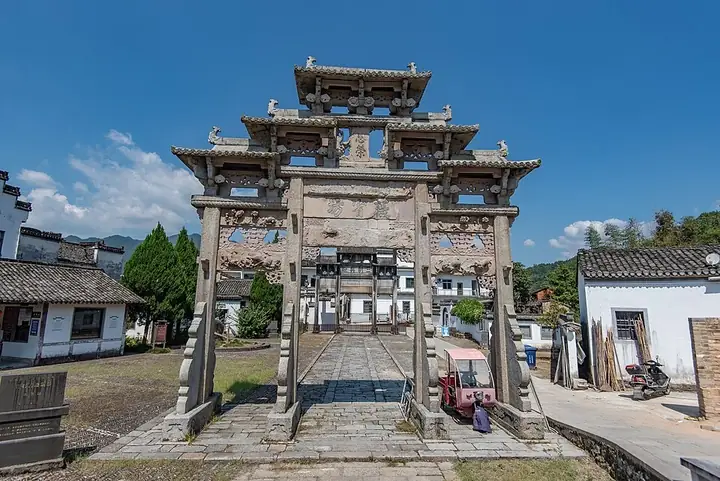
East of the office, outside Yanghe Gate, stands the Xu Guo Stone Archway (许国石坊), the county's most recognisable monument and the anchor of the old centre. Built in 1584 for Xu Guo, a Wuying Hall grand secretary, it is a four-sided arch: two three-bay, four-pillar, three-roof sections front and back are joined by single-bay sections on either side, giving eight pillars in all — the reason it is known locally as the eight-footed archway (八脚牌楼). It measures 11.54 m by 6.77 m and stands 11.4 m high, cut from hard, dark-green 茶园石; every bracket, beam, plaque and sparrow brace is carved, twelve lions sit on the bases, and each of the four faces carries a different scene, from a leaping dragon on the south face to cranes on the north. The inscriptions are by the Ming painter-calligrapher Dong Qichang.
From there, walk Doushan Street (斗山街), the residential lane where merchant houses stand behind high walls with carved entrances, old wells in the side alleys and small arches over doorways. Inside the old town you can also visit the Xin'an Stele Garden (新安碑园) with its inscribed stones, the Tao Xingzhi Memorial Hall (陶行知纪念馆), Huiyuan Garden (徽园) and Taibai Tower; all four are commonly listed among the town's principal sights.
On admission: the old town itself is not gated — visitors walk in freely — while individual sights such as the prefectural office are ticketed separately, and the evening performance-based night tour is sold as its own product. Prices reported in 2025 were ¥48 for the prefectural office and ¥98 for the night tour; treat both as indicative and check the current booking channel before travelling.
Yuliang: the weir and the old wharf street
One kilometre south of the walled town, the Yuliang Dam (渔梁坝) crosses the Lian River. First built in the Tang and rebuilt in 1605, it is about 140 m long, 27 m wide at the base and 4 m at the crown, assembled from blue stone blocks of roughly a tonne each, locked with stone keys between the courses and fitted with a sluice gate in the middle. The dam held water upstream for boats and released it downstream, and this was the wharf from which Ming and Qing Huizhou merchants set out for Zhejiang and Jiangsu. The Ming Ziyang Bridge just below was built unusually tall — about 14 m — so that masted boats could pass. The cobbled Yuliang Street runs off the dam's northern end, with side alleys dropping towards the water and former wharf buildings along the way.
The villages: archways, water-mouths and rammed earth
Tangyue (棠樾), in Zhengcun town, is the county's archway village: the Bao clan's line of seven Ming and Qing memorial arches stands on the approach to the village. The group is a nationally protected site and, in the culture ministry's wording, an outstanding representative of Chinese archway clusters. The neighbouring Bao Family Garden is a bonsai garden; the two are ticketed together, reported at ¥100 full fare and ¥50 concession.
Xucun (许村), in the north of the county, keeps more than 200 Yuan, Ming and Qing structures — archways, pavilions, a covered bridge — and is the clearest place in the county to see water-mouth design, the composed landscape at a village's stream exit. The Fang and Sheng streams meet south of the village; the Gaoyang covered bridge, the Daguan Pavilion and the Double-Longevity Arch were placed to frame that exit, and the village's protected monuments include the Xucun ancient building complex, with fifteen individual points, and the Xu clan ancestral hall. Some old houses have been converted into small homestays.
Yangchan (阳产) is a rammed-earth village on a slope above Shendu town, around 800 m up, with more than 300 earth houses built in tiers — the largest and best-preserved cluster of its kind in southern Anhui and a sharp contrast to the whitewashed Huizhou style. Houses are mostly three storeys, with animals and storage at ground level, living space in the middle and sleeping rooms above; the walls are rammed earth mixed with bamboo and glutinous rice paste. Cars stop at a car park below the village and a shuttle continues up the narrow road (a 2026 visitor account mentions ¥30 round trip; confirm on arrival). In autumn, households spread chillies, corn and chrysanthemums on trays and rooftops to dry.
Shitan (石潭) in Xiakeng town is a hillside village rather than a monument, visited in spring when the terraces below it fill with rapeseed.
Working trades: ink, inkstones, chrysanthemums and tea
She County is a principal production area for Hui ink (徽墨) and She inkstones (歙砚), the two scholar's-table crafts that made Huizhou's name.
The She County Laohukaiwen Ink Factory (歙县老胡开文墨厂) is the one place in the county where visitors can walk a working ink workshop. Founded in 1782, merged from four ink houses in 1956 and renamed in 1982, it has opened its production halls — soot, kneading, moulding, drying, gilding — to visitors, and in its study-tour workshops you can pound ink paste and paint gold onto a plain ink stick. The factory buildings entered the national industrial heritage list in 2019, and the site reports 190,000 study-tour visitors in 2025. Hui ink making was placed on the first national intangible-heritage list in 2006.
She inkstone carving was likewise listed nationally in 2006, with She County named as one of the declaring areas. Stones are grouped by grain into five classes — 罗纹, 眉纹, 金星, 金晕 and 鱼子 — with more than a hundred varieties, and the work centres on carving: choosing the stone, reading its grain, designing the shape, carving, polishing and fitting the box. The result is a stone dense enough to hold ink without leaking it.
Huangshan tribute chrysanthemum (黄山贡菊, also called 徽州贡菊) has been grown here for about 700 years, originating in Jinzhu village, Beian town (北岸镇金竹村); it has been a protected geographical-indication product since 2004 and is dried for tea and used medicinally. She County is also one of the main growing areas of Huangshan Maofeng tea (黄山毛峰).
Getting there and around
There is no metro in Huangshan, so no subway option applies anywhere in the county. The practical ways in and out are high-speed rail, tourist and city buses, coaches, taxis and boats.
Rail. Two stations serve the county and they are different places. 歙县北站 (Shexian North) is the high-speed station, in Chengshi village, Fu'e town (富堨镇承狮村), on both the Hefei–Fuzhou and the Hangzhou–Nanchang high-speed lines; it opened on 28 June 2015 and stands under 5 km (straight-line distance) from the county town. 歙县站 (Shexian station) is the older station on the conventional Wan-Gan railway at 新安路89号 in Huicheng town; it is a small class-4 station with few stopping trains, so check the timetable before building a plan on it.
Tourist bus from Huangshan North. The simplest arrival for the old town is 游1路 between 高铁黄山北站 (Huangshan North high-speed station) and 徽州古城游客中心 (Huizhou Ancient City Visitor Centre). It calls at Xixinan, Tangmo scenic area, Wangcunbian, 棠樾牌坊群 (Tangyue archways) with 鲍家花园, Zhengcun, the Shexian highway coach station, Shezhou Square and Huishang Mansion before the visitor centre — so you can break the journey at the archways. The April 2025 schedule gave about 36 departures a day in each direction and roughly 60 minutes end to end, first bus 09:00 and last 19:40 from Huangshan North, 08:20–18:40 from the ancient city; holiday timetables differ. The fare is metered: ¥10 for the full run, ¥5 up to Wangcunbian. Operator hotlines: Huangshan Intercity Bus 0559-2558518, Shexian Hanghui Public Transport 0559-6512536.
City buses. Flat ¥1 fare. Reported routes: 701路 links 歙县公路客运站 (the highway coach station) with 歙县北站, calling at 歙县站, with roughly 06:50–20:00 and 07:20–20:45 working hours; 1路 passes 歙县站, 徽州府衙, 古城游客中心 and 渔梁景区 on its way south-east; 2路 runs from the town centre to 牌坊群 (the Tangyue archways) via 古城游客中心, 徽州府衙, 郑村 and 鲍家花园. These line numbers and hours come from an encyclopaedia entry last updated in October 2026 rather than from the operator, so confirm at the stop.
Coaches. 歙县公路客运站 stands in Yangcun, at the junction of Shezhou Avenue (S215) and Xingzhi Avenue in Huicheng town. It handles long-distance services to Shanghai, Hangzhou, Nanjing, Hefei and other cities, intercity buses 6001/6002 and the 歙屯快线 to Huangshan Passenger Transport Terminal in Tunxi (¥5 flat fare), and the rural routes into the county's towns and villages.
Boats. Cruises on the Xin'an River Landscape Gallery leave from Shendu Port (深渡港/深渡码头), about 26 km from the old town. The scenic-area cruise runs roughly 3.5 hours with shore stops, and a long-distance boat links Shendu with Qiandaohu. Cruise times and fares here come from a tour operator's guide — cruise ticket reported at ¥68, scenic-area admission ¥80, upper-deck upgrade extra — and should be confirmed at the port, since seasonal services change.
Taxi or ride-hailing. There is no single drop-off for the county; give the driver the exact site. Useful Chinese destinations: 徽州古城游客中心 (visitor centre), 徽州府衙 (prefectural office), 渔梁坝 or 渔梁村 (the weir and wharf street), 棠樾牌坊群 (archways), 许村 (Xucun village), 深渡港 (Shendu port), 阳产土楼游客中心 (Yangchan shuttle car park) and 歙县北站 (high-speed station).
When to go, and how long to give it
Two or three days is a workable minimum: one for the old town and Yuliang, one for the archways and Xucun, one for the river and the hill villages. Spring (March–April) brings rapeseed on the terraces around Shitan and along the Xin'an; autumn (late September–October) brings the drying trays of Yangchan; midsummer is hot and humid, and the villages are quiet but cold in winter. The old town is a lived-in town rather than a closed museum, so expect ordinary traffic, school groups and renovation work on individual buildings.
Where to stay
Nearly all lodging is in Huicheng town, within walking distance of the old town walls; the one international-brand property verified here is the ibis Huangshan Shexian Huizhou Ancient City hotel at 披云路1号 (Piyun Road 1). A small number of village homestays exist in the older villages — Xucun has at least one run by a family in its own old house — but capacity is limited and booking is mostly through domestic channels, so reserve early if you want to stay outside the county town.
Guide sources
- 歙县 — 维基百科
- 歙县北站 — 维基百科
- 黄山北站⇌徽州古城!旅游公交优化调整(来源:黄山市人民政府发布)
- 黄山北站⇌徽州古城!中秋国庆期间旅游公交运营有调整(歙县融媒体中心,经新浪财经转载)
- 5A级旅游景区 - 黄山市古徽州文化旅游区(中华人民共和国文化和旅游部)
- 中国之城丨歙县:一座没有屋顶的徽派文化艺术馆(新华社)
- 许国石坊 — 维基百科
- 渔梁坝 — 维基百科
- 走进安徽歙县老胡开文墨厂:一缕徽墨香 玩转新消费(中国文明网转载)
- 歙砚制作技艺 — 中国非物质文化遗产网
- 七百年黄山贡菊焕新机 助力乡村振兴(中国新闻网安徽)
- 徽州古城(门票与开放信息)— Klook
- 古徽州文化旅游区门票与预约信息(合肥本地宝,2025 年 9 月更新)
- 歙县站 — 百度百科
- 歙县公路客运站 — 百度百科
- Ancient Huizhou Town — Huangshan Tour Guide
- Xin'an River Landscape Gallery — China Discovery
- 藏在徽州深处的土楼秘境——阳产土楼(北京日报客户端“北京号”作者稿)
- 宜必思黄山歙县徽州古城酒店 — Accor
Explore She County
Core places to explore, with English and Chinese names.
Places to explore around She County
 Xu Guo's eight-pillared stone archway, raised in 1584, spanning the crossroads in the old town. Photo: Zhangzhugang · CC BY-SA 4.0
Huizhou Ancient City徽州古城
The old prefectural seat of Huizhou in She County, where prefecture and county shared one circuit of walls for over 1,400 years. The lanes are open and lived in; the anchors are the 1584 eight-pillared Xu Guo archway, a prefectural office rebuilt on its Ming plan, and Doushan Street's merchant houses.
Read the place guide →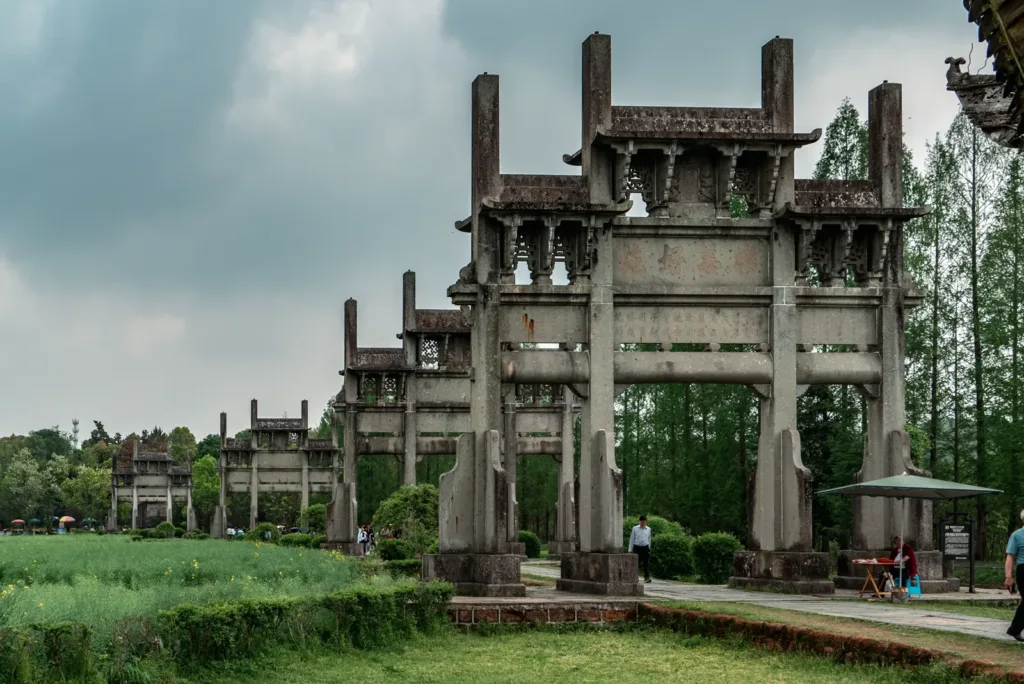 The row of Ming and Qing arches along the east avenue at Tangyue, seen from the farmland beside the processional way. Photo: 王淞 (uploaded to Wikimedia Commons by user 来斤小仓鼠吧) · CC BY-SA 4.0
Tangyue Memorial Archways棠樾牌坊群
Seven Ming- and Qing-dynasty stone arches built between 1420 and 1820 line the east avenue of Tangyue village near Shexian, in Huangshan: one family's public record of loyalty, filial piety, chastity and charity, with the Bao lineage's ancestral halls a few minutes' walk away and the family's bonsai garden about 500 m beyond.
Read the place guide → Yuliang Dam seen from the south bank: the weir runs bank to bank, with the flat pool above it and Yuliang village on the north shore. Photo: Poorjohnny · CC BY-SA 4.0
Yuliang Dam渔梁坝
Yuliang Dam is a Ming-era stone overflow weir across the Lian River at Yuliang village, about a kilometre south of She County's old town. Blocks of over a tonne are pinned and locked into one mass, three spill gates step down from north to south, and the pebble-paved street behind the dam was the wharf from which Huizhou merchants sailed for Zhejiang and Jiangsu. It has been free to walk since April 2023.
Read the place guide →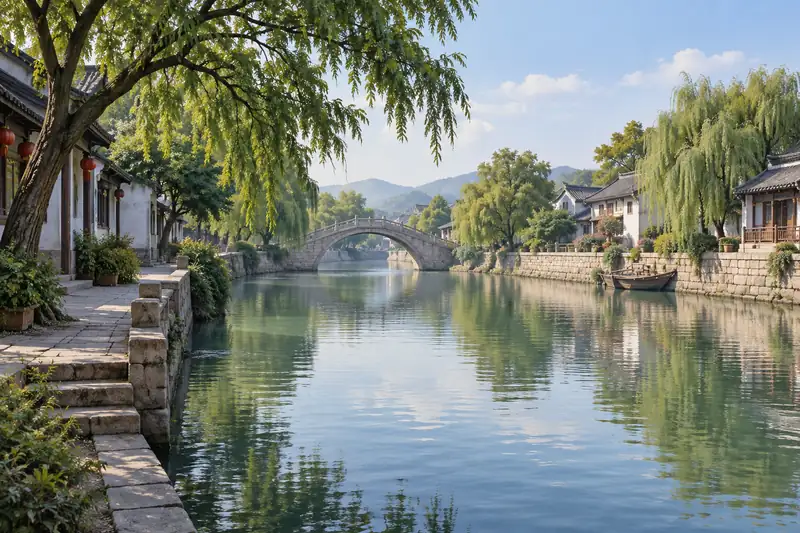 AI illustration · AI 示意图(仅供参考,非该地点实拍)
Xin'an River Landscape Gallery新安江山水画廊
A stretch of the Xin'an River in She County, Huangshan, where wooded hills, tea and loquat slopes and white-walled Huizhou villages line both banks. Boats leave Shendu Wharf on a roughly three-hour round trip that calls at the riverside villages of Jiusha, Miantan and Zhangtan, so the sightseeing unit here is the valley rather than a single village.
Read the place guide →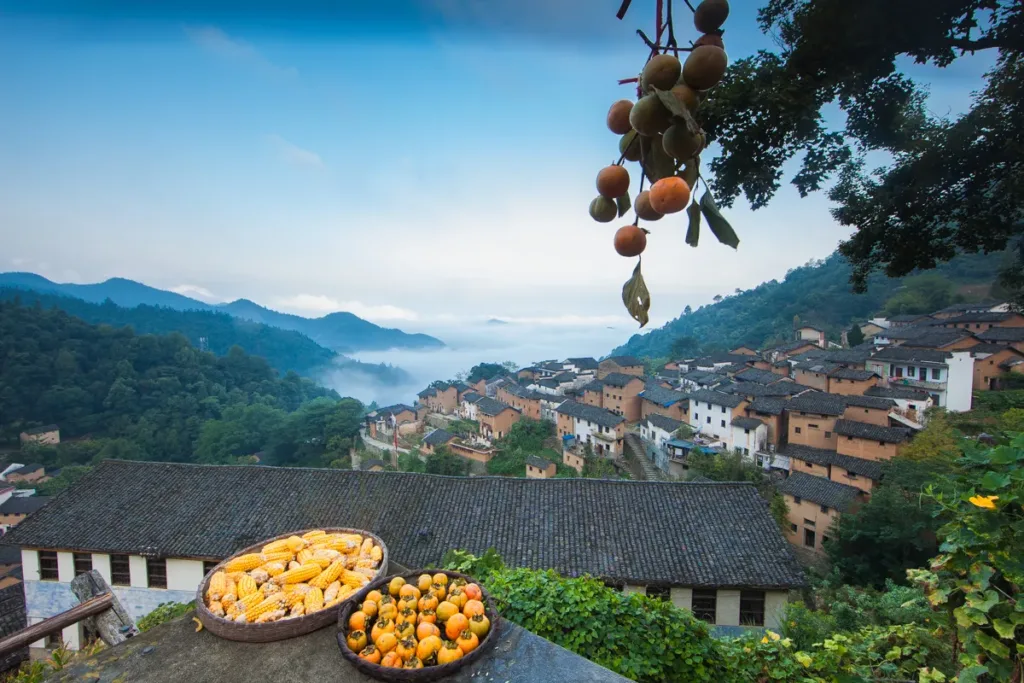 Baskets of drying maize and persimmons on a tiled roof above the Yangchan houses, with mist filling the valley below Photo: Deweicoffee (Wikimedia Commons) · CC BY-SA 4.0
Yangchan Tulou Village阳产土楼
Yangchan Tulou (阳产土楼) is a hillside village of some 360 rammed red-earth houses in Shendu Town, She County — the largest surviving cluster of earthen buildings in southern Anhui, and a sharp contrast to the whitewashed Huizhou villages nearby. Stone lanes, three-storey earth houses and autumn trays of maize and chillies on the roofs are the draw; entry is free, but cars stop below and visitors ride the shuttle up.
Read the place guide →Plan your visit
Getting there
She County is about 20 km (straight-line distance) from central Huangshan. Search for 歙县 in a map app to find stations and your accommodation.
Where to stay →Build your route
Huizhou Ancient City and Tangyue Memorial Archways are about 6 km apart (straight-line distance). The linked place guides have entrance and visit details.
Continue with Huangshan →More in Huangshan
Sources & geographic information
Administrative names and parent areas: Official geographic directory (dmfw.mca.gov.cn) · Reference date 2026-09-06.
Background text adapted from She County, Anhui — Wikipedia contributors, under CC BY-SA 4.0. Text has been shortened and reorganized; source revision 1338807680.
Map data © OpenStreetMap contributors. Pins mark approximate centres, not entrances or boundaries.
Image credits & notes (1)
- The historic stone gateway and village street in Xucun village, She County, Anhui. Photo: 2021-09-26 12:02:54.Photo: Siyuwj · CC BY-SA 4.0Resized for the web; the photo itself has not been edited. Thumbnails may show a cropped view.
