

Huizhou steamed cured pork 徽州刀板香
Salt-cured pork belly from the old Huizhou region, dried through the winter and steamed over bamboo shoots on a wooden board, then sliced warm and eaten with plain rice. Salty, rich and at its best in spring, when the Wenzheng Mountain shoots come in.
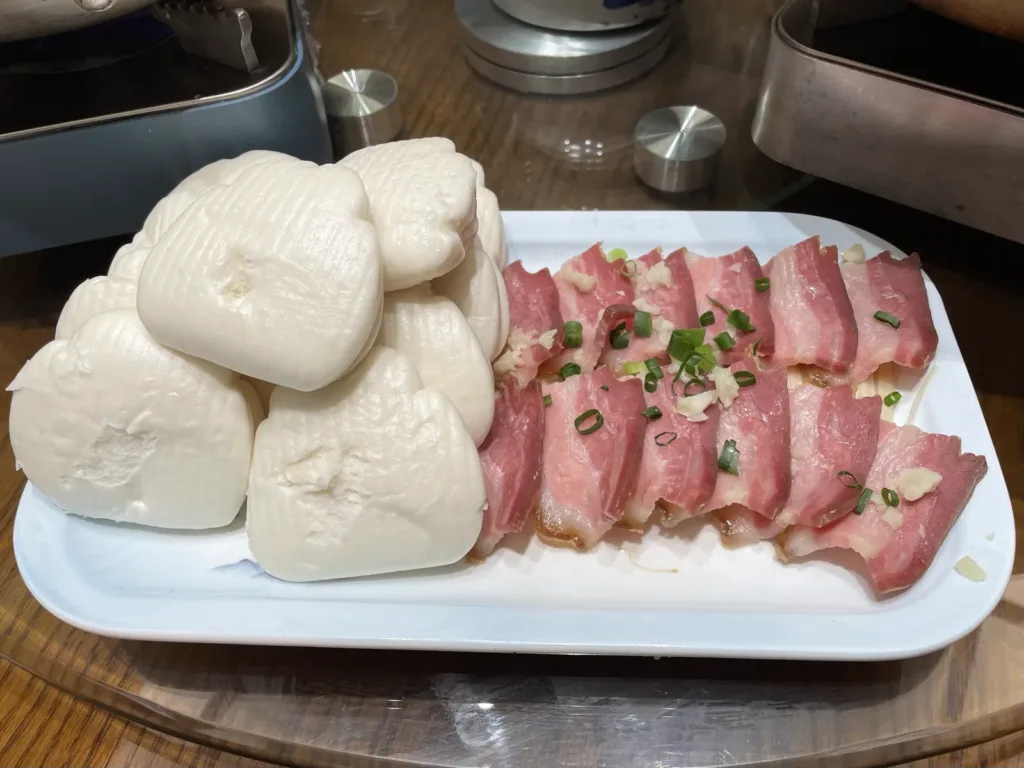
Salt-cured pork belly, dried through the winter and steamed over bamboo shoots on a wooden board: daobanxiang (刀板香, dāo bǎn xiāng, “knife-board fragrance”) is one of the two dishes travellers to Huangshan are told not to miss, alongside stinky mandarin fish. The board is not a prop — it is part of how the dish is cooked and how it tastes.
What it is
Daobanxiang belongs to the cured-pork repertoire of the old Huizhou region in southern Anhui. Pork belly is cured with salt in winter, dried until it turns amber and glossy, then steamed and sliced. It comes to the table warm, usually with plain rice, and in the traditional presentation the slices are still on the wooden board they were steamed on. In Huangshan the same word also names the cured slab that is sold as an ingredient, before any cooking happens.
The name and the story behind it
The story local kitchens tell concerns Hu Zongxian (胡宗宪), the Ming-dynasty Minister of War and anti-pirate commander from Longchuan in Jixi. Returning home, he stopped at Wenzheng Mountain (问政山) near Shexian to visit his old teacher; the teacher’s wife laid pork from the family’s winter cure over local mountain bamboo shoots and steamed the two together on a cutting board. Tasting it, he is said to have remarked on the fragrance the board had taken on, and the dish became 刀板香.
Treat this as the story attached to the dish rather than a dated historical record. It is repeated by chefs, provincial media and encyclopedias, and the details shift between tellings.
How cured pork becomes daobanxiang
Curing and drying. Pork belly is rubbed with salt — traditionally from local breeds such as Huizhou black pigs and the Lantian spotted pig, which is listed separately as a Xiuning County specialty. Producers in Huangshan describe the traditional window as running from the winter solstice through the twelfth lunar month, with temperatures below 10 °C and drying done on bright days with a steady breeze. Household recipes give different curing times, from about a week to around 40 days; the meat then sun-dries until it yellows and the fat beads on the surface, and finishes indoors in spring, in the draught that moves through old Huizhou houses. The result is a firm, salty slab with the cured, faintly ham-like aroma that southern Anhui cooking is built on.
Steaming and slicing. The slab is rinsed, then steamed or boiled to roughly 70–80 per cent done, which leaves it firm enough to cut: traditional home versions slice it about a centimetre thick, restaurant versions as thin as 2 mm. The slices are then steamed a second time over bamboo shoots, so the shoots sit between the meat and the heat.
The shoots. Bamboo shoots are the second half of the dish: they take up fat and add a fresh, faintly sweet note. The preferred shoots are 问政山笋 from Wenzheng Mountain in Shexian — described in a local gazetteer quoted by provincial sources as red-sheathed, white-fleshed and so tender it breaks when it falls — and 问政山贡笋 is listed among Shexian’s specialties on Anhui’s official touring routes.
The board
Traditional accounts say the pork was steamed on a slab of camphor wood (香樟木), whose aroma worked into the steam while its porous surface drew off fat. A Huangshan chef quoted by Anhui’s tourism channel disagrees: camphor was used in the province for insect-repelling chests rather than for food, he says, and kitchen boards are ordinary fir (杉木), pine (松木) or maple (枫木), kept for years until the surface is worn dark. Other descriptions name other woods again. Whichever wood a kitchen uses, the board does the same job: it holds the slices, drains part of the fat, and gives the dish its name.
Flavour and texture
This is salt-cured pork at full strength: a dense, savoury lean section, fat that softens to translucent, and little of the greasiness you would expect from pork belly, because some of the fat has run off into the board and the shoots. A Huangshan chef describes the aroma as three things at once — cured pork, wood and bamboo shoots (三香合一). It is rich enough that a few slices carry a whole bowl of rice, and the saltiness depends on the cure and on how thoroughly the kitchen rinses and cooks the meat.
How it comes to the table
Versions differ by kitchen and season:
- Board and shoots. The traditional service: slices laid over steamed or stewed bamboo shoots, brought out on or from the board.
- Stewed with spring shoots. Cured pork simmered with fresh spring bamboo shoots in a clay pot, then lifted out and sliced — the version families cook when the shoots come in.
- Restaurant plating. A modern method steams the meat for around 40 minutes, slices it thin, lays it over stir-fried tea bamboo shoots (茶笋丝) with dried chilli, and steams the assembled plate for a few more minutes.
- Made with Huizhou ham. Some kitchens use the region’s cured ham instead of salt pork, soaked and steamed before its final steam.
- As an ingredient. The cured slab is sold vacuum-packed in roughly 300 g or 500 g pieces as a gift item, and is also made at industrial scale in Huangshan District.
Ordering it
Show the characters 徽州刀板香 or 刀板香 on your phone. Two questions are worth asking before the dish lands: 是咸肉还是火腿? (“is it salt-cured pork or ham?”) and 下面有笋吗? (“is there bamboo shoot underneath?”).
What to know at the table:
- It is pork, cured with salt and steamed in its own fat, so it is not a vegetarian dish and not suitable if you avoid pork or lard.
- It is salty and rich: order one portion to share with plain rice and a green vegetable rather than as a solo main.
- The dish is at its best in spring, when fresh shoots are in season — the season both Huizhou cooks and provincial media single out.
Why it belongs to Huangshan
Daobanxiang is a Huizhou-region dish rather than a Huangshan-only one. Hui cuisine cooking techniques are inscribed on China’s national intangible cultural heritage list (fifth batch, 2021, No. Ⅷ-270), and that heritage is defined by the old Huizhou prefecture’s six counties: today’s Shexian, Xiuning, Yixian and Qimen in Huangshan City, plus Jixi — now in Xuancheng — and Wuyuan in Jiangxi. Daobanxiang is named among the dishes that illustrate the technique, described in the heritage material as cured pork boiled, sliced and steamed on a wooden board. Jixi, the Minister of War’s home county, markets itself as China’s hometown of Hui cuisine and also claims daobanxiang as a local specialty, while Anhui’s provincial list of 200 must-eat dishes files 徽州刀板香 under Huangshan City, in the hot-dish category.
Where to eat it
You can find Huizhou steamed cured pork all over Anhui, so there is no need to seek out one particular restaurant. To find one near you, search for “徽州刀板香” in Meituan (美团) or Amap (高德地图) and check recent reviews, distance and opening hours.
More dishes to compare
Explore related local specialties and compare their names, preparation notes and ordering guidance.
Linhuan fermented-tofu pork 临涣培乳肉 →
Pork is seasoned with fermented bean curd and cooked slowly until its fat and connective tissue soften. The bean curd dissolves into the sauce rather than remaining as large tofu cubes. The result is deeply savory, rich and soft, with a fermented aroma that distinguishes it from an ordinary soy-sauce braise. Sauce strength varies by kitchen.
Bengbu pork-filled sesame bun 烧饼夹里脊 →
A sesame flatbread is split and filled with cooked pork tenderloin, often with sauce and optional vegetables. Shops may fry the meat or use a different cooking style. Crisp sesame bread meets tender, seasoned pork, with sauces adding sweetness or heat and vegetables bringing freshness.
Sources & reading
Recipes and servings vary between kitchens.
- Eating in Huangshan (China Expedition Tours guide)
- Hui Cuisine — China's Wild Cuisine (China Highlights)
- 美食带你游安徽|徽菜经典——刀板香 (Anhui travel channel, 2022-06-15)
- 徽州名菜刀板香 (Sohu feature, 2017-03-01)
- 刀板香 (Baidu Baike)
- 徽州刀板香 (Baidu Baike)
- 首批游安徽「不得不吃」的特色美食(小吃)名单 (Anhui 200-dish list, PDF)
- 全江牌徽州刀板香 (China Food Safety News, 2023-05-31)
- 徽菜烹饪技艺 (China Intangible Cultural Heritage, ihchina.cn)
- Huizhou Cuisine Cooking Techniques (Baidu Baike, English)
- 安徽自驾游线路推荐 (Ministry of Culture and Tourism, 2020-09-23)
Image credits & notes (1)
- Sliced salt-cured pork served with plain steamed buns, photographed in Anhui in 2023 and described by the photographer as daobanxiang. Photo: Zheng ZhouPhoto: CC BY-SA 4.0