

Dried Milk Curds 奶疙瘩
Dried milk curds (奶疙瘩) are concentrated curds from Altay's Kazakh pastoral dairy tradition, valued as a portable snack; ask for local variations such as 酸奶疙瘩 rather than assuming one fixed recipe.
Tap any red Chinese text to hear it in Mandarin.
A portable dairy food from Altay’s pastoral kitchens
Dried milk curds, or 奶疙瘩 Nǎigēda, are a concentrated dairy food associated with Kazakh herding families in Altay Prefecture. They are not one fixed cheese with one universal recipe. In a Fuhai County account, dairy appeared at everyday meals and sour curds, 酸奶疙瘩 Suānnǎi Gēda, were remembered as a favourite snack for children waiting beside the drying pieces.
The appeal is in the change from fresh milk to a small, durable bite. A Fuhai maker reported that spring milk is thinner than autumn milk and that one kilogram of milk yields about 200 grams of curd. She also stressed that households work by experience rather than exact measures, with the starter culture, 引子 Yǐnzi, making a major difference to the result.
How it is made
A documented pastoral method starts by collecting milk over several days, cooling and stirring it, then boiling it. The butter is lifted off, while the remaining dairy is wrapped in gauze and hung to drain. It is pressed into lumps and dried for about three days. Strong direct sun can crack the pieces and darken them, so drying conditions matter.
A separate 2024 report from another Xinjiang Kazakh and Uzbek food-making community describes a workshop method: fresh milk is heated, a yoghurt starter is added for fermentation, and the curd is filtered, cut into small blocks and dried for storage. This is a useful documented variant, not a replacement for every Altay household method. The practical lesson is that 奶疙瘩 Nǎigēda is made through concentration, draining and drying, while the order of fermentation, butter removal, shaping and heating can differ.
Texture, taste and real variations
Expect a firm, concentrated curd rather than the mild, moist texture of fresh yoghurt. Sourness, saltiness, sweetness, fat and hardness can change with the milk, starter, season and drying time. In the Altay account, 酸奶疙瘩 Suānnǎi Gēda is the clearly named sour-style option.
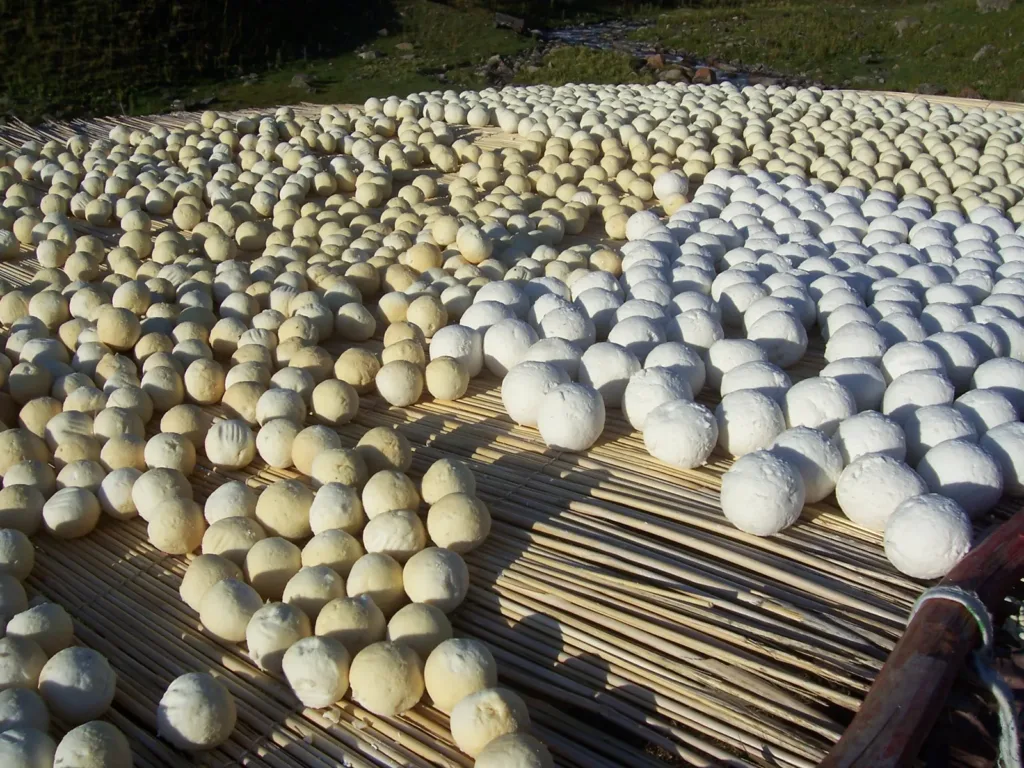
The wider Kazakh qurt tradition helps explain why no single shape or serving rule should be imposed on Altay. Freshly made pieces are softer, while longer drying makes them harder; some are pressed into hand-shaped pieces or small balls. Qurt is eaten as a snack and, in some Kazakh traditions, dissolved in water or broth, with acidity and saltiness becoming part of the flavour. Ethnographic writing also records different starter systems, curd bases and shaping methods, so these broader comparisons should be read as regional context rather than a claim that every Altay batch follows them.
For a tasting, ask what kind of 奶疙瘩 Nǎigēda is being offered and whether it is fresh, lightly dried or fully dried. It may be pleasant to nibble in small pieces, but do not assume that a batch is sweet, mild, low-salt or lactose-free. It is a milk product; people with milk allergies or dietary restrictions should ask about ingredients and preparation before eating.
How to look for it without inventing a restaurant
This is a regional food, not a single shop or attraction. Search for 奶疙瘩 Nǎigēda on Meituan (美团) or Amap / Gaode Maps (高德地图) near your current town. Add 酸奶疙瘩 Suānnǎi Gēda if you want the sour style, or add 阿勒泰 Ālètài and the county or town name if a broad search is ambiguous. Check the menu, recent reviews, opening information and whether the result is a shop, market stall or packaged dairy listing before setting out. Map ranking is not proof of quality or authenticity, and this guide does not endorse a particular seller.
Getting there and getting back
奶疙瘩 has no dedicated entrance, ticket, station, final shuttle or return route. Once you choose a live nearby listing, use that seller’s Chinese address for the last local taxi, ride-hailing or walking leg, and confirm that the business is open before travelling. Return by the same local transport arrangement or continue to your next stop after checking the map listing again. Exact minutes, fares and a fixed public-transport route cannot be stated until a specific seller is selected; no such route is inherent to the dish.
Sources & reading
Image credits & notes (1)
- Kurut drying on bamboo racks in Kyrgyzstan — a regional qurt reference for Altay's dried milk curds, not a claim of local provenance. Photo: Paul MunhovenPhoto: CC BY-SA 3.0