

Zhaosu Horse Meat 昭苏马肉
Zhaosu Horse Meat is an Ili specialty tied to Zhaosu’s horse country: salted or smoked horse meat, sometimes horse sausage, served on its own or as horse-meat narin with wide noodles, broth, and onion.
Tap any red Chinese text to hear it in Mandarin.
If you are travelling through Zhaosu County, this is a dish to seek for its strong local connection rather than a single fixed recipe. Zhaosu lies in the western Ili Valley and is one of Ili’s core horse-producing areas; a 2024 report says horse products there are processed into meat and other products. Local tourism material describes horse-meat narin as smoked horse meat and horse intestine served with noodles.
What you are tasting
An Ili government food guide describes Zhaosu horse meat as lean, with visible grain and a firm, elastic bite. It also describes a related sausage smoked with Tianshan pine branches, giving it a glossy surface and pine aroma. These are useful markers, not a promise that every kitchen uses the same cut or smoke level.
Traditional regional methods vary. A Yining government account of Kazakh smoked meats describes salting meat before pine-wood smoking; its horse-sausage variation fills cleaned intestine with strips of rib meat, salt and pepper, then air-dries it for about a month. Treat that as a regional traditional variant, not a mandatory Zhaosu recipe.
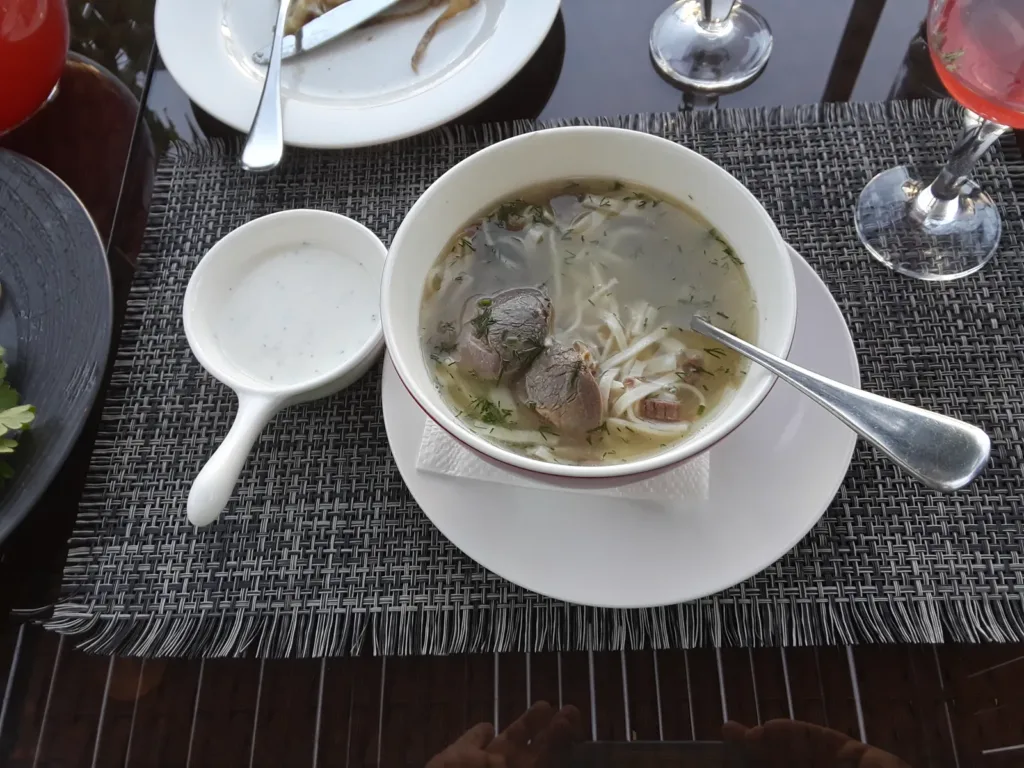
Horse-meat narin is the most useful way to order the dish if you want a complete bowl. The official guide describes broad, belt-like noodles cooked in horse-meat broth, with the noodles and broth poured over smoked horse meat and chopped onion added on top. A separate Yining government description of classic narin (using lamb) explains the broader serving logic: meat is cooked, noodles are boiled in the broth, and onion or other seasonings are added; the diner may cut and mix the meat with the noodles. Ask whether a serving includes horse sausage as well as meat, and whether the kitchen serves it as narin or as sliced smoked meat; those are different presentations.
How to look for it
This is a regional dish, not a ticketed attraction or a single venue, so it has no visitor entrance, ticket, or fixed transport route. In Zhaosu County or another Ili stop, search the Chinese names 昭苏马肉 Zhāosū Mǎròu, 马肉纳仁 Mǎròu Nàrén, and 熏马肉 Xūn Mǎròu in Meituan (美团) or Amap/Gaode Maps (高德地图). Open nearby results and check the menu text or a recent menu photo, reviews with dates, today’s opening status, and whether the dish is available that day. If the listing does not say whether it is horse meat, horse sausage, or the lamb version of narin, confirm before ordering. Do not treat a map listing as proof of a current supply.
The Ministry of Culture and Tourism’s 2022 Zhaosu route gives June–August as the route’s best travel period, but that is a dated, route-level recommendation—not a current promise that horse meat or a particular shop will be open. Smoking itself has traditionally been associated with late autumn and winter preparation in regional Kazakh households. For a current trip, ask locally about same-day supply rather than relying on either seasonal label.
Dietary questions
If you need halal, vegetarian, allergy-safe, or alcohol-free food, ask the kitchen about the meat source, broth, sausage casing, seasonings, and shared cookware. Do not infer suitability from the dish’s appearance, name, or a generic “local food” label.
Image credits & notes (1)
- Horse-meat qazı and noodles in naryn soup at a restaurant in Nur-Sultan, Kazakhstan; a regional illustrative image, not a Zhaosu-specific photograph. Photo: Ser Amantio di NicolaoPhoto: CC BY-SA 4.0