

Yexie soft rice cake 叶榭软糕
A Songjiang specialty made from finely milled rice, Yexie soft rice cake is steamed into a tender, lightly springy cake. Look for plain or filled versions; bean paste and red-and-green winter-melon strips are traditional accompaniments, while recipes differ between makers.
Tap any red Chinese text to hear it in Mandarin.
What it is
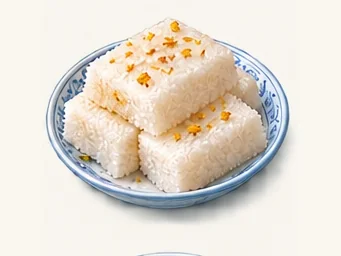
Yexie soft rice cake is a steamed rice-flour cake associated with Yexie in Songjiang, southwestern Shanghai. Its defining texture is soft and finely crumbed, with some spring rather than the dense, elastic chew of many glutinous-rice dumplings. Local descriptions call it song, ruan, tian, xiang, fei—loose or fluffy, soft, sweet, fragrant and rich. The rice and method matter more than a single fixed shape or filling.
It belongs to a broader local Songjiang food tradition, not a claim that all Shanghai rice cakes are made this way. The Yexie craft was recognized as Shanghai intangible cultural heritage in 2011, according to the district government.
Rice, steaming and fillings
A local maker’s account describes a traditional blend of white japonica rice with a smaller share of glutinous rice, specifically 90:10. Treat that as one reported traditional formula, not a guaranteed ratio for every producer. The grains are soaked, ground—traditionally with a stone mortar—and sifted to a fine powder. The powder is layered into a mold or steaming frame, a hollow is made for filling, more flour covers it, and the cake is steamed and released from its mold.
A filled cake may have sweet bean paste at its centre, with red and green candied winter-melon strips used as a visible garnish. The same district reporting also describes plain versions and newer fillings; the filling and shape can vary by maker and occasion. The plain cake is typically pale and finely textured. A filled square can show a dark red-brown bean centre against a white rice layer, with coloured melon strips on top.
The finished cake is tender and lightly springy, not a sticky, strongly elastic mochi-like bite. One maker’s description contrasts it with nian gao as easier to chew and with a glutinous-rice dumpling as more substantial. Bean paste adds a mellow sweetness; the rice brings a quiet grain aroma. These are descriptions of reported local examples, not a promise that every shop’s cake tastes identical.
How to eat it
It is best understood as a small steamed sweet or gift cake rather than a stir-fried rice-cake dish. Eat a fresh piece while its crumb is soft; for a filled square, cut or bite through the rice layer and centre together. A Yexie maker interviewed in 2020 described adding mint in some summer batches, but seasonal availability should not be assumed.
For ordering, show 叶榭软糕 Yèxiè ruǎngāo and ask whether the piece is plain or filled and what the filling contains.
Where to eat it
You can find Yexie soft rice cake all over Shanghai, so there is no need to seek out one particular restaurant. To find one near you, search for “叶榭软糕” in Meituan (美团) or Amap (高德地图) and check recent reviews, distance and opening hours.
More dishes to compare
Explore related local specialties and compare their names, preparation notes and ordering guidance.
Bar-shaped rice cakes 条头糕 →
Glutinous-rice dough is shaped into slender bars, commonly around sweet bean paste, and cooked until soft. Some versions carry a light osmanthus fragrance or finishing syrup. The wrapper is chewy and supple, contrasting with the smoother, denser filling. Its sweetness and sticky texture make a small piece quite satisfying.
Eight-treasure sticky rice 八宝饭 →
Sticky rice is steamed with a sweet filling, often bean paste, and arranged with dried fruit or nuts before being turned onto a serving plate. Additional syrup or fat may enrich the rice. The dessert is dense, glossy and chewy, with concentrated sweetness and contrasting bits of fruit or nuts.
Sources & reading
Recipes and servings vary between kitchens.