

Explore the region
Tap any red Chinese text to hear it in Mandarin.
What makes Fuzhou feel like Fuzhou
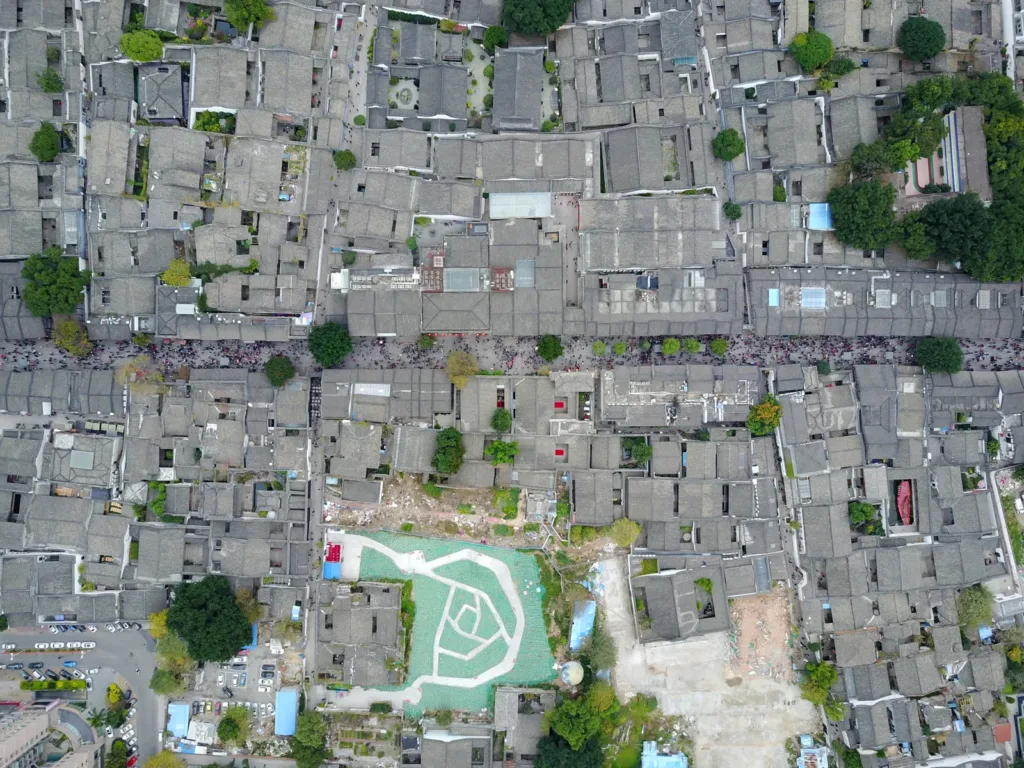
Fuzhou is easiest to understand at walking speed. The central historic quarter, Sanfang Qixiang (三坊七巷), is not just a decorated shopping street: three lanes sit to the west of Nanhou Street and seven alleys to the east, preserving the logic of the old city. The Fujian provincial government describes roughly 270 old residences and 159 listed preserved buildings here, including former homes associated with Yan Fu, Bing Xin and Lin Zexu.
Use Nanhou Street as your orientation, then turn into Yijin Lane (衣锦坊), Wenru Lane (文儒坊), Guanglu Lane (光禄坊), Yangqiao Alley (杨桥巷) or Langguan Alley (郎官巷). Look down at the flagstone paving, then up at the white walls, dark tiled roofs, carved timber and the changing width of each lane. The point is to notice how courtyards and thresholds make a residential neighbourhood, not to collect one identical facade after another. Fuzhou’s own city introduction calls the surviving layout a “living fossil” of the old ward system.
A good first day adds one contrasting stop rather than trying to cover the whole prefecture-level city. West Lake Park (福州西湖公园) gives the old capital a garden-and-water setting, while Fujian Museum (福建博物院) places local architecture and craft in a wider Fujian history. Visit one of them after the lanes, and leave time for a slow meal or tea break. Fuzhou is more rewarding when you keep the sequence compact and pay attention to the transition from protected historic houses to ordinary streets.
The old quarter also rewards a little restraint. Do not treat occupied houses as open exhibits, photograph residents without permission or block narrow doorways for a picture. If you want a particular former residence or exhibition, search its exact Chinese name separately: the historic block is a district with multiple venues, not one entrance with one uniform ticket.
A practical first visit
Search for 三坊七巷 Sānfāng Qīxiàng in Amap (高德地图) or another map app, then choose the specific lane or former residence you intend to enter. For a broader day, search 福州西湖公园 Fúzhōu Xīhú Gōngyuán or 福建博物院 Fújiàn Bówùyuàn as a second destination rather than relying on a generic “Fuzhou old town” pin. Allow the return leg before walking into a distant part of the municipality; the city centre and the coastal airport are not interchangeable locations.
Getting there and back
Fuzhou Changle International Airport (福州长乐国际机场) is outside the historic centre. Follow airport signs to Binhai Express Line Airport Station (滨海快线机场站). The line opened on 29 September 2025 and links the airport with Fuzhou Railway Station (福州火车站). The current public transport guide describes a direct train taking about 30 minutes, a semi-express taking about 38 minutes and local trains stopping at every station. An earlier municipal operating report gives the same airport–Fuzhou Railway Station connection and describes the line as 62.4 kilometres with 15 stations.
Fuzhou Railway Station is a useful city arrival point, but the airport train does not place you at the entrance of Sanfang Qixiang. From the railway station, continue by a separately planned city transfer or taxi using the exact Chinese name of your destination. I have not added an unverified exit number or walking-minute estimate for the historic block.
If your intercity ticket says Fuzhou South Railway Station (福州南站), treat it as a separate arrival point and plan the local transfer from that station; do not assume that “Fuzhou Station” and “Fuzhou South” are the same place. The exact onward choice depends on your first stop and luggage, so check the live route after the train station is confirmed.
For the return to the airport, start from the Binhai Express Fuzhou Railway Station station and check the same-day timetable. The published service information lists normal operation roughly from 05:55 to 22:30, with longer service on certain holidays; it also notes that the fastest direct service is limited, while semi-express and local patterns provide the more flexible options. Schedules and temporary access arrangements can change, so do not plan a flight around the headline travel time alone.
Combine your visit
A suggested sequence linking the specific features of this visit.
-
Sanfang Qixiang三坊七巷
Start with the historic residential street pattern.
-
West Lake Park西湖公园
Continue into the garden and literary landscape.
-
Fujian Museum福建博物院
Place the city visit in the wider provincial history.
This order is editorial. Confirm access and any transfers between stops; it does not establish a walking route, same-day connection or common admission ticket.
Find Fuzhou overview
福州 · 福州市
The pin marks the area, not the entrance.
More places nearby
Approximate straight-line distances between map pins, not travel distances.
Wu Mountain 乌山
Less than 1 km awayWu Mountain is a compact hill of rock ledges, inscriptions and shaded paths in central Fuzhou. The Black Pagoda marks its lower slopes, while calligraphy cut into the stone turns the climb into a record of the city’s literary…
View guide →Lin Zexu Memorial Museum 林则徐纪念馆
Less than 1 km awayThe Lin Zexu memorial occupies the ancestral shrine built in his honour on Aomen Road. Courtyards, ceremonial halls and inscriptions frame an account of the Fuzhou-born official whose career included the campaign against the…
View guide →Yu Mountain 于山
1 km awayYu Mountain is a small hill in central Fuzhou with a concentration of temples, inscriptions and memorial buildings. The White Pagoda marks its lower approach, while Qi Gong Shrine connects the site with the memory of the Ming…
View guide →Sources & visit information
Sources checked on 2 November 2026. Hours, tickets, reservations and transport can change; confirm with the operator before you go.
Image credits & notes (1)
- Aerial view of Sanfang Qixiang (Three Lanes and Seven Alleys) in Fuzhou, showing the dense gray-tiled historic urban fabric and the central pedestrian street. Photo: 之乎Photo: CC BY 4.0