

Explore the region
Tap any red Chinese text to hear it in Mandarin.
Read the place as a street plan
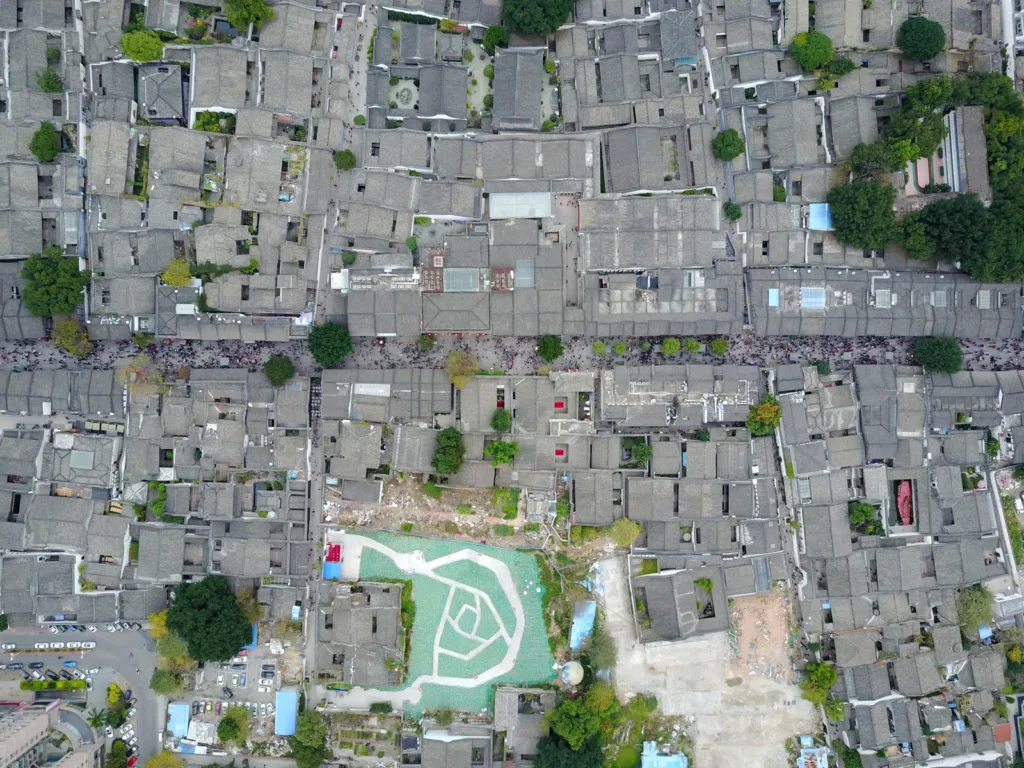
Sanfang Qixiang sits in Fuzhou’s central Gulou District. Its name describes the arrangement around Nanhou Street: Yijin Lane, Wenru Lane and Guanglu Lane lie to the west, while seven alleys run to the east. The pattern developed from the old residential ward system and remains legible in the relationship between the main axis, narrow lanes and inward-looking courtyards. More than 200 Ming- and Qing-period historic buildings survive in the quarter, but the spacing between them is as important as any single façade.
Begin on Nanhou Street, where shopfronts and pedestrian movement make the historic quarter feel like part of the living city rather than a sealed museum. Then turn into one of the lanes and slow down. Compare the broad, commercial frontage with gate walls, covered passages, timber details and courtyards that are only partly visible from public space. This contrast is the most useful way to understand the district: preservation has kept the urban fabric, while daily life and carefully managed visitor uses continue inside it.
What to look for
The waterside theatre in Yijin Lane is a good architectural detail to seek out. Its position over a pond and its relationship to the surrounding residence show how performance, garden and domestic space could be joined in one traditional compound. If the theatre or a particular residence is your main reason for visiting, check that building’s current entrance and programme rather than assuming that the whole quarter has one shared admission arrangement.
Wenru Lane and the quieter alleys are best approached as residential streets, not as a checklist of façades. Look at how deep compounds sit behind modest street gates, how lanes frame glimpses of roofs and walls, and how the scale changes when you leave Nanhou Street. Named former residences and exhibition buildings add biographies and displays, but some houses remain private or have their own opening, reservation or ticket rules. Enter only buildings explicitly open to visitors, and keep the ordinary life of the neighbourhood in view.
A compact first visit can start at the northern end near Daming Road, follow Nanhou Street, then turn west into Yijin or Wenru Lane before comparing one of the eastern alleys. This is an editorial sequence for reading the space, not a guaranteed walking route, common ticket or promise that every interior will be open on the day.
Getting there and returning
For the northern entrance near Daming Road, take Fuzhou Metro Line 1 to Dongjiekou Station (东街口站), use Exit C, and follow Yangqiao East Road for about 400 metres to the entrance. For the southern entrance near Macao Road, take Line 1 or Line 2 to Nanmendou Station (南门兜站), use Exit A1, and follow Daoshan Road and Macao Road for about 600 metres. These are two different approaches to the same historic quarter; choose the one that matches the part you want to see first.
Useful bus stops are Sanfang Qixiang (Qiaoxiong) / 三坊七巷(侨雄) for the northern end, Sanfang Qixiang (Macao Road) / 三坊七巷(澳门路) for the southern end, and Yijin Fang / 衣锦坊, Wenru Fang / 文儒坊 or Guanglu Fang / 光禄坊 for the three western lanes. The same transport guide also lists Nan Jie / 南街 for access to the eastern alleys. Routes change, so check the stop and service on the day rather than relying on a remembered bus number.
For a return journey, leave through the north or south side and retrace the corresponding route to Dongjiekou or Nanmendou. If using a taxi or ride-hailing service, say 三坊七巷街区 Sānfāng Qīxiàng Jiēqū and specify the 达明路北入口 Dámíng Lù Běi Rùkǒu or 澳门路南入口 Àomén Lù Nán Rùkǒu; the lane network does not function as one single vehicle drop-off point. Individual courtyards and exhibitions can change their hours, reservations and access, so verify the particular building before setting out.
Combine your visit
A suggested sequence linking the specific features of this visit.
-
Nanhou Street
Read the north-south commercial spine of the quarter.
-
Yijin Lane
Seek the waterside theatre in the publicly accessible residence.
-
Wenru Lane
Compare the quieter courtyard-house street with the main shopping axis.
This order is editorial. Confirm access and any transfers between stops; it does not establish a walking route, same-day connection or common admission ticket.
Find Sanfang Qixiang
三坊七巷 · 福州市
The pin marks the area, not the entrance.
More places nearby
Approximate straight-line distances between map pins, not travel distances.
Lin Zexu Memorial Museum 林则徐纪念馆
Less than 1 km awayThe Lin Zexu memorial occupies the ancestral shrine built in his honour on Aomen Road. Courtyards, ceremonial halls and inscriptions frame an account of the Fuzhou-born official whose career included the campaign against the…
View guide →Wu Mountain 乌山
Less than 1 km awayWu Mountain is a compact hill of rock ledges, inscriptions and shaded paths in central Fuzhou. The Black Pagoda marks its lower slopes, while calligraphy cut into the stone turns the climb into a record of the city’s literary…
View guide →Yu Mountain 于山
1 km awayYu Mountain is a small hill in central Fuzhou with a concentration of temples, inscriptions and memorial buildings. The White Pagoda marks its lower approach, while Qi Gong Shrine connects the site with the memory of the Ming…
View guide →Sources & visit information
Sources checked on 2 November 2026. Hours, tickets, reservations and transport can change; confirm with the operator before you go.
Image credits & notes (1)
- Aerial view of Sanfang Qixiang, showing the dense grey-tiled courtyards and the central pedestrian street in Fuzhou. Photo: 之乎Photo: CC BY 4.0