

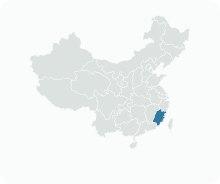
Get to know Haicang District
- Administrative area
- District · 市辖区
- Part of
- Xiamen
- Chinese name
- 海沧区
- Local areas
- District guide
Area & population
- Area
- 176.90 km²
- Population · 2020
- 582,519
Source: English Wikipedia, as of the dates shown.
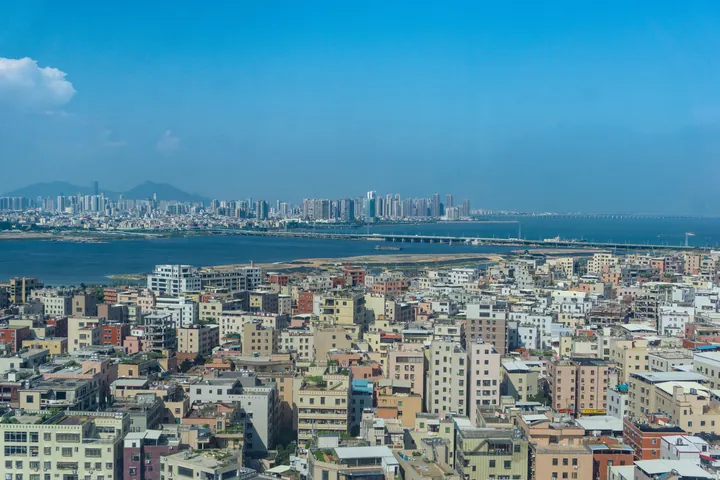
Haicang lies west of Xiamen Island. Its visitor landscape changes across the district: the Haicang Bay waterfront and ferry terminal are urban and easy to pair with the metro, while the forested hills around Tianzhu Mountain and the old village setting of Qingjiao call for separate excursions.
Three different Haicangs
The bayfront is the easiest introduction. Metro Line 2 serves Haicang Bay Park (海沧湾公园), Haicang Business Center (海沧商务中心) and Haicang Administrative Center (海沧行政中心). Use the bayfront for a walk by the water and as a practical base for onward connections; it is not a gateway on foot to the district's more distant mountain and village sights. The official metro map lists these stops on Line 2.
Tianzhu Mountain is the district's forest-and-lakes outing in Dongfu Subdistrict. The scenic area's own overview describes three lakes—Tianzhu, Haoyue and Liang'er—alongside valleys, peaks and temples. On a first visit, the east side makes a straightforward walk: Xiamen Daily reported that Line 2's Tianzhushan (天竺山) station is about a five-minute walk from the park's East Gate. Within the park, the paper distinguishes a greener east route through Yulan Valley and Tianzhu Lake from a west route along Yuanyang Creek and the Liang'er and Haoyue lakes. The routes are not a single short loop; bring water and insect repellent, and avoid starting a long walk late in the day.
Qingjiao is a village-side cultural visit rather than another stop on the waterfront promenade. Qingjiao Ciji Palace (青礁慈济宫) is one of the two ancestral temples of the Baosheng Dadi faith named in the Fujian Taiwan Affairs Office profile; the heritage listing groups Qingjiao and Baijiao Ciji palaces together as a national key cultural relics protection unit. Across from the temple, the provincial tourism profile describes Yuanqian community's Minnan red-brick houses, including swallow-tail and saddle-shaped rooflines, carved brickwork and courtyards. Treat the temple and the village lanes as distinct places to look around, and be respectful where worship is taking place.
Haicang's Centipede Float (海沧蜈蚣阁) is a local festival performance, not a daily attraction. The national intangible-heritage record describes linked, jointed wooden platforms decorated as a long procession, with children in opera-story costumes seated above; the parade has been associated with villages including Dongyu, Jinli, Qingjiao and Wencuo. It is worth seeking out only when a public event is actually announced.
Getting around and planning a visit
For Tianzhu Mountain, take Line 2 to Tianzhushan (天竺山) and walk to the East Gate; the reported five-minute approach is from the station, not a promise about time to any trail or lake. Check the current station exit and park conditions before setting out. Line 2 also connects the bayfront stops with the wider city; the official network map shows the Haicang stations and Tianzhushan, while the listed Line 2 route continues across Xiamen Island toward Wuyuanwan (五缘湾). Return from the park using Tianzhushan station in the opposite direction.
For Qingjiao, use 青礁慈济宫 as the destination in a taxi or ride-hailing app. A current bus route and a verified visitor-gate drop-off were not confirmed in the sources reviewed, so do not rely on an old route list without checking it on the day. The temple's current admission, opening and booking arrangements were also not established here; foreign-passport acceptance or any identity-check procedure should be confirmed with the site before travelling.
There is also a useful water connection at Haicang's Songyu Passenger Terminal (嵩屿客运码头), at 建港路2188号. The ferry operator lists public passenger service between Songyu and Xiamen Island's First Wharf (第一码头), as well as a separate tourist service between Songyu and Gulangyu's Neicuo'ao Wharf (内厝澳码头). For the Songyu terminal, the operator suggests reaching Haicang Bay Park station on Line 2 and transferring by bus to Songyu bus terminal; the bus number is not stated on that connection page. The same ferry operator lists the reverse Songyu-to-First-Wharf route, so this can work as a return crossing rather than a one-way arrival. Check sailing information at the operator or terminal on the day; ferry schedules and fares can change. This water link serves the bayfront and Songyu, not Tianzhu Mountain or Qingjiao directly.
Plan the bayfront, Qingjiao and Tianzhu Mountain as separate parts of a district-scale visit. The forest park is a substantial walking destination, while the village and temple need their own road transfer; combining them in one outing depends on current site hours and transport connections, which should be checked before departure. No current official ticket price, opening schedule or advance-booking rule for these named attractions was verified for this guide.
Explore Haicang District
Core places to explore, with English and Chinese names.
Places to explore around Haicang District
 AI illustration · AI 示意图(仅供参考,非该地点实拍)
Tianzhu Mountain Forest Park天竺山
Tianzhu Mountain Forest Park in Haicang pairs forested reservoir valleys with two distinct walks: an eastern route through Yulan Yougu to Tianzhu Lake, or a western creek-side route linking Liang’er and Haoyue lakes.
Read the place guide → AI illustration · AI 示意图(仅供参考,非该地点实拍)
Riyuegu Hot Spring Resort日月谷温泉
Riyuegu is a purpose-built hot-spring park in Haicang, where landscaped outdoor pools with different themes are the main attraction; it is a half-day bathing outing rather than a city-centre bathhouse.
Read the place guide →Plan your visit
Getting there
Haicang District is about 5 km (straight-line distance) from central Xiamen. Search for 海沧区 in a map app to find stations and your accommodation.
Where to stay →Build your route
Tianzhu Mountain Forest Park and Riyuegu Hot Spring Resort are both listed here. The linked place guides have entrance and visit details.
Continue with Xiamen →More in Xiamen
Sources & geographic information
Administrative names and parent areas: Official geographic directory (dmfw.mca.gov.cn) · Reference date 2026-09-06.
Background text adapted from Haicang, Xiamen — Wikipedia contributors, under CC BY-SA 4.0. Text has been shortened and reorganized; source revision 1302160646.
Map data © OpenStreetMap contributors. Pins mark approximate centres, not entrances or boundaries.
