

Explore the region
Tap any red Chinese text to hear it in Mandarin.
Why this building is different
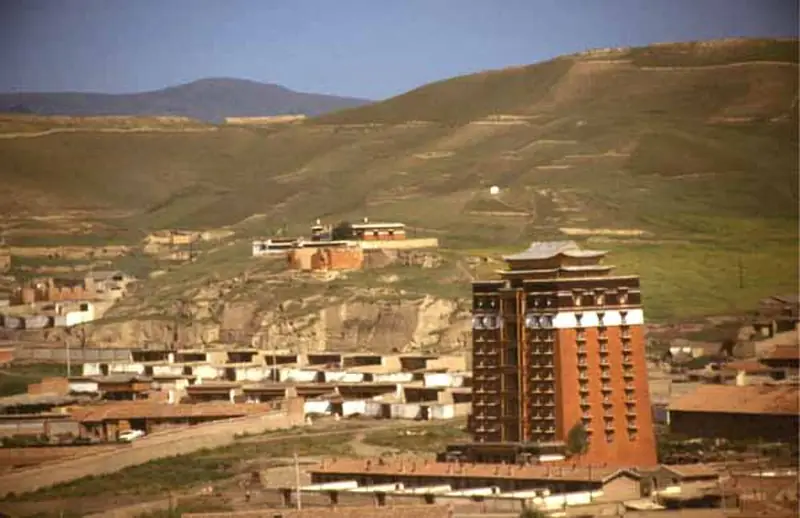
Milarepa Pavilion stands in the An Duo Hezuo Monastery precinct on the edge of Hezuo, the seat of Gannan Tibetan Autonomous Prefecture. The Gannan prefectural government describes the building as a nine-storey, watchtower-like structure that combines Tibetan fortress architecture with the form of a Buddhist pavilion. It dates the pavilion to 1777, gives its height as more than 40 metres, and identifies its subject as the founders of different Tibetan Buddhist traditions.
The tower is a more vertical experience than a conventional monastery courtyard. Start outside, where the red walls, repeated projecting levels and roofline are easiest to read as one composition. The present building is a reconstruction: a local Tibetan-culture account records that the earlier pavilion was destroyed during the Cultural Revolution and that the current building was rebuilt from 1988, with the work completed in 1994.
What to look for inside
If the interior is open to visitors, take the climb slowly and treat the rooms as devotional spaces rather than a conventional museum. The same local account describes walls covered with murals, painted decoration, thangka paintings and sculpture. It also describes a programme that brings together figures associated with several Tibetan Buddhist schools, with different levels devoted to different groups of deities, teachers and cultural figures. These details are useful for knowing what to look for, but the account is from 2014 and should not be read as a current inventory or as proof that every level is open on your date.
Look for the contrast between the compact circulation route and the density of the imagery: a stair and corridor system leading upwards, shrines viewed at close range, and painted surfaces that are part of an active religious setting. Do not assume that the name “Nine-Storey Pavilion” guarantees access to all nine floors. Ask at the site which doorway and interior route are open before entering.
Visiting respectfully
The pavilion belongs to a working monastery precinct, not a staged architectural display. The local account notes that monks continue to study and conduct religious activities there. General Gannan temple guidance advises visitors to keep quiet, remove hats and sunglasses before entering, avoid touching statues or scriptures, and not take photographs inside halls. Follow any newer sign or instruction from the monastery if it is stricter, and ask before photographing anywhere beyond the exterior.
The climb can be tiring at Hezuo’s high elevation, especially soon after arriving from a lowland city. Take breaks rather than turning the visit into a rushed ascent. The public sources used here do not establish a current accessibility arrangement, lift, or alternative upper-floor route, so visitors who cannot manage stairs should confirm what can be seen at ground level before paying or entering.
Getting there and getting back
For an intercity approach, Gannan tourism guidance recommends travelling by train to Lanzhou and then transferring to a coach for Hezuo; it also advises checking the current flights to Gannan Xiahe Airport rather than assuming a daily service. The Gansu transport directory lists the operating 甘南州汽车运输有限公司合作公用型汽车站 (Gannan Prefecture Transport Company Hezuo Public Bus Station) at 人民东街, Hezuo City, and separately lists 甘南州汽车运输有限责任公司合作汽车站 Gānnán Zhōu Qìchē Yùnshū Yǒuxiàn Zérèn Gōngsī Hézuò Qìchēzhàn on 西路, above the Shiyou Building. Confirm which station your ticket uses before setting out.
From the coach station or your Hezuo accommodation, show a driver the full destination name 安多合作米拉日巴佛阁 Ānduō Hézuò Mǐlārìbā Fógé. Amap places it at 那吾路与铁坝路交叉口安多合作寺院 Nàwú Lù yǔ Tiěbà Lù Jiāochākǒu Ānduō Hézuò Sìyuàn in Hezuo’s 坚木克尔街道/那吾镇 area. Use the mapped monastery precinct as the arrival point, then confirm on foot which entrance admits visitors to the pavilion rather than stopping at a generic monastery gate.
For the return, keep the Chinese destination for your next stop or accommodation ready and arrange the ride back to the correct coach station before you leave the precinct. Public sources checked for this article do not establish a current city-bus line, departure timetable, taxi fare, or a guaranteed same-day connection from the pavilion. Do not plan around Hezuo Railway Station yet: a 14 July 2026 report from the Hezuo municipal government describes that station as under construction and says the railway connection is for a future opening.
Check before you go
Current opening hours, ticket or donation arrangements, reservation rules, passport-holder booking or identification requirements, and the exact interior route were not published consistently in the sources available for this draft. Check the monastery or the local official tourism channel close to your visit, and confirm both the entrance and the rules for the day. This is a religious site in Gansu; do not import entry-permit rules from the Tibet Autonomous Region, but do not assume that a passport is automatically accepted for every local booking system either.
Combine your visit
A suggested order for the documented features and stops.
-
Pavilion exterior
Read the layered building form from the monastery precinct.
-
Permitted interior shrine route
Study the paintings and figures while following the religious site’s visitor instructions.
This is an editorial sequence. Check access and any road or boat transfers; it does not establish a walking route, common ticket or guaranteed same-day connection.
Find Milarepa Pavilion
米拉日巴佛阁 · 合作市
The pin marks the area, not the entrance.
More places nearby
Approximate straight-line distances between map pins, not travel distances.
Dangzhou Grassland Scenic Area 当周草原景区
6 km awayDangzhou Grassland combines an open meadow setting with developed visitor facilities on the southern edge of Hezuo. A Tibetan-style entrance decorated with auspicious motifs introduces paths, viewpoints and white-stupa features…
View guide →Labrang Monastery 拉卜楞寺
42 km awayLabrang is a working monastery and centre of learning beside the Daxia River in Xiahe. Its halls and colleges form a substantial settlement of white walls, courts and gilded roofs. The prayer-wheel route shows the monastery’s…
View guide →Sources & visit information
Sources checked on 1 November 2026. Hours, tickets, reservations and transport can change; confirm with the operator before you go.
Image credits & notes (1)
- Milarepa Pavilion · 米拉日巴佛阁Photo: The original uploader was Gruschke at German Wikipedia . · CC BY-SA 3.0Resized for the web; the photo itself has not been edited.
