

Explore the region
Tap any red Chinese text to hear it in Mandarin.
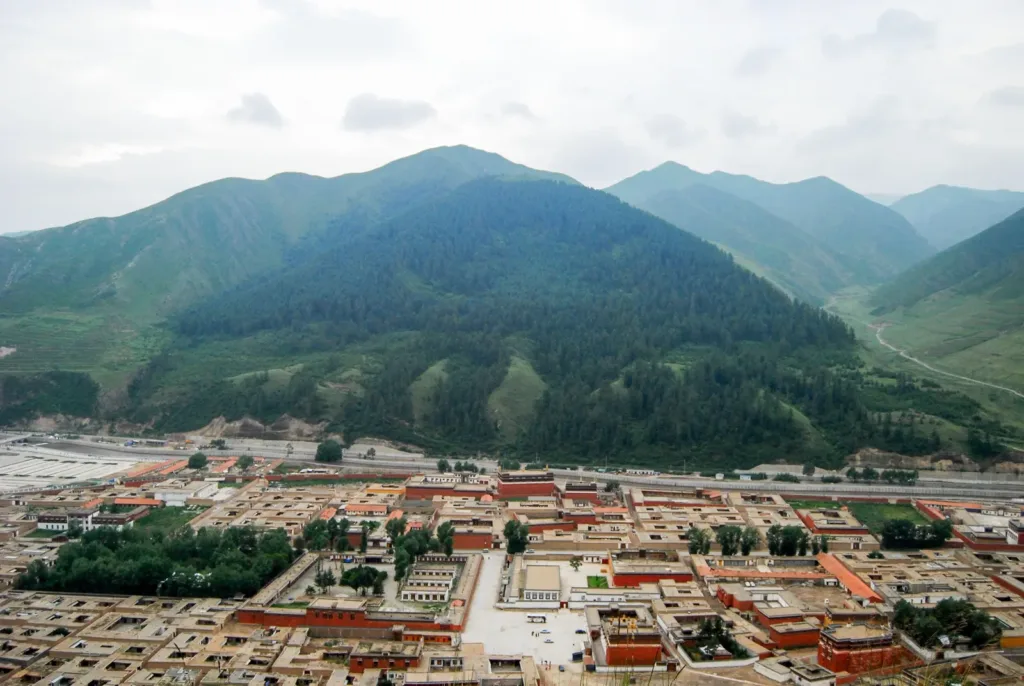
Labrang is a working monastery and a place of study, worship and pilgrimage, not simply a group of historic façades. It stands at the western end of Labrang Town in Xiahe County, on the north bank of the Daxia River. The setting is unusually legible: the monastery occupies the open river-side basin while hills rise behind it, and the buildings spread as a settlement rather than gathering around one isolated shrine.
The monastery was founded in 1709 by the first Jamyang, Ngawang Songzhe, and is one of the six great monasteries of the Gelug school of Tibetan Buddhism. Xiahe County describes it as a large institution with six colleges, while the 2025 county report records that it remains open to visitors and continues to receive guided groups. It was designated a National Key Cultural Relic Site in 1982.
What to notice
Follow the prayer-wheel corridor
The long prayer-wheel corridor is the most immediate way to understand Labrang as a living religious place. The Gannan government describes it as about 3.5 kilometres long. Many visitor descriptions present the circuit as clockwise, which follows the devotional flow around the monastery; walk at the pace of worshippers, keep clear of people praying, and do not treat the corridor as a timed attraction.
The corridor also gives you a way to read the complex from outside. Look across the whitewashed walls and red, yellow and white painted buildings, then notice how the prayer route links halls, colleges and smaller religious structures. The provincial government describes the traditional buildings as using local stone, wood, earth and hemp, with stone on the outside and timber within.
See the colleges as a learning complex
Labrang’s importance lies in the relationship between its colleges, assembly spaces, residences and devotional routes. The county identifies six colleges, and the older architectural account describes the Wen Si College and its Great Assembly Hall as the central gathering space. From a visitor’s point of view, the useful question is not how many halls can be checked off, but which spaces are open on the day and how they relate to the continuing monastic community.
A 2025 county report describes conservation work, new visitor paths and active protection of the timber buildings and religious objects. Some areas may therefore be separated or temporarily unavailable even when the monastery itself is receiving visitors.
Enter only where the current arrangement allows
A dated People’s Daily tourism notice distinguishes the generally accessible monastery area and ordinary halls from a ticketed main-hall area, and places that ticket point at a visitor centre beside the boundary between the county town and the monastery. It is useful as an entrance clue, but it is from 2018 and does not establish today’s price, ticketing, reservation or hall-opening rules.
The provincial tourism platform currently lists 06:00–18:00 as the scenic area’s hours, but the page has no clear publication date. Confirm the day’s opening, the halls available to visitors and any guided-tour arrangement at the venue before entering. No source reviewed here confirms the current passport, booking or foreign-visitor ticket procedure; do not assume that a domestic ID arrangement automatically applies to a passport.
Dress and behave as you would in an active religious institution. Keep to public routes, ask before photographing people or interiors, and stop when a sign, monk or guide indicates that a hall or ritual area is not for visitors. The corridor and the worshippers using it are part of the monastery’s daily life, not a staged performance.
Getting there and getting back
For a map or taxi, use the Chinese name 拉卜楞寺 Lābǔléng Sì. The monastery is in Labrang Town’s western end, beside the Daxia River; the official descriptions place it on the river’s north bank. The provincial tourism platform lists local bus routes 1 and 2, describes the connection as about 5–10 minutes, and gives a listed operating window of 07:00–18:30. Its page does not provide a current stop map or direction-specific timetable, so confirm the stop with your accommodation or driver on the day rather than relying on an old map label.
For the final approach by car, an older tourism notice places the visitor centre and ticket point by the county–monastery boundary. A Xiahe transport notice from July 2026 names 拉卜楞寺停车场入口 Lābǔléng Sì Tíngchēchǎng Rùkǒu (“Labrang Monastery parking-lot entrance”) as a stop on a temporary festival shuttle to Sangke Grassland. That notice is useful for the Chinese destination name, but the shuttle was tied to the 12–19 July 2026 event and is not evidence of a year-round regular route.
Plan the return before you start the circuit. The sources reviewed here do not establish a current last-bus time or a permanent return stop. Ask where the reverse-direction bus stops, or arrange a taxi back to 夏河县城 Xiàhé Xiànchéng before entering. Do not count on the July 2026 event shuttle after the event period; its return service was specifically described as event transport.
Combine your visit
A suggested order for the documented features and stops.
-
Prayer-wheel perimeter
Understand the monastery’s daily devotional circuit without obstructing worshippers.
-
Authorised hall tour
Learn how the assembly spaces and colleges relate to monastic life.
-
Gongtang chorten area
Compare the stupa form with the halls, subject to its own access arrangements.
This is an editorial sequence. Check access and any road or boat transfers; it does not establish a walking route, common ticket or guaranteed same-day connection.
Find Labrang Monastery
拉卜楞寺 · 夏河县
The pin marks the area, not the entrance.
More places nearby
Approximate straight-line distances between map pins, not travel distances.
Milarepa Pavilion 米拉日巴佛阁
42 km awayMilarepa Pavilion is a tall, red-walled religious building within the Hezuo monastery precinct. Its vertically arranged shrines bring together figures associated with different Tibetan Buddhist traditions, while paintings and…
View guide →Dangzhou Grassland Scenic Area 当周草原景区
44 km awayDangzhou Grassland combines an open meadow setting with developed visitor facilities on the southern edge of Hezuo. A Tibetan-style entrance decorated with auspicious motifs introduces paths, viewpoints and white-stupa features…
View guide →Sources & visit information
Sources checked on 1 November 2026. Hours, tickets, reservations and transport can change; confirm with the operator before you go.
Image credits & notes (1)
- Aerial view over Labrang Monastery's monastic buildings and the surrounding Xiahe valley, Gansu, China. Photo: ShizhaoPhoto: CC BY-SA 3.0