

Explore the region
Tap any red Chinese text to hear it in Mandarin.
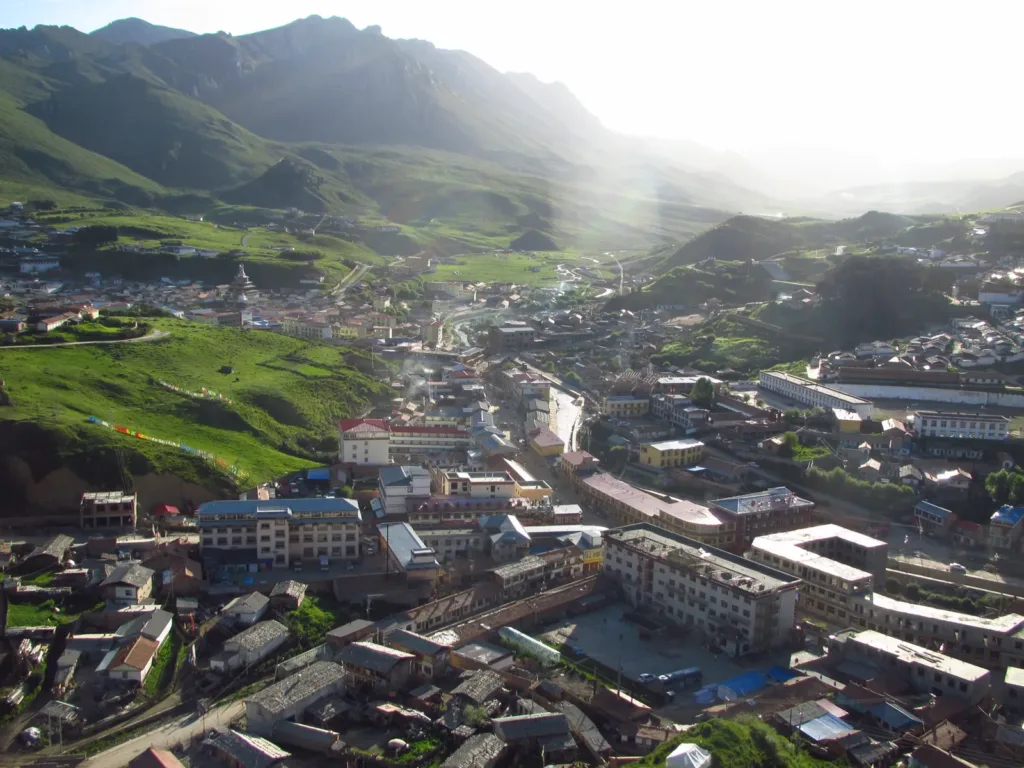
Langmusi is a high-altitude Tibetan town in Luqu County where the Bailong River valley separates a Gansu-side monastery precinct from a Sichuan-side one. Its character comes from the close fit between river, hills, religious buildings and an inhabited settlement, not from a single attraction with a single entrance.
The place name needs care. On the north bank, the Gansu side is associated with Dacang Langmu Saichi Monastery, usually shortened to Saichi or Sertri. On the south bank, across the provincial boundary, is the complex variously written in local sources as 格尔登寺 or 格底寺 and in English as Kirti or Ge’erdi. The town and the two religious precincts are related, but they are not one combined venue. Keep the Chinese name of the side you want to visit when arranging a drop-off.
What makes the town worth a stop
Start with the valley rather than a checklist. The Bailong rises here, and the watercourse runs through a narrow settlement framed by monastery-covered hills. From public streets and viewpoints, look at how the Gansu and Sichuan sides occupy opposite banks; this is the most legible way to understand why “Langmusi” can mean the town, one monastery, or the wider two-sided landscape.
On the Gansu side, Saichi’s religious architecture gives the northern hillside its visual weight. A local government account dates the beginning of the monastery’s construction to 1748 and describes a large complex with colleges and multiple halls. Treat those buildings as an active religious institution rather than a museum: follow the permitted visitor route, ask before entering a hall, and do not assume that every building is open.
The Sichuan-side complex makes a useful second reference point, but it should be planned separately. The different Chinese and English names are not a reason to merge the two entrances or assume one ticket. If you cross the town to see it, confirm that its visitor route is operating on your date.
Between the two religious areas, Langmusi remains a lived-in town with homes, monastic quarters, small shops and restaurants. Walk quietly, leave worshippers and residents unposed, and treat prayer wheels, shrines and ceremonies as religious objects and practices rather than scenery. The town’s everyday scale is part of the experience: the two monastery hills make sense only when read together with the valley streets below.
Seasonal and religious visits
The county’s account of Saichi’s 羌姆 describes a ritual performance by monks involving music, masks, movement and a procession. It records a particular field observation, not a current annual timetable. If your visit coincides with a religious event, watch from the edge, follow instructions from the monastery and check locally before photographing people, halls or ritual objects.
Langmusi is high and cold, and the local government describes the town as a high-cold, humid environment. Pack for rapid weather changes even outside winter. Road and monastery conditions can vary with season; current opening arrangements should be checked for the exact date rather than inferred from a map listing or an old travel schedule.
Getting there and getting back
National Highway G213 crosses Langmusi Town. From Luqu, approach south on the G213 corridor and ask to be dropped in the settlement or at the exact side you intend to visit. G213 gets you to the town; it does not by itself identify a monastery gate.
Give the driver a precise Chinese destination: 郎木寺镇 Lángmùsì Zhèn for the settlement, 达仓郎木赛赤寺 Dácāng Lángmù Sàichì Sì or 赛赤寺 Sàichì Sì for the Gansu-side monastery, and 格尔底寺 Gé’ěrdǐ Sì for the Sichuan-side complex. The English labels Saichi/Sertri and Kirti/Ge’erdi can vary, so keep the Chinese name on your phone. A map pin for 郎木寺 marks the area, not a guaranteed entrance.
Do not set out on an assumed direct coach, shared ticket or same-day connection between the two monastery precincts. Confirm the current road service and your return arrangement at the departure point, and check with the relevant monastery about entry on the day. No current public timetable, ticket price or unified opening schedule is fixed here because the sources reviewed do not establish one.
There is no need to turn the whole town into a single gate-to-gate route. Choose the religious precinct or valley walk that is actually open, keep enough daylight for the return road, and treat any onward connection as something to verify locally rather than a guaranteed service.
Combine your visit
A suggested order for the documented features and stops.
-
Sertri Monastery
Begin with the Gansu-side religious precinct and its permitted visitor route.
-
Bailong headwater settlement
Read the valley and the relationship between the two monastery hills.
-
Kirti Monastery
Consider a separately admitted visit to the Sichuan-side complex rather than assuming one combined ticket.
This is an editorial sequence. Check access and any road or boat transfers; it does not establish a walking route, common ticket or guaranteed same-day connection.
Find Langmusi Town
郎木寺 · 碌曲县
The pin marks the area, not the entrance.
More places nearby
Approximate straight-line distances between map pins, not travel distances.
Zhagana 扎尕那
53 km awayZhagana’s villages sit beneath an enclosure of pale limestone peaks, with forested slopes, fields and Tibetan houses filling the basin below. The setting becomes clearer as you move between the inhabited lanes and the designated…
View guide →Dangzhou Grassland Scenic Area 当周草原景区
99 km awayDangzhou Grassland combines an open meadow setting with developed visitor facilities on the southern edge of Hezuo. A Tibetan-style entrance decorated with auspicious motifs introduces paths, viewpoints and white-stupa features…
View guide →Milarepa Pavilion 米拉日巴佛阁
105 km awayMilarepa Pavilion is a tall, red-walled religious building within the Hezuo monastery precinct. Its vertically arranged shrines bring together figures associated with different Tibetan Buddhist traditions, while paintings and…
View guide →Sources & visit information
Sources checked on 1 November 2026. Hours, tickets, reservations and transport can change; confirm with the operator before you go.
Image credits & notes (1)
- View of Langmusi Town from the east, showing the dense settlement in the valley beneath steep green hills. Photo: NoGhostPhoto: CC BY-SA 4.0