

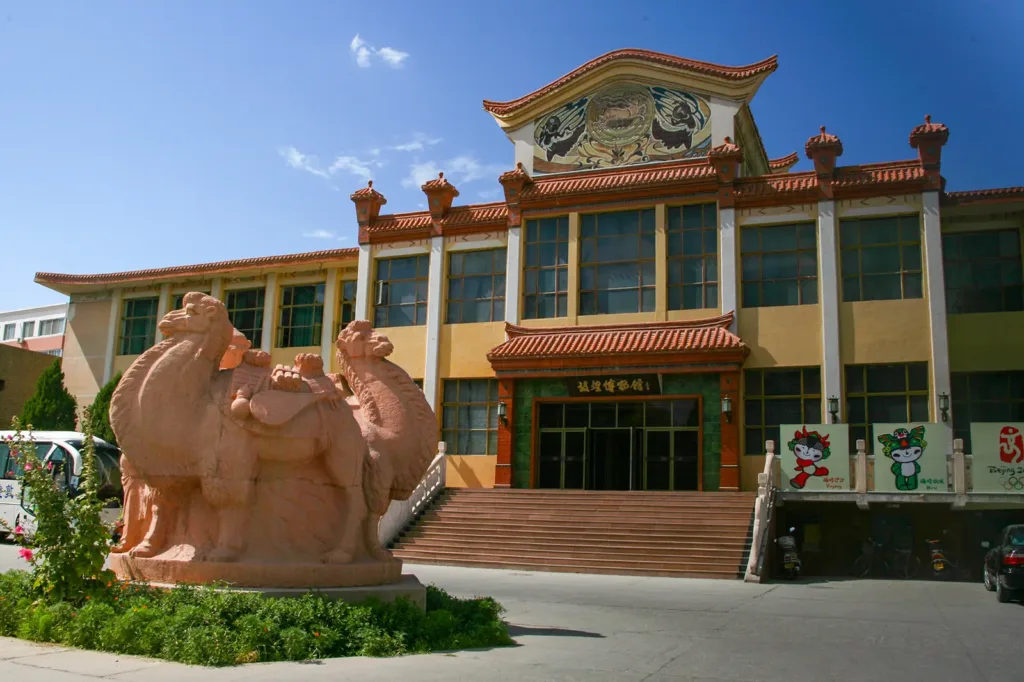
Explore the region
Why visit
Dunhuang is often reduced to the painted caves at Mogao. The city museum gives the wider setting: its permanent display, titled A City Where Chinese and Foreign Peoples Meet — Dunhuang History and Silk Road Artefacts, presents Dunhuang as a place where routes, communities and political worlds met. The museum describes the exhibition as a combination of excavated objects, historical images and media-led interpretation.
Read the galleries as a long sequence rather than as a collection of unrelated cases. The museum’s detailed exhibition account moves from early inhabitants and the Han expansion through Wei–Jin and Northern and Southern Dynasties material, the Sui–Tang period, later rule and Qing-era development, ending with Silk Road coins. Painted bricks, weapons, household objects, silk, written records and camel-related objects help turn the phrase “Silk Road” into evidence of work, travel and administration.
This is a city museum, not the Mogao Caves Digital Exhibition Centre. The latter is the first station for a Mogao visit and has its own booking, ticket and onward transfer arrangements, so do not use a Mogao ticket or route as a substitute for the museum’s city-centre visit.
Before you go
Dunhuang Museum is at 1390 Mingshan North Road, Dunhuang (敦煌市鸣山北路1390号). The museum says it was among Gansu’s first free-open museums in 2008. Its visitor notice separately lists special exhibitions, guided interpretation and parking among services that may carry charges.
Bring a passport or another valid identity document. The museum lists passports among the documents accepted for individual visitors, who should present one at the ticket office. Online booking is available through the museum’s WeChat account or Meituan; groups must arrange an advance booking by telephone at 0937-8818173. Treat a booking as a practical step, not as proof that a particular temporary exhibition will be running.
Opening hours follow two seasonal schedules:
- 1 May–30 September: Tuesday–Sunday, 08:30–18:30; last entry 17:30.
- 1 October–30 April: Tuesday–Sunday, 08:30–18:00; last entry 17:00.
- Monday: closed.
Inside, follow the marked route, do not touch objects, and do not smoke. The museum’s notice also prohibits flash photography and fixed tripods in the galleries.
Getting there
The museum’s official access page says that city bus route 3 stops at the museum entrance. If you take a taxi or ride-hailing car, show the Chinese name and address—敦煌市博物馆,敦煌市鸣山北路1390号—and confirm that the driver is taking you to the city museum rather than to the Mogao visitor facilities. The museum publishes no metro directions; its stated local public-transport option is bus route 3.
Allow time to read the object labels and to connect the museum’s chronology with the sites you visit outside town. Check the museum’s own notice on the day of travel for temporary exhibitions, booking availability and any service changes.
Combine your visit
A suggested order for the documented features and stops.
-
Han Dunhuang section
Begin with the expansion of the oasis and frontier connections.
-
Wei–Jin and later regional-history section
Compare the evidence for everyday and cultural life across periods.
-
Sui–Tang section
Finish with the oasis’s flourishing Silk Road connections.
This is an editorial sequence. Check access and any road or boat transfers; it does not establish a walking route, common ticket or guaranteed same-day connection.
Find Dunhuang Museum
敦煌博物馆 · 敦煌市
The pin marks the area, not the entrance.
More places nearby
Approximate straight-line distances between map pins, not travel distances.
Crescent Lake · Mingsha Mountain dunes 鸣沙山月牙泉·月牙泉示意点
5 km awayCrescent Lake is a small curved oasis enclosed by the much larger dunes of Mingsha Mountain. The contrast between water, vegetation and bare sand is the main attraction, with the outline changing as you move between the lakeside…
View guide →Dunhuang Historical Film City 敦煌古城影视城
15 km awayDunhuang Film City was built in 1987 for the film Dunhuang and uses recreated streets to suggest different Silk Road cities. Dunhuang, Gaochang, Ganzhou, Xingqing and Bianliang streets vary their architectural references, with…
View guide →Mogao Caves 莫高窟
16 km awayMogao’s cliff contains a long sequence of Buddhist caves in which murals, painted sculpture and architecture work together. Narrative paintings share walls with donors and repeated Buddha figures, while changing styles reflect…
View guide →Sources & visit information
Sources checked on 23 October 2026. Hours, tickets, reservations and transport can change; confirm with the operator before you go.
Image credits & notes (1)
- The entrance facade of Dunhuang Museum in Dunhuang, with a camel sculpture in front. Photo: WindmemoriesPhoto: CC BY-SA 4.0