

Explore the region
Tap any red Chinese text to hear it in Mandarin.
Why Mogao is different
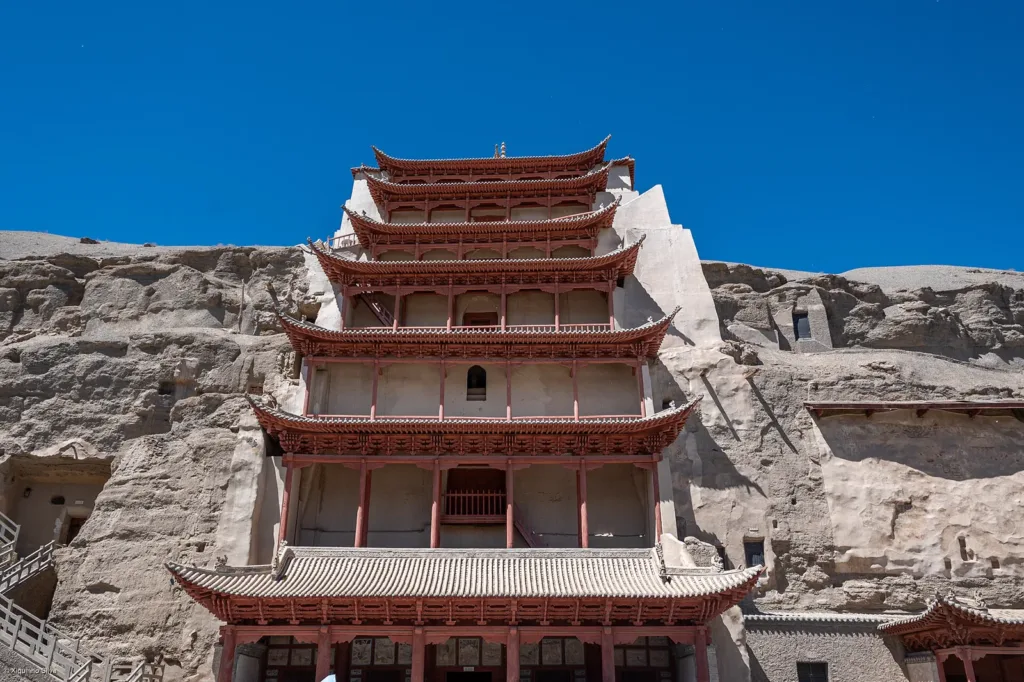
Carved into the cliffs above the Dachuan River southeast of the Dunhuang oasis, Mogao sits where trade routes also carried religious, cultural and intellectual influences. UNESCO describes 492 preserved cave cells and sanctuaries, with about 45,000 square metres of murals and more than 2,000 painted sculptures. Construction began in 366 AD, and the surviving art records the development of Buddhist art from the fourth to the fourteenth century.
The wider surviving cliff is also counted as 735 caves in current Dunhuang Academy material. That figure and UNESCO’s 492 refer to different counting scales; neither means that every cave is part of a normal visitor circuit. The value of a visit lies in seeing how a painted figure, its cave architecture and the surrounding wall paintings work together, while styles and subject matter reveal Dunhuang’s position on the Silk Road. The discovery of the Library Cave in 1900, with its large group of manuscripts and relics, is another part of the site’s story, although many of those objects are now held elsewhere.
Mogao is therefore not a conventional museum with every gallery open for independent wandering. The protected cave zone is reached through the visitor centre, and the normal product pairs digital viewing with a scheduled selection of physical caves. The selection and operating mode protect a fragile site while giving you a focused way to read the cliff, the painted sculpture and the murals together.
How a visit works
Book through the official “Mogao Caves Visitor Reservation Network” channels before travelling. The 2026 operating notice says that visitors holding foreign passports, or Hong Kong, Macao or Taiwan travel permits, can use the official WeChat service account and choose Ticket Booking. Bring the same valid identity document used for the booking.
For the 2026 peak season (1 April–30 November), the normal visit is listed as one digital film exhibition plus eight physical caves, with a daily limit of 6,000 visitors. An emergency mode, used when announced, covers four physical caves with a daily limit of 12,000. Special caves are a separate, limited product arranged at the cave area after the normal or emergency visit; do not assume that a standard booking includes them.
Arrive at the Mogao Digital Exhibition Centre at least 30 minutes before the booked time. It is the first stop for ticket collection or checking, security screening and the digital presentation. The core cave area has no ticket office or visitor parking, so do not drive there as if it were an independent entrance. The centre then directs visitors onward under the booking’s shuttle arrangements.
Inside the caves, do not photograph or film, touch murals or sculptures, write on surfaces, or make a loud disturbance. Large luggage, pets and drones are not allowed in the cave zone; the digital centre lists free large-luggage and pet storage among its services. Strong rain or dust storms can lead to a temporary closure and refunds for bookings that have not been used.
Getting there
Give a taxi driver the destination 莫高窟数字展示中心 Mògāo Kū Shùzì Zhǎnshì Zhōngxīn, at No. 8899 Yangguan East Road, Dunhuang City, Jiuquan, Gansu. The cave zone itself is separately identified near S217, but it is not the place to begin a normal visit.
From central Dunhuang, a current English transport guide reports bus 12 from the stop near Silk Road Yiyuan Hotel (丝路怡苑大酒店) to the digital centre, with a taxi as the simpler alternative. The official visitor pages do not publish a fixed bus timetable here, so confirm the same-day stop and service before relying on it.
From Dunhuang Railway Station (敦煌站), take a taxi to the digital centre rather than navigating directly to the cave zone. There is no metro service to this outlying site. After the centre visit, follow the booked shuttle and staff instructions for the cave transfer and return; do not treat the protected cave area as a normal city pickup point.
Combine your visit
A suggested order for the documented features and stops.
-
Digital Exhibition Centre
Complete entry procedures and the interpretation included in your booking.
-
Assigned cave tour
Study the selected caves with the guide rather than attempting independent cave access.
-
Open site-history exhibitions
Extend the visit with the history of discovery and conservation where included and available.
This is an editorial sequence. Check access and any road or boat transfers; it does not establish a walking route, common ticket or guaranteed same-day connection.
Find Mogao Caves
莫高窟 · 敦煌市
The pin marks the area, not the entrance.
More places nearby
Approximate straight-line distances between map pins, not travel distances.
Crescent Lake · Mingsha Mountain dunes 鸣沙山月牙泉·月牙泉示意点
13 km awayCrescent Lake is a small curved oasis enclosed by the much larger dunes of Mingsha Mountain. The contrast between water, vegetation and bare sand is the main attraction, with the outline changing as you move between the lakeside…
View guide →Dunhuang Museum 敦煌博物馆
16 km awayDunhuang Museum follows the oasis’s history through objects ranging from pottery and bronze to silk, written slips and painted bricks. Its permanent exhibition treats the city as a meeting place, tracing Han development, later…
View guide →Dunhuang Historical Film City 敦煌古城影视城
24 km awayDunhuang Film City was built in 1987 for the film Dunhuang and uses recreated streets to suggest different Silk Road cities. Dunhuang, Gaochang, Ganzhou, Xingqing and Bianliang streets vary their architectural references, with…
View guide →Sources & visit information
Sources checked on 23 October 2026. Hours, tickets, reservations and transport can change; confirm with the operator before you go.
Image credits & notes (1)
- The nine-storey facade of Cave 96 at the Mogao Caves, carved into the cliff above Dunhuang. Photo: Xiquinho Silva (xiquinhosilva)Photo: CC BY 2.0