

Explore the region
Tap any red Chinese text to hear it in Mandarin.
What Yangguan is
Yangguan was the southern gateway from the Hexi Corridor towards the Western Regions. It stood south of Yumen Pass, which explains the name, and was established in the Western Han period as part of the frontier system around the four Hexi commanderies. The pass later became a military and administrative centre before the route declined and the settlement was gradually abandoned.
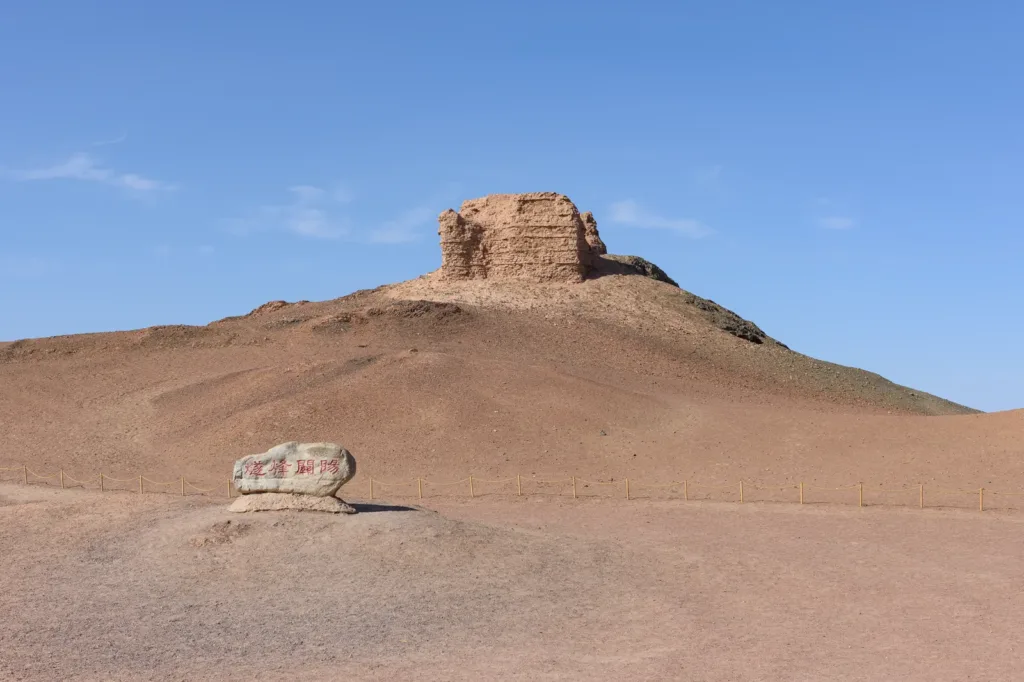
The site is also a place where geography carries the history. The authentic remains are spread across a sandy, gravelly landscape rather than gathered inside a complete city wall. From the top of Dundun Mountain, the surviving beacon tower overlooks the former pass and the route towards the desert and oasis. Local heritage accounts describe this tower as the best-preserved and most visible physical witness to ancient Yangguan.
Wang Wei’s line “西出阳关无故人” (“beyond Yangguan, no old friends”) made the pass a lasting image of departure. The poetry is part of the visit, but it should not disguise the archaeology: the main experience is standing among traces in a wide, wind-exposed landscape, not walking through a preserved Han city.
What to look for
- The Dundun Mountain beacon tower: the clearest standing ancient remnant and the site’s high viewpoint. Follow the designated visitor route and do not climb, touch or alter the structure.
- Gudong Tan (古董滩): the sandy and gravelly area identified with the old settlement. Heritage descriptions record east–west sand ridges, low wall footings, rammed-earth remains and Han–Tang fragments. Treat anything on the ground as protected archaeology: do not pick up pottery, brick or tile.
- The relationship between old and new: the ticketed scenic-area route begins with the Yangguan Museum and reconstructed Han-style buildings, then uses a sightseeing vehicle to reach the beacon and ruins area. The museum and replica pass help explain the site, but they are not the surviving ancient fortress.
- The view: the ridge and stele corridor look across the Dunhuang oasis, desert and distant snow peaks. The contrast between irrigated green land and bare gravel is one of the most legible ways to understand why this pass mattered.
Plan the visit
The address used by the operator is Yangguan Ruins, Yangguan Town, Dunhuang City, Gansu, about 70 km southwest of central Dunhuang. It is part of the wider Yangguan–Yumen tourist area, while the ruins, beacon and museum are distinct elements within the Yangguan side of that area.
A current operator notice dated 12 August 2026 says that, from 20 August, the area’s opening and ticket-checking hours are 08:00–19:30, with the last sightseeing-car departure at 19:30. This is a seasonal operating notice rather than a permanent promise; check the latest notice before leaving and allow time for the road back. The operator lists 400-001-9181 as the consultation number.
The official online-ticket page describes a full-price Yangguan–Yumen tourist-area ticket that covers both ruins and says visitors check in with their identification at the gate. It does not display a current amount or explain the passport workflow. An older operator guide lists separate Yangguan and sightseeing-ticket prices, and the two operator notices show different sightseeing-ticket amounts, so do not budget from those older figures. Ask the operator about the current price and foreign-passport purchase or entry before travelling.
Allow roughly two hours inside the scenic area for the published museum-to-ruins route, but a longer block is sensible if you want time for the viewpoint, exhibits and the return connection. The ground is exposed and dry: bring water, sun protection and shoes suitable for uneven paths. Keep to signs and barriers, do not mark or remove anything, and note that the current tourist-area notice prohibits drones.
Getting there and back
The operator’s access plan uses road services from Dunhuang. A railway-station or airport feeder still transfers via Dunhuang Bus Station, so the final leg to the ruins is by road. From Dunhuang, self-driving or a pre-arranged car is the simplest flexible option; the operator describes the road journey as about one hour and advises following the signs southwest. Keep 阳关遗址 (Yangguan Ruins) and 敦煌市阳关镇阳关遗址 Dūnhuáng Shì Yángguān Zhèn Yángguān Yízhǐ ready for a driver or map search.
The operator’s transport page, whose body includes a 4 September 2025 update, lists a tourist-area service from Dunhuang Bus Station: departure at 08:30, arrival at Yangguan at 09:40, onward travel to Yumen Pass at 12:40, departure back from the Yumen transfer point at 15:30 and arrival in Dunhuang at 17:00. The same page lists feeder departures from Dunhuang Railway Station and Mogao International Airport via the bus station. It says fares and times can change with season, weather or traffic control, and asks passengers to confirm before travelling.
An 11 July 2025 report described a different timetable for a similar Yangguan–Yumen service, including a 14:00 return from Yumen and a 14:50 departure from Yangguan. That discrepancy is exactly why a same-day check matters: a bus that reaches the ruins is not automatically a guaranteed return service.
Combine your visit
A suggested order for the documented features and stops.
-
Yangguan Museum
Establish the pass’s role before viewing the remains.
-
Dundun Mountain beacon viewpoint
Relate the surviving earthwork to the open desert beyond.
This is an editorial sequence. Check access and any road or boat transfers; it does not establish a walking route, common ticket or guaranteed same-day connection.
Find Yangguan Pass Ruins
阳关 · 敦煌市
The pin marks the area, not the entrance.
More places nearby
Approximate straight-line distances between map pins, not travel distances.
Dunhuang Historical Film City 敦煌古城影视城
42 km awayDunhuang Film City was built in 1987 for the film Dunhuang and uses recreated streets to suggest different Silk Road cities. Dunhuang, Gaochang, Ganzhou, Xingqing and Bianliang streets vary their architectural references, with…
View guide →Yumen Pass 玉门关
50 km awayYumen Pass survives as a compact, square earthen stronghold known as Xiaofangpan Cheng. Its thick walls and small openings make a striking object in the open desert, but the wider heritage area tells a larger story of frontier…
View guide →Crescent Lake · Mingsha Mountain dunes 鸣沙山月牙泉·月牙泉示意点
55 km awayCrescent Lake is a small curved oasis enclosed by the much larger dunes of Mingsha Mountain. The contrast between water, vegetation and bare sand is the main attraction, with the outline changing as you move between the lakeside…
View guide →Sources & visit information
Sources checked on 23 October 2026. Hours, tickets, reservations and transport can change; confirm with the operator before you go.
Image credits & notes (1)
- The surviving Yangguan beacon tower on Dundun Mountain, photographed from the protected visitor route. Photo: N509FZPhoto: CC BY-SA 4.0