

Explore the region
Tap any red Chinese text to hear it in Mandarin.
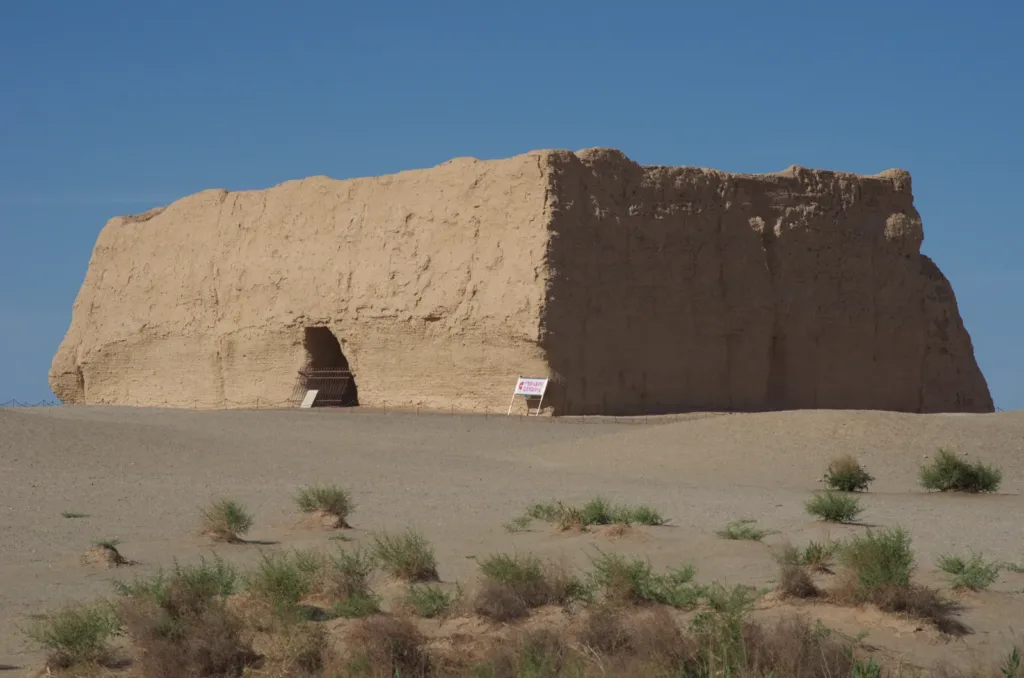
Yumen Pass sits in Dunhuang City, Jiuquan, Gansu, roughly 90 km northwest of central Dunhuang. It is a remote Gobi site rather than an urban monument, and the first impression is of scale: a low, open horizon interrupted by an earthen fort that once controlled movement along the northern Silk Road route.
The visible core is Xiaofangpan Cheng (小方盘城, “Small Square Fort”), a square rammed-earth fort with walls about 10 metres high and gates in its north and west walls. Nearby remains make the visit more than a photograph of one ruin: Hecang Cheng (河仓城), also called Dafangpan Cheng (大方盘城), served the frontier’s grain-storage system, while Han frontier-wall and beacon remains show how warnings and movement were managed across the desert.
The site is presented by its operator as a core area of the 2014 UNESCO Silk Roads inscription. UNESCO describes that transnational property as a 5,000-km corridor whose 33 components include passes, beacon towers, Great Wall sections and posthouses. At Yumen Pass, history is easiest to understand by looking for those connections rather than imagining a single monumental gateway.
What to look for
- Xiaofangpan Cheng: Look closely at the compact plan, the thickness and weathering of the earthen walls, and the two surviving gate positions. The small scale is part of the point: this was a working frontier post, not a later brick-built city wall.
- Hecang Cheng / Dafangpan Cheng: Follow the scenic-area route to the separate grain-store ruin. Its position within the wider site helps explain the food and supply infrastructure needed to keep a far-western garrison and travellers moving.
- Han frontier wall and beacon remains: The open sections around Danggu Sui (党谷燧) preserve the landscape logic of watchtowers, walls and natural barriers. Their low earthen, reed-and-gravel construction looks very different from the high brick walls associated with the Ming period.
- The desert–wetland edge: The ruins were built in a Gobi environment that also contains river and wetland areas. The contrast between dry ground, surviving earthwork and pockets of water is part of the site’s historical meaning: the route depended on carefully used water and supply points.
One familiar explanation links the name “Yumen” to jade moving from the Western Regions. The site’s own interpretation notes that this explanation remains unsettled, so treat it as a traditional story rather than a proven etymology.
Plan the visit
This is a west-of-Dunhuang outing, not a walk from the city centre. The operator’s transport page gives the destination as Yumen Pass Ruins in Dunhuang City and describes it as about 90 km from central Dunhuang. If you drive, use the Chinese name 玉门关遗址 Yùménguān Yízhǐ or 阳关玉门关旅游区(玉门关) and aim for the Yumen Pass visitor-centre parking area; confirm the final entrance and road condition before leaving.
The operator currently publishes a combined shuttle route from Dunhuang Coach Station through the Yangguan–Yumen Pass scenic area and back. The listed coach-station departure is 08:30, with a return departure from the Yumen transfer point at 15:30 and arrival back in Dunhuang at about 17:00; the displayed round-trip fare is CNY 120, excluding admission. A Railway Station variant is listed at 11:00, connecting through Dunhuang Coach Station, returning from Yumen at 18:00 and reaching the city around 19:30 for CNY 140. An airport variant is also listed. These are operator-published service details, but the same page warns that times can change with season, weather, traffic controls and demand, so confirm the date and return vehicle before setting out.
The latest operator notice available when checked sets opening and ticket-checking hours at 08:00–19:30, effective from 20 August 2026, with the sightseeing bus’s last departure at 19:30. The notice also says that hours may be adjusted, so do not plan to arrive at the last minute.
The official booking page describes a combined Yangguan–Yumen Pass ticket covering both ruins and says that entry is checked against the purchaser’s identification document. It does not explain whether a foreign passport can be used for this product or whether a visitor can buy a Yumen-only ticket. International visitors should confirm this with the operator before paying: +86 400-001-9181.
Bring water, sun protection and a layer for wind. The site’s own visitor guidance asks people not to climb walls or cross safety barriers, to protect the earthworks and to avoid drone flights in the scenic area.
Combine your visit
A suggested order for the documented features and stops.
-
Xiaofangpan Cheng
Begin with the compact fort and its surviving walls.
-
Han wall section
Compare the isolated fort with the frontier’s linear defences where access is included.
-
Hecang ruins
Continue by the arranged transport to a different part of the frontier complex.
This is an editorial sequence. Check access and any road or boat transfers; it does not establish a walking route, common ticket or guaranteed same-day connection.
Find Yumen Pass Ruins
玉门关 · 敦煌市
The pin marks the area, not the entrance.
More places nearby
Approximate straight-line distances between map pins, not travel distances.
Yang Pass 阳关
50 km awayYang Pass marked a southern departure from the Dunhuang oasis into the desert routes of the Silk Road. The old fortified gateway has not survived as an intact gate: the beacon on Dundun Mountain and the surrounding desert are…
View guide →Dunhuang Historical Film City 敦煌古城影视城
65 km awayDunhuang Film City was built in 1987 for the film Dunhuang and uses recreated streets to suggest different Silk Road cities. Dunhuang, Gaochang, Ganzhou, Xingqing and Bianliang streets vary their architectural references, with…
View guide →Dunhuang Museum 敦煌博物馆
72 km awayDunhuang Museum follows the oasis’s history through objects ranging from pottery and bronze to silk, written slips and painted bricks. Its permanent exhibition treats the city as a meeting place, tracing Han development, later…
View guide →Sources & visit information
Sources checked on 23 October 2026. Hours, tickets, reservations and transport can change; confirm with the operator before you go.
- Yumen Pass Ruins, Dunhuang Yangguan Yumen Pass Scenic Area ↗
- Transport Guide, Dunhuang Yangguan Yumen Pass Scenic Area ↗
- 不入“两关”,怎到敦煌? ↗
- Silk Roads: the Routes Network of Chang'an-Tianshan Corridor ↗
- Notice on Adjusting Opening and Closing Hours, Dunhuang Yangguan Yumen Pass Scenic Area ↗
- Ticket Reservation, Dunhuang Yangguan Yumen Pass Scenic Area ↗
Image credits & notes (1)
- Xiaofangpan Cheng, the earthen core fort of Yumen Pass, seen from the desert edge. Photo: PopolonPhoto: CC BY-SA 3.0