

Explore the region
Tap any red Chinese text to hear it in Mandarin.
Why this riverside corridor matters
The Yellow River Scenic Belt is not one fenced attraction with a single gate. It is a broad urban riverfront of roads, green spaces, parks, walking paths, and connected public viewpoints. A 2020 report describes a 123-kilometre scenic area with a 42-kilometre core section, so choose a short riverside outing rather than assuming that every landmark belongs to one compact park.
Its character comes from the way the riverfront was planned for city life. Lanzhou’s 1951 urban plan proposed a riverside scenic road on the south bank, with small riverside parks and a protected strip beside the river; later planting, paths, garden spaces, and sculpture groups gradually turned that idea into the corridor visitors see today. The useful way to visit is to watch the waterfront work as a public place: people walk, exercise, cycle, pause by the river, and use the parks without performing for visitors. Keep photography considerate and do not treat residents as part of a staged attraction.
What to look at
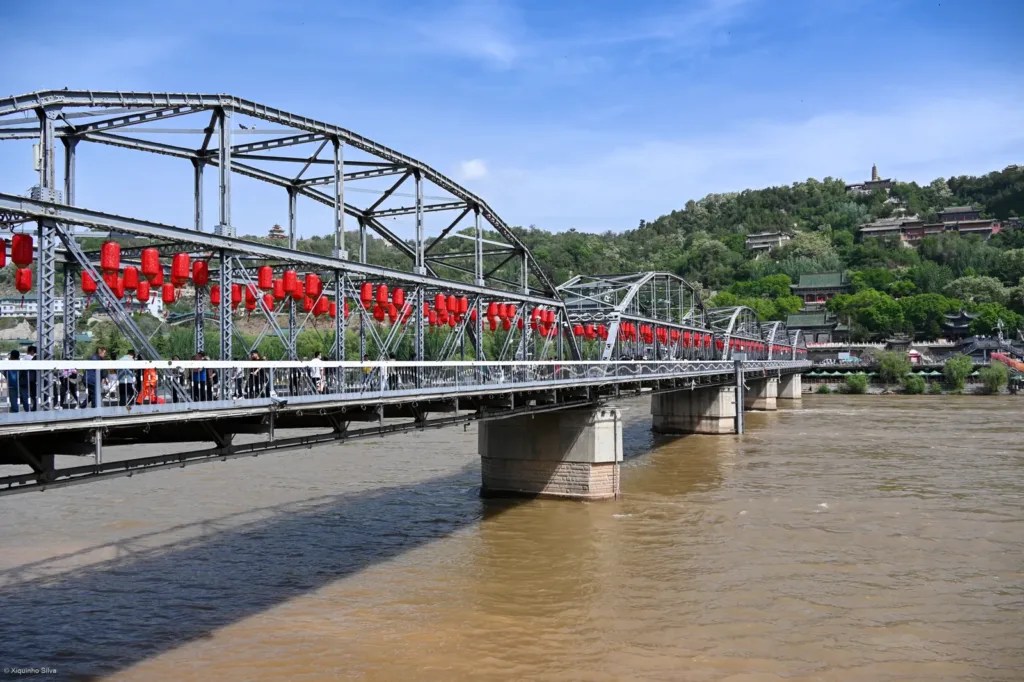
Start with Zhongshan Bridge, the dark iron truss crossing below White Pagoda Mountain. The historical record is reported in two ways: China Tourism News calls it a 1907 bridge, while a Gansu cultural account records construction in 1908 and opening in August 1909. Both accounts agree that it was first known as the Lanzhou Yellow River Iron Bridge and was renamed Zhongshan Bridge in 1928. The more detailed account describes four piers and five spans and records that the bridge stopped carrying road traffic in 2004 and became a pedestrian bridge; it was listed as a national key cultural relic in 2006.
Walk across rather than treating the bridge as a backdrop only. Look at the repeated truss members, the piers set in the current, and the changing relationship between the bridge, the river, and the two banks. The south-bank approach opens onto the main riverside road and public promenade. Across the bridge, White Pagoda Mountain is a separate hillside attraction, not an automatic extension of this entry; check its own entrance and operating information if you plan to go uphill.
Back on the south bank, continue along the public paths and look for the riverside sculpture group associated with the corridor’s 1980s garden spaces: Yellow River Mother, Green Hope, Wild Geese Alighting on Sand, and Fighting the Waves. These works are best understood alongside the planted banks and walking routes, not as a promise that every nearby building or facility is open for entry. The corridor’s parks and paths are also a good place to see how Lanzhou residents use the riverfront in ordinary time; the city’s public reporting describes morning exercise, running, cycling, and family walks here.
Practical visit
Use “中山桥” (Zhongshan Bridge) for the immediate landmark and 兰州市城关区南滨河东路中山路路口北侧 Lánzhōu Shì Chéngguān Qū Nánbīnhé Dōnglù Zhōngshān Lù Lùkǒu Běicè for the south-bank address. A published visitor listing identifies the south-bank bridgehead at this road junction and describes the bridge as freely accessible; it also notes a north-bank approach at 白塔山公园站 Báitǎshān Gōngyuán Zhàn. These are useful map terms, but the listing is not a current operating notice, so follow local signs if a section is temporarily fenced or diverted.
Metro: Take Lanzhou Metro Line 1 to 西关站 (Xiguan Station). The operator confirms that Line 1 remains in operation and identifies Xiguan as part of the active network; its station-project notice also records a connection between Xiguan Station and the Xiguan Shizi bus hub, including the C-entrance side of the station. From the station, follow street signs north toward the river and 南滨河东路. A visitor transport listing places the walk from 西关十字 at about 500 metres, but do not rely on an unverified exit number or fixed walking time.
Bus and train arrival: The China Railway 12306 public-transport table for Lanzhou Railway Station lists route 6 and route 9 via 中山桥 Zhōngshān Qiáo, and also lists route 34 via 西关什字 and 中山桥. Visitor transport information separately lists 中山桥站 for south-bank arrival and 白塔山公园站 Báitǎshān Gōngyuán Zhàn for the north bank. Bus routes and stop positions can change for construction, events, or traffic control; check the same-day result in Amap (高德地图) before boarding, and use the Chinese stop name rather than assuming that “Yellow River Scenic Belt” is a single stop.
Taxi or ride-hailing: Give the driver “中山桥南岸桥头,兰州市城关区南滨河东路中山路路口北侧”. This names the pedestrian bridgehead rather than an unspecified point along the much longer scenic belt. Do not ask to be dropped on the bridge itself.
The public sources reviewed here do not establish a current scenic-belt management office, a universal opening timetable, a reservation requirement, or a current water-bus route. Treat the corridor and pedestrian bridge as an outdoor public visit, stay on signed paths and behind any barriers, and check local notices before crossing if weather, river conditions, or an event has changed access. Boat rides, adjacent parks, and any ticketed facilities are separate products and are not included in this entry.
Find Yellow River Scenic Belt
黄河风情线与中山桥 · 城关区
The pin marks the area, not the entrance.
Sources & visit information
Sources checked on 1 November 2026. Hours, tickets, reservations and transport can change; confirm with the operator before you go.
Image credits & notes (1)
- Zhongshan Bridge crossing the Yellow River in Lanzhou, photographed from the Baitashan side; its iron trusses, piers, pedestrian deck, and tree-covered bank are visible. Photo: xiquinhosilva (Xiquinho Silva)Photo: CC BY 2.0