

Explore the region
Tap any red Chinese text to hear it in Mandarin.
What to see
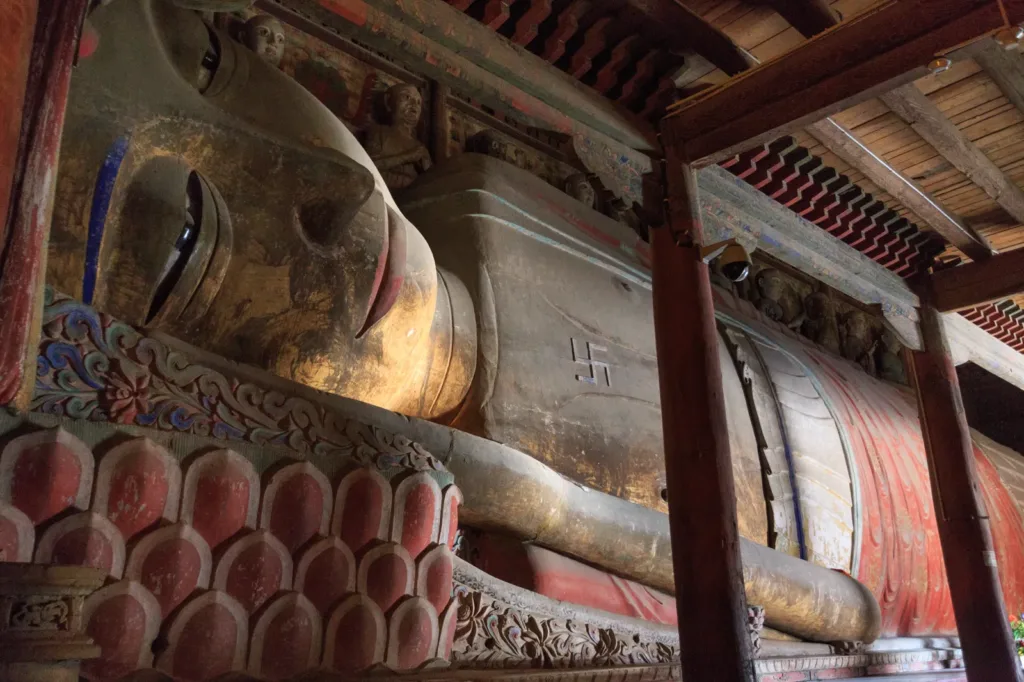
The temple is not simply a single statue in a modern gallery. The Great Buddha Hall holds a reclining image made with a wooden frame and clay, with attendant figures and the ten chief disciples behind it. The scale is easiest to understand from inside the hall: the long image occupies the room as part of a complete Buddhist scene. The Zhangye municipal visitor page describes it as Asia’s largest indoor wood-frame clay reclining Buddha.
After the hall, look for the surviving scripture hall and the rounded earthen stupa along the historic temple axis. The current scenic-area listing also names the Ming Amitabha Thousand-Buddha Pagoda, bell and drum towers, and the Qing Shanxi Guild Hall among the attractions open to visitors. These buildings give the visit a useful change of scale: a monumental timber hall, a building associated with Buddhist texts, and smaller structures that show the complex’s later layers. Access to individual buildings can change, so follow the signs and conservation instructions on the day.
The temple’s main historical date for visitors is 1098, when the Western Xia period complex associated with the giant nirvana image was built. Zhangye’s local gazetteer also records an earlier Kasyapa Tathagata Temple tradition and later names including Baojue Temple and Hongren Temple, as well as Ming rebuilding between 1411 and 1419. Those layers explain why the site is both a Western Xia Buddhist monument and a later imperial and civic landmark.
Look up as well as forward. The hall’s painted decoration includes Qing-period murals with Buddhist subjects and stories connected with the Silk Road. Together with the clay sculpture, the timber structure and the scripture tradition, they make the temple a place to read how religion, art and travel met in the Hexi Corridor rather than a quick photo stop.
Location and getting there
The official visitor listing gives the address as No. 28, Minzhu West Street, Ganzhou District, Zhangye — 张掖市甘州区民主西街28号. For a taxi or ride-hailing car, enter the Chinese destination 张掖大佛寺 Zhāngyè Dà Fósì and the full address. This is a city-centre temple in Ganzhou District, separate from the Qicai Danxia and Binggou Danxia scenic areas outside the urban area.
The Zhangye municipal tourism page currently lists opening hours as 07:00–18:30 and gives 0936-8233496. It does not publish a current ticket price or reservation procedure on that page. Opening arrangements and access to individual buildings can change; confirm the day’s details with the venue before setting out.
Bus
The same official city listing names city bus routes 1路, 4路, 5路, 18路 and 23路 for the scenic area. It does not identify a stop name or boarding direction. Check the live stop serving 张掖大佛寺 / 民主西街28号 in Amap or at the stop before boarding, then check the opposite-direction service for your return rather than assuming that every bus on the same route goes back toward your origin.
Railway arrival and return
For high-speed rail, the relevant arrival point is Zhangye West Railway Station — 张掖西站. The regional transport authority describes the adjacent Zhangye West Comprehensive Passenger Transport Hub — 张掖西站综合客运枢纽站 as a transfer point linking high-speed rail with taxis, buses and tourism transport. From the station, a taxi or ride-hailing car to 张掖大佛寺,张掖市甘州区民主西街28号 is the clearest direct option; arrange the return to 张掖西站 Zhāngyè Xī Zhàn in the same way or verify a current city-bus connection before leaving the temple. The city transport bureau says the station uses a designated taxi boarding channel, so follow the station signs rather than accepting an informal roadside pick-up. No fixed fare or travel time is stated here.
Combine your visit
A suggested order for the documented features and stops.
-
Great Buddha Hall
Begin with the reclining image and its surrounding figures.
-
Scripture hall
Continue along the surviving axis to the temple’s textual tradition.
-
Earth stupa
Compare the stupa’s mass and form with the timber halls.
This is an editorial sequence. Check access and any road or boat transfers; it does not establish a walking route, common ticket or guaranteed same-day connection.
Find Giant Buddha Temple
张掖大佛寺 · 张掖
The pin marks the area, not the entrance.
More places nearby
Approximate straight-line distances between map pins, not travel distances.
Zhangye Wooden Pagoda Temple 张掖木塔寺
Less than 1 km awayZhangye’s Wooden Pagoda is the most recognisable survivor of Wanshou Temple. The present tower was rebuilt in 1926 and combines masonry in its lower levels with timber eaves and more extensive timberwork above. Its stacked roofs…
View guide →Zhangye National Geopark 张掖国家地质公园
28 km awayZhangye’s geopark contains several distinct landscapes at the northern foot of the Qilian Mountains. Qicai Danxia is known for coloured layers folded across rounded hills; Binggou is more strongly defined by upright red-rock…
View guide →Pingshanhu Grand Canyon 平山湖大峡谷
42 km awayPingshanhu’s red and ochre rock has been cut into a maze of towers, walls and deep channels. The rim viewpoints reveal the large pattern, while the authorised lower route changes the scale to narrow passages and tall rock faces…
View guide →Sources & visit information
Sources checked on 25 October 2026. Hours, tickets, reservations and transport can change; confirm with the operator before you go.
Image credits & notes (1)
- The reclining Buddha inside the Great Buddha Hall at Zhangye's Giant Buddha Temple, showing the clay figure, attendant figures, painted decoration and timber roof structure. Photo: ZhangzhugangPhoto: CC BY-SA 3.0