


Get to know Ganzhou District
- Administrative area
- District · 市辖区
- Part of
- Zhangye
- Chinese name
- 甘州区
- Local areas
- District guide
Area & population
- Area
- 4,240.00 km²
- Population · 2020
- 519,096
- Administrative seat
- Dongjie Subdistrict
Source: English Wikipedia, as of the dates shown.
Ganzhou District 甘州区 is the seat of Zhangye in the middle of the Hexi Corridor. The Hei River crosses the district and supports an oasis plain between the Qilian Mountains to the south and the Heli and Longshou ranges to the north. The district government describes the landscape as a basin of farmland, mountains, desert edge and wetlands, with a temperate continental climate.
That setting shapes daily life as much as it shapes sightseeing. Official profiles identify wheat, maize, minor grains, vegetables and medicinal plants among the district’s agricultural products, and describe Ganzhou as a major county-level corn-seed production base. The green fields and irrigation channels are not a decorative preface to the city; they are part of why a large settlement can exist in this otherwise dry corridor.
The name also carries the older city with it. Zhangye was historically known as Ganzhou, and the old names of Ganzhou and Suzhou—today’s Jiuquan—were combined to give Gansu its provincial name. The city’s position on the Silk Road helped make it a western trading and military node. In the present district, the most legible traces are the concentration of historic sites and the surviving Buddhist and civic buildings rather than a reconstructed “old town” experience.
What to see in the district
Zhangye Great Buddha Temple 张掖大佛寺 is the most concentrated urban heritage visit. The official city listing describes it as a national key protected site and a 4A scenic area, with a Western Xia Buddha Hall, a large indoor wood-framed clay reclining Buddha, the Ming Mituo Thousand Buddha Pagoda, bell and drum towers, and the Qing Shanxi Guild Hall. The temple is also the site of the Ganzhou District Museum. It is at 张掖市甘州区民主西街28号; the published opening hours are 07:00–18:30. The temple complex is a separate destination within the district, not the name of Ganzhou District as a whole.
Zhangye National Wetland Park 张掖国家湿地公园 gives the urban area a different scale. The Hei River wetland is an international wetland in the middle reaches of the river, extending across Ganzhou, Linze and Gaotai. It is a desert-region inland wetland system with rivers, lakes, marshes and mudflats; the national forestry authority notes that the area supports migratory and wintering waterbirds, including black storks. Treat the public park and the wider protected wetland as related but not interchangeable places. The exact open sections, current facilities and seasonal bird-viewing conditions need a same-day check before setting out.
Pingshanhu Grand Canyon 平山湖大峡谷 is the district’s far-edge geological contrast to the city. The Zhangye municipal government lists it as a 4A scenic area and national geopark, 56 km from the urban area, in desert Gobi. Its red conglomerate cliffs and eroded channels are the point of the visit: read the rock layers from the rim, then use only the authorised lower route if it is open and suitable for you. The canyon is not the same landscape or ticketed destination as the Zhangye Rainbow Mountains.
Keep the scope straight
The famous Zhangye Rainbow Mountains 七彩丹霞 are not in Ganzhou District. The municipal tourism listing places the 5A scenic area in Linze County and Sunan Yugur Autonomous County, about 40 km east of Zhangye city, and describes its own core viewing area and viewpoints. Plan it as a separate county-level destination with its own entrance, ticket, shuttle and return arrangements; do not use the Ganzhou district page as a Rainbow Mountains access guide.
Ganzhou itself is large and administrative, not a compact walking neighbourhood. The official district profile gives it an area of 3,661.23 km² and identifies Zhangye’s municipal government and party offices as being here. A sensible visit therefore combines one urban heritage stop with a separately planned wetland or canyon outing instead of treating every place on the map as walkable from the temple.
Getting there and getting back
For rail, check the station name on your ticket. Zhangye West Railway Station 张掖西站 is the high-speed station; Zhangye Railway Station 张掖站 serves conventional trains. Both are identified in travel transport guidance as being in Ganzhou District, while the city’s transport plan records the Zhangye West comprehensive passenger hub as an operating facility. From either station, use a taxi or ride-hail with the Chinese name of your actual destination—甘州区 Gānzhōu Qū, 张掖市甘州区民主西街28号 for the Great Buddha Temple, or 平山湖大峡谷 Píngshān Hú Dàxiágǔ for the canyon. A railway station is an arrival point, not a scenic entrance. Keep the return train and pickup plan tied to the same named station; do not assume “Zhangye” on a booking identifies both stations.
The Zhangye West Comprehensive Passenger Transport Hub 张掖西站综合客运枢纽站 also functions as a road-transport and tourism transfer point. In a 2024 account, the Gansu transport authority said the hub had city-bus and taxi connections, a tourism distribution centre, and cooperation with major attractions including 七彩丹霞, 马蹄寺 and 平山湖. That report describes a service model, not a guaranteed daily timetable, so confirm the current departure, destination and return connection at the hub before buying a same-day outing.
For the Great Buddha Temple, the official tourism listing names bus routes 1, 4, 5, 18 and 23. It does not establish a current stop name or direction for every route, so verify the vehicle and the return side locally rather than guessing an exit or stop. No district-wide local bus route is asserted here for the wetland park or Pingshanhu Grand Canyon.
The air gateway is Zhangye Ganzhou Airport 张掖甘州机场, IATA YZY. The Civil Aviation Administration’s airport report confirms the airport’s official name and its civil–military airport project; a specialist Zhangye transport guide identifies the same Chinese name and code. Current flights and any airport shuttle are not fixed in this guide: check the dated flight ticket and ask for the Chinese airport name when arranging the onward taxi or ride-hail.
There is no district-wide ticket or single visitor entrance. Opening hours, tickets, reservations, shuttle arrangements and weather limits belong to each independent venue. For a canyon or wetland day, arrange the outward and return legs before leaving the city, and avoid entering closed or unmanaged routes.
Explore Ganzhou District
Core places to explore, with English and Chinese names.
Places to explore around Ganzhou District
 AI illustration; an interpretive view, not a photograph. AI 示意图,非景点实拍。
Pingshanhu Grand Canyon平山湖大峡谷
Pingshanhu Grand Canyon is an independent canyon and geological attraction in Pingshanhu Mongolian Township, Ganzhou District, Zhangye. Its appeal is the change of scale: broad rim viewpoints show a northern dryland Danxia and coloured-hill landscape, while a lower route—when open and suitable—leads into narrow channels and tall eroded walls. It is a separate visit from Qicai Danxia, not another entrance to it.
Read the place guide →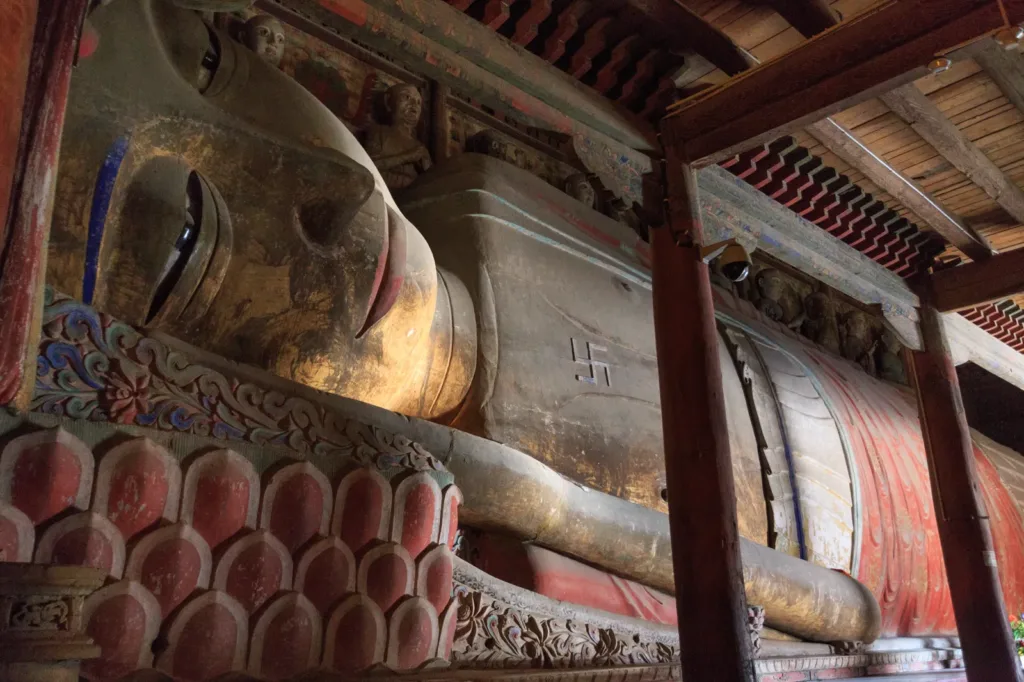 The reclining Buddha inside the Great Buddha Hall at Zhangye's Giant Buddha Temple, showing the clay figure, attendant figures, painted decoration and timber roof structure. Photo: Zhangzhugang · CC BY-SA 3.0
Giant Buddha Temple张掖大佛寺
Zhangye’s Giant Buddha Temple (Dafo Temple, 大佛寺) is a city-centre Buddhist and heritage complex built around a 34.5-metre Western Xia reclining Buddha. Its timber hall, painted clay sculpture, murals and surviving scripture hall make it a distinct urban visit, separate from the colourful Danxia landscapes outside Zhangye.
Read the place guide →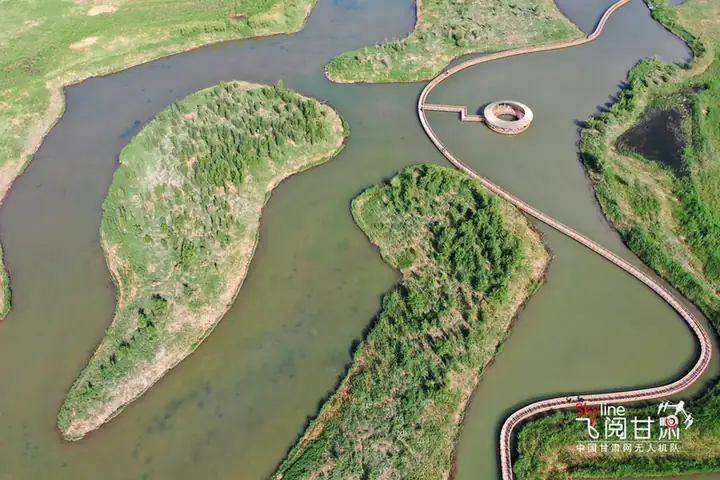 Zhangye National Wetland Park · 张掖国家湿地公园
Zhangye National Wetland Park张掖国家湿地公园
Zhangye National Wetland Park is a city-edge wetland in Ganzhou District, north of Zhangye, where water from the Qilian Mountains sustains lakes, reed beds and bird habitat in the arid Hexi Corridor. Its appeal is close-range wetland scenery—boardwalks, open water, a tall birdwatching tower and seasonal waterbirds—rather than a dramatic mountain panorama.
Read the place guide →Plan your visit
Getting there
Ganzhou District is about 4 km (straight-line distance) from central Zhangye. Search for 甘州区 in a map app to find stations and your accommodation.
Where to stay →Build your route
Pingshanhu Grand Canyon and Giant Buddha Temple are about 40 km apart (straight-line distance). The linked place guides have entrance and visit details.
Continue with Zhangye →More in Zhangye
Sources & geographic information
Administrative names and parent areas: Official geographic directory (dmfw.mca.gov.cn) · Reference date 2026-09-06.
Background text adapted from Ganzhou, Zhangye — Wikipedia contributors, under CC BY-SA 4.0. Text has been shortened and reorganized; source revision 1368775920.
Photo: Zhangye National Wetland Park · gansu.gscn.com.cn. Resized for the web; the photo itself has not been edited.
Map data © OpenStreetMap contributors. Pins mark approximate centres, not entrances or boundaries.
Image credits & notes (1)
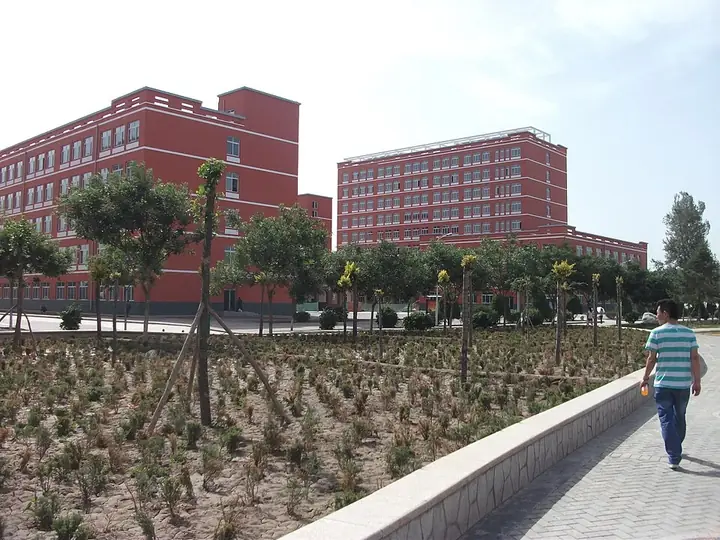
- Public buildings, planted grounds and a sidewalk in Ganzhou District, Zhangye. Photo: Taken on 15 June 2012.Photo: shannabian · CC BY 3.0Resized for the web; the photo itself has not been edited. Thumbnails may show a cropped view.
