


Get to know Meijiang District
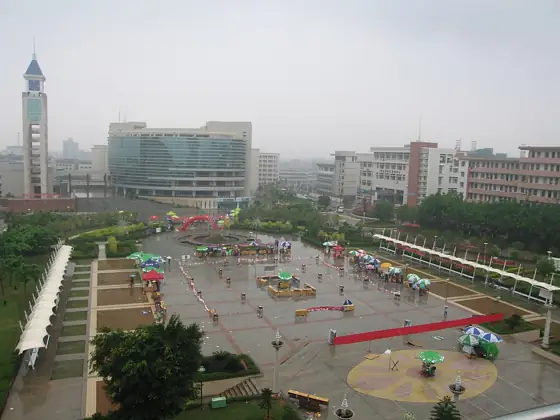
Photo adjustments
Resized and WebP compressed; subject not altered.
- Administrative area
- District · 市辖区
- Part of
- Meizhou
- Chinese name
- 梅江区
- Local areas
- District guide
Area & population
- Area in the source
- 323.00 km²
- Population · 2020 census
- 435,616
Source: cited geographic source, as of the dates shown.
Setting and landscape
The land rises to the southeast and falls toward the northeast and northwest, from the river basin through hills to mountains. The Mei River enters from Changsha town (长沙镇), crosses the city and leaves through Xiyang town (西阳镇) toward the Han River at Sanheba in Dabu. The Cheng River (程江) and Zhouxi stream (周溪水) join it inside the district. Mingshan peak (明山峰) stands on the border with Dabu, Yinlongding (银窿顶, 1,357 m) to its southeast is the district's highest point, and Qingliang Mountain (清凉山) in southern Xiyang is often in cloud and suited to tea.
History
The town was the seat of Chengxiang County (程乡县), yet for more than 500 years it had no wall; the first earthen wall north of the river went up in 1052, under the Northern Song, and the Ming enlarged it in 1385. Chengxiang became Jiaying Prefecture (嘉应州) in 1733, and the town was called Meicheng under the Republic. It became a county-level Meizhou city in 1978, and Meijiang District was formed in March 1988 from the urban area and nearby townships. Xiyang town joined it from Meixian in 2012.
What to see
The district government names the Jiaying old town (嘉应古城) and the Pangui (攀桂坊) and Wangxing (望杏坊) quarters among Meizhou's most complete historic areas. Lingfeng East and West Road (凌风东西路) is a Guangdong historic block, and the Meizhou Confucian school (梅州学宫), founded in the Song, and the Dongshan Academy (东山书院) survive in the district, along with the former home of the painter Lin Fengmian (林风眠). There are 371 Hakka weilong houses (客家围龙屋), 24 of them on the city protection list.
The Hakka Museum of China (中国客家博物馆), in Hakka Park in Jinshan subdistrict (金山街道), opened in 2008 and was rated a national first-grade museum in 2020. Its round building is shaped like a Hakka earth building, and its western part is a memorial to the diplomat-poet Huang Zunxian (黄遵宪), including Renjinglu (人境庐).
Food and local products
Crafts recorded by the district include Hakka salt-baked chicken (客家盐焗鸡), Hakka niang wine (客家娘酒), Qingliang Mountain tea (清凉山茶), Meitang preserved mustard greens (梅塘梅菜), Meicheng yanmian noodles (梅城腌面) and Hakka pounded meatballs (客家捶丸). Mothers traditionally eat rooster stir-fried with ginger and wine in the month after giving birth.
Highlights
- Hakka Museum of China 中国客家博物馆: Opened 2008; national first-grade museum since 2020; includes the Huang Zunxian memorial area.
- Jiaying old town 嘉应古城: Named with the Pangui and Wangxing quarters as one of Meizhou's most complete historic areas.
- Meizhou Confucian school 梅州学宫: Founded in the Song dynasty.
- Meicheng yanmian 梅城腌面: Noodle cooking technique recorded by the district as a traditional craft.
Sources for this guide
梅江区人民政府网站 基本介绍 梅江简介 · Meijiang District People's Government (district chronicles office)
梅江区人民政府网站 人文景观 · Meijiang District People's Government (district chronicles office)
梅江区人民政府网站 政区沿革 · Meijiang District People's Government (district chronicles office)
广东中国客家博物馆 - 维基百科,自由的百科全书 · Wikipedia (Chinese) · CC BY-SA 4.0
Original English written from the listed sources and checked sentence by sentence against quoted extracts by a separate reviewer. Updated 2026-09-23.
Explore Meijiang District
Core places to explore, with English and Chinese names.
Places to explore around Meijiang District
 Hakka Museum of China (
Plan your visit
Getting there
Meijiang District is about 3 km in a straight line from central Meizhou. Search for 梅江区 in a map app to find stations and your accommodation.
Where to stay →Build your route
Start with Hakka Museum of China. The linked place guides have entrance and visit details.
Continue with Meizhou →More in Meizhou
Sources & geographic information
Administrative names and parent areas: Official geographic directory · Reference date 2026-09-06.
Some facts checked against 广东中国客家博物馆 — Wikipedia contributors, CC BY-SA 4.0.
Photo: Hakka Museum of China · Zhangzhugang · CC BY-SA 3.0. Full frame retained; EXIF orientation normalized, proportionally resized to at most 800 pixels and converted to WebP. No generated pixels or subject changes. Cards may crop the display.

Map data © OpenStreetMap contributors. Pins mark approximate centres, not entrances or boundaries.