

Explore the region
Zhuhai is best understood through water. The municipal government records 262 islands, ten of them inhabited, and a mainland coast of about 227 kilometres. Channels, bays and island groups are not scenery placed behind the city; they explain its spread-out neighbourhoods, its ferry network and the way local life meets the sea.
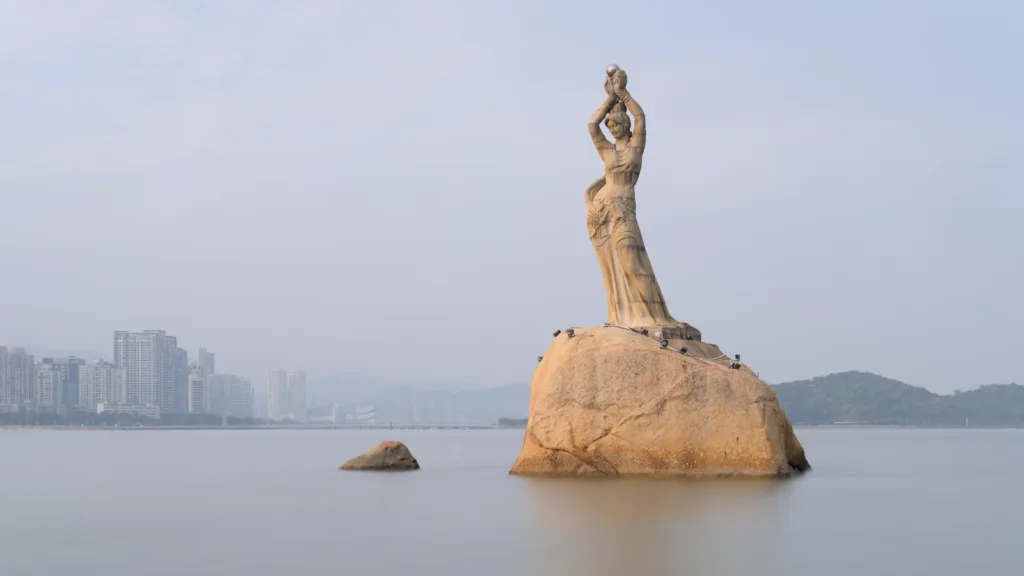
On the eastern shore, Lovers’ Road follows a changing sequence of bays, beaches and public waterfront spaces. At Xianglu Bay, the granite Zhuhai Fisher Girl statue is a civic landmark completed in 1982; farther along, Yeli Island and the shell-like Zhuhai Opera House add a newer cultural counterpoint. The point of this coast is not to tick off a single monument: pause at the shore, watch the bay change, and use a specific section of the road as your walk.
The city’s older layers sit beside this modern waterfront. Baojingwan’s rock carvings on Gaolan Island date to roughly 3,000 years ago, while Meixi Archways and Tangjiawan’s Gongle Garden connect Zhuhai with the late Qing and early Republican period. That mix of delta settlement, maritime trade, public beaches and newer cultural buildings gives Zhuhai a more useful character than the generic label of a resort city.
Choose the city by landscape
Zhuhai has three directly administered districts: Xiangzhou, Doumen and Jinwan. For a first stay, think in landscape units rather than trying to cover all three in one walk: the Xiangzhou waterfront is the easiest introduction to the city’s public coastal life; Doumen takes you into delta villages, old commercial streets and food traditions; Jinwan and the airport sit in the western part of the city. The offshore islands are separate outings, not extensions of the central promenade.
A sensible first visit pairs one central shore with one deliberate excursion. You might spend a morning around Xianglu Bay and a selected stretch of Lovers’ Road, then reserve another half-day or day for an island ferry or a western-delta stop. Allow time for transfers: even within one prefecture-level city, a harbour, airport, old street and waterfront landmark are different destinations.
Eat with a sense of place
Zhuhai’s food identity is seafood-led, but it is not one fixed recipe or one restaurant. Hengqin oysters are associated with the waters around Hengqin and are described in the city’s official English guide as large, fleshy, white, tender and crisp. Doumen double-shelled crab is a mud-crab delicacy valued for its tender meat; Baijiao sea bass is a protected geographical-indication product from Baijiao in Doumen.
The delta also has everyday sweets and seasonal customs. Tangjiawan folk refreshments include more than one style of handmade rice and festival cake, with examples tied to the lunar calendar. Ask what is being served that day and how it is cooked rather than assuming that a dish has a single city-wide preparation. Shellfish and seafood are common ingredients, so state allergies and dietary limits before ordering; appearance alone cannot establish that a dish is vegetarian or free of allergens.
Arrive and make the return leg explicit
By air. Zhuhai Jinwan Airport (珠海金湾机场) uses Terminal 1. After baggage collection, the airport’s current guide directs arriving passengers to the arrivals-hall exit 03. The airport express boards in zone D, while city-direction taxis for Xiangzhou, Gongbei, Jida, Hengqin and Tangjia use a separate queue; western-district destinations such as Doumen, Jinwan and Gaolangang use another queue. For ordinary buses, the guide lists route 207 to 拱北口岸总站 and route 504 to 白蕉总站.
The airport is connected to the Zhuhai Airport Station (珠海机场站) on the Zhuhai–Zhuhai Airport intercity line. The airport guide says to use the signed 1A or 1B access and allow about 500 metres on the pedestrian walkway between the station and Terminal 1. A 2026 Hengqin government notice also advertises a direct airport shuttle from 横琴口岸 to Terminal 1; treat its departure pattern, price and availability as date-sensitive and check the current ticket channel before relying on it.
By rail. Zhuhai Railway Station (珠海站) is an active intercity and high-speed arrival point. A recent station notice identifies A and B entrances and directs passengers to use 12306 for the live train plan. Book the exact station shown on your ticket, then arrange the last leg to a named destination such as 珠海渔女, 情侣路 or 珠海大剧院 rather than assuming that “Zhuhai” is a single walkable centre. Use the same live rail channel for the return journey.
For the offshore islands. The official Xiangzhou Port passenger site gives the terminal as Xiangzhou Port Passenger Terminal (香洲港客运站), at the Beidi wharf on Lovers’ Middle Road in Xiangzhou. It serves island destinations including Guishan, Wailingding, Dong’ao and Wanshan; the site provides a live booking form and current notices. The municipal transport guide lists buses 11 and 56 for the terminal, but bus routing and ferry departures can change. Buy or reserve the return leg before leaving the mainland, and recheck the operator’s weather and holiday notices: ferries are not a guaranteed all-weather connection.
Cross-border ports, domestic island ferries and sightseeing around the Hong Kong–Zhuhai–Macao Bridge are different products. A convenient location near a port does not by itself establish passport eligibility or entry permission; check the current immigration and carrier requirements separately if your plan crosses a border.
Combine your visit
Suggested order for the visit:
-
Fisher Girl waterfront
Start with the statue and coastal view.
-
Selected Lovers’ Road section
Follow a manageable part of the seaside promenade.
-
Yeli Island opera-house exterior
Use a separate transfer to see the shell-shaped buildings.
This is an editorial sequence of named spaces or places. It does not imply a verified walking connection or promise opening, ticket availability or a journey time.
Find Zhuhai overview
珠海 · 珠海市
The pin marks the area, not the entrance.
More places nearby
Approximate straight-line distances between map pins, not travel distances.
Zhuhai Opera House 珠海大剧院日月贝
2 km awayZhuhai Opera House stands on Yeli Island and is recognised by its shell-like architectural forms. The building’s relationship with the sea is central to its appearance: the curved outline reads differently from the island…
View guide →Zhuhai Museum 珠海市博物馆
2 km awayZhuhai Museum’s current home is on Haihong Road, where its permanent exhibitions connect the city’s maritime setting, local history and community traditions. The Zhuhai History displays include both a chronological history and…
View guide →New Yuanming Palace 圆明新园
5 km awayNew Yuanming Palace is a landscaped reconstruction in Zhuhai inspired by Beijing’s Old Summer Palace. Traditional-style halls and smaller garden structures are arranged around a large lake, with the local hills forming a…
View guide →Sources & visit information
Sources checked on 24 October 2026. Hours, tickets, reservations and transport can change; confirm with the operator before you go.
Image credits & notes (1)
- The Zhuhai Fisher Girl statue in Xianglu Bay, with the waterfront skyline across the water. Photo: Daniel Lu (Dllu)Photo: CC BY-SA 4.0