

Explore the region
Tap any red Chinese text to hear it in Mandarin.
A temple landscape, not just a hall
湘山寺 stands at the southern foot of Xiangshan in Quanzhou County, northwest of Guilin’s urban core. Its history is traditionally traced to a Tang-era Buddhist foundation; the nationally protected site is formally known as the Xiangshan Temple Towers and Stone Inscriptions, a complex of surviving heritage from later dynasties. This is the Quanzhou temple—not Guilin city’s Elephant Trunk Hill, also called Xiangbishan.
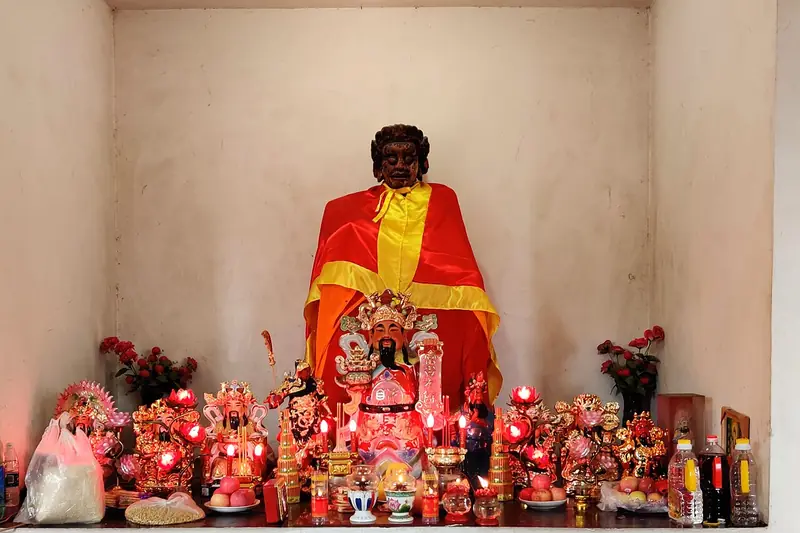
Begin at the temple’s worship spaces, pausing outside or entering only where visitors are permitted. The setting combines active Buddhist practice with a hillside scatter of historic remains. Look for Miaoming Pagoda (妙明塔), the pagoda’s stone base and surrounding inscriptions, and the carved animals associated with the former Free-Life Pond (放生池). The old spring installation called Washing Bowl Spring (洗钵岩泉) is another distinctive detail: its stone-lined basins and inscribed name tell of the practical, everyday life once organized around the monastery as well as its devotional life.
As you follow open, signed paths uphill, take time to read the rock inscriptions rather than treating them as decoration. The complex includes inscriptions and stele from different periods; among its best-known features is the large “Shou Shi Ci Yin” (寿世慈荫) cliff inscription, attributed to the Kangxi emperor. The layered writing—dedications, records and religious phrases—makes the hillside a kind of outdoor archive. Miaoming Pagoda is described as an octagonal, seven-storey structure; appreciate its profile and masonry from accessible ground-level viewpoints. Do not assume the tower interior or every trail is open for climbing.
The surviving remains are only part of a once much larger religious landscape. The temple’s reputation grew across the Tang and Song eras, while the structures and carved surfaces visitors encounter today reflect centuries of rebuilding, worship and local patronage. Visit slowly and quietly: people may be praying, and access to halls, inscriptions or the hill path can be restricted for religious observance or conservation. Follow signs and staff directions, avoid touching or rubbing carved stone, and ask before photographing worshippers.
Getting there
The destination is 湘山寺, 桂林市全州县全州镇桂黄中路66号. For a taxi or ride-hail, show the driver that full Chinese name and address; use the public curb by the signed visitor entrance if it is open, and do not ask to be driven into a temple courtyard. The listed address is also a practical map-search term.
There is no metro serving Quanzhou. Local route listings show bus 110 between 火车南站 (Quanzhou South Railway Station) and 翰林苑, with a 湘山寺 Xiāngshān Sì stop. From Quanzhou South, ride toward 翰林苑 and get off at 湘山寺; for the return, board the opposite-direction 110 at 湘山寺 toward 火车南站. The same route listing includes 城南客运站 (Chengnan Coach Station) on the line, so a passenger arriving there can use the 110 toward 翰林苑 and leave at 湘山寺; reverse the direction for the return. Confirm the route display and service on the day, since local line details can change and some departures may short-turn.
Tourism listings currently describe admission as free and show a 05:00–17:00 visiting window, but these are platform listings rather than a current official temple notice. Check the posted gate information before setting out; hours, access to the hill and tower, and any temporary worship or conservation restrictions may differ. One travel listing gives the inquiry number 19997905756; confirm that it still reaches the temple before relying on it.
Combine your visit
Suggested order for the visit:
-
Miaoming Pagoda
Look at the tower’s exterior form.
-
Shoufo Hall
Continue with the main religious setting.
-
Yuantong Hall
Complete the hall sequence without interrupting worship.
This is an editorial sequence of named spaces or places. It does not imply a verified walking connection or promise opening, ticket availability or a journey time.
Find Xiangshan Temple
湘山寺 · 全州县
The pin marks the area, not the entrance.
More places nearby
Approximate straight-line distances between map pins, not travel distances.
Quanzhou Tianhu Lake 全州天湖
29 km awayQuanzhou Tianhu is a highland landscape of connected reservoirs, grassland and forest on the eastern side of Zhenbaoding. Open water and rounded grassy slopes create a different scene from Guilin’s steep limestone towers. The…
View guide →Bajiaozhai · Guangxi Side 八角寨·广西侧
50 km awayBajiaozhai’s Guangxi side offers a landscape of red-bed ridges and tightly grouped, rounded peaks. The viewpoint called Whales in the Sea looks across the clustered hills; in mist, the analogy becomes particularly clear. Dragon…
View guide →Lingqu 灵渠
53 km awayLingqu links the Xiang and Li river systems through an ancient engineered channel. The most revealing features are the structures that divide, guide and regulate the water: Huazui forms the dividing head, the Tianping dams…
View guide →Sources & visit information
Sources checked on 21 October 2026. Hours, tickets, reservations and transport can change; confirm with the operator before you go.
Image credits & notes (1)
- Xiangshan Temple · 湘山寺Photo: Augoustoshai · CC BY-SA 4.0Resized for the web; the photo itself has not been edited.
