

Explore the region
Tap any red Chinese text to hear it in Mandarin.
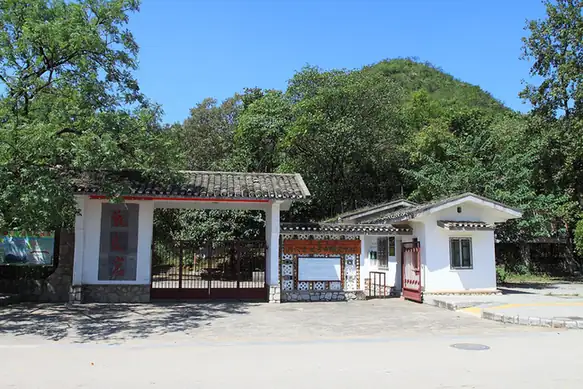
Zengpiyan is both an archaeological cave site and a museum devoted to the evidence found there. The site lies at the southwestern foot of Dushan; excavations began after its discovery in 1965, and a museum was established here in 1978. Archaeologists date the site’s principal occupation to about 12,000–7,000 years ago.
Give the displays time before entering the protected site area. The museum’s listed permanent exhibitions, “Prehistoric Guilin: A Landscape Home” (《史前桂林·山水家园》) and “Archaeology Chat: An Archaeological Science Exhibition on Guilin’s Zengpiyan Site” (《考古“漫”谈·桂林甑皮岩遗址考古科普展》), set the local finds in a wider environmental and archaeological story. Look for pottery, stone and bone tools, shell remains, and food traces discussed in the displays. Xinhua’s report describes pottery, snail shells, a carbonized taro fragment, ancient human remains and other finds; these are clues to cooking, food gathering and experimentation with plant cultivation, not a complete record of a single settled lifestyle.
Then relate the objects to their original setting. The cave complex has a main cave, a lower cave and a water cave; the principal archaeological deposits are in the main cave. If the managed site route is open, follow its interpretation from the display area to the protected cave remains rather than treating the cave as a decorative show cave. Compare visible stratigraphy and excavation areas with the objects in the galleries, and distinguish surviving archaeological evidence from explanatory reconstructions. Burial practices, traces of fire and tool-making remains help make the cave’s long human use legible. The park also lists a Deng Xiaoping Footprints Hall (甑皮岩遗址邓小平足迹馆) and a simulated archaeology area; check at the entrance which spaces are open on your visit.
Visitor information and getting there
The museum is at 26 Zengpiyan Road, Xiangshan District (象山区甑皮岩路26号). A local heritage listing gives opening hours of Tuesday–Sunday, 09:00–17:00, with ticket sales ending at 16:30, and Monday closure except on statutory public holidays. It lists a standard admission price of CNY 13 and ticket purchase at the ticket desk with valid identification. These details are not confirmed by the museum’s own website, which currently displays a site-stopped notice; call 0773-3655181 before setting out to confirm that the museum, cave route, ticketing and hours are operating on your date.
Guilin has no operating metro service to this site. The local listing gives buses 5, 12, 36 or 86 to 甑皮岩路口 (Zengpiyan Road Junction), or 82 or 86 to 万福路东站 (Wanfu Road East). From either stop, continue on the street toward 甑皮岩路26号 and follow the visitor-entrance signs; the listing provides no measured walking distance or named exit. For the return, use the stop serving your direction and check the route display for the bus going back toward your destination.
For a taxi or ride-hail, show the driver 桂林甑皮岩遗址博物馆,桂林市象山区甑皮岩路26号. Ask for the public visitor entrance at that address and use only a lawful roadside drop-off; do not assume a car can enter the archaeological park.
Combine your visit
Suggested order for the visit:
-
Site museum displays
Look at the stone and pottery evidence.
-
Managed archaeological site area
Relate the displays to their original setting.
This is an editorial sequence of named spaces or places. It does not imply a verified walking connection or promise opening, ticket availability or a journey time.
Find Zengpiyan Site Museum
甑皮岩遗址博物馆 · 象山区
The pin marks the area, not the entrance.
More places nearby
Approximate straight-line distances between map pins, not travel distances.
Chuanshan Scenic Park 穿山公园
5 km awayChuanshan Park brings limestone hills and small caves into Guilin’s urban landscape. The natural opening at Moon Rock contrasts with the enclosed, illuminated formations of Chuanshan Cave, while the Xiaodong River gives a…
View guide →Elephant Trunk Hill 象鼻山
6 km awayElephant Trunk Hill stands where the Taohua and Li rivers meet in Guilin. The limestone outline resembles an elephant lowering its trunk into the water, with a rounded opening beneath the arch. That opening is known as…
View guide →Sun and Moon Pagodas 日月双塔
6 km awayThe Sun and Moon Pagodas rise from Shan Lake in central Guilin as a paired waterside landmark. Both have octagonal plans, but their finishes and proportions differ: the Sun Pagoda is faced in bronze, while the Moon Pagoda uses…
View guide →Sources & visit information
Sources checked on 21 October 2026. Hours, tickets, reservations and transport can change; confirm with the operator before you go.
Image credits & notes (1)
- Zengpiyan Site Museum · 甑皮岩遗址博物馆Photo: Zhangzhugang · CC BY-SA 3.0Resized for the web; the photo itself has not been edited.
