

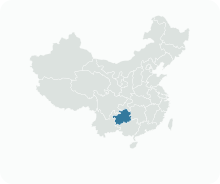
Get to know Dejiang County
- Administrative area
- County · 县
- Part of
- Tongren City
- Chinese name
- 德江县
- Local areas
- County guide
Area & population
- Area in the source
- 2,071.90 km²
- Population · 2010
- 367,908
- Administrative seat
- Qinglong
Source: cited geographic source, as of the dates shown.
Setting and landscape
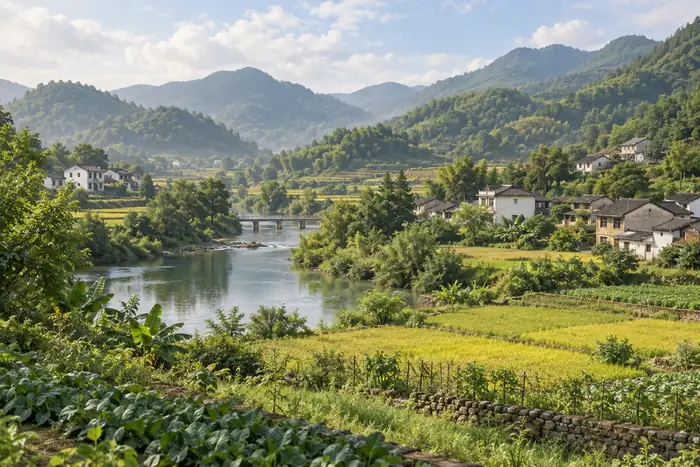
The east of the county belongs to the Wuling Mountains (武陵山) and the west to the Loushan range (娄山), with heights between 320 and 1,534 metres. It is karst country: the Wujiang flows through from south to north as the trunk of a system of 31 gorge rivers. The county government lists karst caves such as Dalongqian (大龙阡), Yipin Dongtian (一品洞天) and Fuwang Cave (福王洞), the Yongzhou grassland and stone forest (庸州草原和石林), and the old Wujiang towpath (乌江古纤道).
History
A Fuyang County (扶阳县) was set up here in the Sui and Tang periods, and the county counts 128 old sites, among them the seat of the Sui-era Yongzhou (庸州). Under the Yuan a native chieftaincy office was set up here; in 1605 the Ming made it Anhua County (安化县), whose seat moved in 1882 to Dabao (大堡), today's county town. The China Intangible Cultural Heritage Network dates the renaming to Dejiang to 1913, while the county government gives 1914.
On 19 June 1934 the Third Red Army under He Long (贺龙) reached Fengxiangxi (枫香溪), where the Fengxiangxi Meeting launched what the county government calls the first revolutionary base on the Yunnan–Guizhou Plateau.
Customs to see
Dejiang Nuo altar drama (德江傩堂戏), which Tujia people call gangshen (杠神), is a masked ritual theatre entered on the first national intangible heritage list in 2006. Its repertoire runs to more than 80 pieces, 16 of them main plays, and performances also include feats of skill. Before a performance the Tujia ritual master builds a Nuo altar that combines weaving, paper cutting, dyeing, painting and calligraphy.
The Dejiang fire dragon (德江炸龙), added to the national list in 2021, fills the county town at the Lantern Festival. Dragons of bamboo strips and bark paper are taken to a river or well on the ninth day of the first lunar month. On the night of the 15th bare-chested dancers carry them into the firecrackers that households hang from bamboo poles along the streets, and on the 16th the frames are burned where the dragons were first brought to the water.
Local products
Dejiang gastrodia (德江天麻), a medicinal tuber, has national geographical-indication protection, and the Dejiang Fuxing pig (德江复兴猪) is registered as an agricultural geographical-indication product.
Highlights
- Dejiang Nuo altar drama 德江傩堂戏: Masked ritual theatre on the first national intangible heritage list (2006).
- Dejiang fire dragon 德江炸龙: Lantern Festival dragon dance through firecrackers, on the national list since 2021.
- Fengxiangxi 枫香溪: Where the Red Army held the 1934 meeting that founded its eastern Guizhou base.
- Dejiang gastrodia 德江天麻: Medicinal tuber with national geographical-indication protection.
Sources for this guide
德江县情简介 · Dejiang County People's Government
德江的由来 · Dejiang County People's Government
傩戏(德江傩堂戏) - 中国非物质文化遗产网 · China Intangible Cultural Heritage Network (Chinese National Academy of Arts)
元宵节(德江炸龙习俗) - 中国非物质文化遗产网 · China Intangible Cultural Heritage Network (Chinese National Academy of Arts)
Original English written from the listed sources and checked sentence by sentence against quoted extracts by a separate reviewer. Updated 2026-09-24.
Explore Dejiang County
Core places to explore, with English and Chinese names.
Dejiang County 德江县
Plan your visit
Getting there
Dejiang County is about 120 km in a straight line from central Tongren City. Search for 德江县 in a map app to find stations and your accommodation.
Where to stay →More in Tongren City
Sources & geographic information
Administrative names and parent areas: Official geographic directory · Reference date 2026-09-06.
Map data © OpenStreetMap contributors. Pins mark approximate centres, not entrances or boundaries.